
BIBLICAL THEOLOGY: SCRIPTURE INTERPRETING SCRIPTURE


  • Home
  • Are You Saved?
  • The Passion of Jesus Christ
  • What Is Revival?
  • Folly in Israel
  • Calvinism vs. Arminianism
  • Seminary, Academia, Psychology, & Science
  • Church History
  • Persecution, Suffering, Mortality, & Immortality
  • The Last Days
  • The Descension, Resurrection, & Ascension of Jesus Christ
  • Contact

The Revival of Job?

7/23/2025

0 Comments


Article #18 on Revival 

Picture
A book written about a controversy is bound to be controversial. A situation that confounded the most godly men of the Early Church will no doubt confuse readers today. Doubtful readers of the Book of Job would do well to put aside all preconceived notions, and let the Almighty introduce the Book of Job. 

Heaven’s Official Introduction: Job 1:1-2:13

As a vital interpretation to the earthly situation that was soon to unfold, the first two chapters of Job give the reader a glimpse into Heaven. For, unless men look heavenward, their earthly pilgrimage will be fraught with stumbling-stones that purposefully debase proud mortals into the dust from which they came (Ezek. 3:20, Jer. 6:21). 
The Heavenly Vision: Job 1:1, 6-12, 2:1-7
The Book of Job is unique from all others in the Bible because it is a written record of an actual discourse between several of the godliest men in the Church, exchanging words with Job while in sharp disagreement with him. Therefore, seeing that nearly the whole book is a record of an ongoing controversy that took place in real time, a heavenly perspective is offered in retrospect at the beginning of the Book to prevent the reader from being tossed about with confusion during the discourse, which begins in Job 3.

There would have been no controversy at all, if only Job’s friends had been more informed about the heavenly situation that is freely conveyed to the reader in Job 1-2. For, the controverted issue was whether or not Job was righteous or wicked to begin with, which would determine whether these calamitous judgments were unmerited or merited. Lo and behold, Job was righteous (Job 1:1, 2:8)! Furthermore, Job’s righteousness was far from average. God said, “there is none like him in the earth” (Job 1:8)! This extraordinary divine statement about Job is worthy of our studious consideration (“What about Job?”). The 42 Chapters provided should be cherished by Christians everywhere. At the very least, this would mean that the life of Job is a character study worthy of our utmost attention.

Heaven loved Job. Therefore, he became the focal point of conversation between Satan and God amidst an assembly of Holy Angels in the splendor of Eternity (Job 1:6, 2:1). God directed the attention of Satan to Job, by the question, “Hast thou considered My servant Job…?” (Job 1:8). The man was so esteemed by Heaven he became known in Hell! …can you believe it? Job wasn’t the last person on earth to garner such a reputation among Devils either. 

“And the evil spirit answered and said, Jesus I know, and Paul I know; but who are ye?” - Acts 19:15
For obvious reasons the Apostle Paul was known in Hell. Christianity today isn’t wondering why the Fallen Angel of Acts 19:15 already knew about Paul. He was a man full of the Holy Ghost and power by the grace of God in Christ. Therefore, every waking moment that he was alive, the Gates of Hell were being pushed back and suffering defeat (Php. 1:19-24). However, for less obvious reasons Job was known in Hell. The 42 Chapters of the Book of Job would offer some good reasons, but sadly this would be a tiresome read to most people. Suffice it to say, Job was a man of consequence in his generation like the Apostle of Paul was in the 1st Century. Hence, the calamity that befell him was occasioned as a result of Job’s extraordinary righteousness (not wickedness!), while it honestly appeared to be the contrary in the eyes of the generally assembly of the Saints (Job 5:1; Jude 1:14).

Nevertheless, in love, Eliphaz, Bildad, and Zophar were burdened to come and comfort him (Job 2:11), but upon hearing his first outcry of bitterness after 7 days of silence (Job 3:1-26), which further convinced them that Job had been secretly engaging in wickedness before God, Job’s friends were moved to rebuke him for his foolishness. The fact that Job broke the silence of 7 days with such vile words of bitterness and worldly sorrow certainly complicated things for Eliphaz, Bildad, and Zophar (Job 2:12-3:1). 

Job Curses his Birth and Wishes to Die: Job 3:1-26, 6:8-9, 10:18-22
However, despite the fact that Job fell into sin in this way from Job 3 and onward, this doesn’t change the reality that Job was blameless and upright prior to this time (Job 1:20-22), which would mean that this calamity didn’t befall him for any wickedness found in him. Therefore, upon being reproved and reasoned with by his friends, Job held to his integrity. 
Job Holds to his Integrity: Job 6:10, 14-15, 24-25, 9:15-28, 10:7, 14-15, 12:3, 9-10, 13:2, 15-18, 16:16-17:10, 19:3-5, 7, 23-27, 21:5-6, 16, 19-20, 22, 29-31, 23:11, 27:4-6, 30:25, 31:1-40
Job said a lot of things amiss while holding to his integrity! Truly. Nevertheless, there would be no argument, or ongoing discourse, if it wasn’t integrous for Job to maintain the confession that he was indeed righteous before God to begin with. This is where Job was proved right and the others were proved wrong at the end of the day (Job 42:8). Eliphaz, Bildad, and Zophar were convinced that this calamity originally came upon Job because of wickedness that he was committing in secret before God, and the fact that Job held to his integrity only further exasperated the others, and this in turn further exasperated Job. 
Explicit Instances where Job’s Friends Sought to Erroneously Prove to Job that he was Wicked: Job 4:7-8, 5:3-5, 8:3-7, 11-22, 11:2-20, 21:27-28, 22:3, 5-23
This isn’t to be taken lightly (Ps. 55:12-14). Job loved these men as dear friends and brethren (Job 6:14-15, 27)! Therefore, it pained him deeply to be dealt with falsely and wrongly accused, and as a result Job’s spiritual condition worsened over time. In the beginning, Job’s worldly sorrow and bitterness was directed towards himself, and so he cursed his birth and wished to die and nothing more (Job 3). At this point Job refused to accuse God of any wrongdoing. However, as bitterness progressed within his soul, and as the discourse escalated in sharp disagreement with his friends, Job then began to doubt the integrity of God and accuse the Most High (Job 7:11-21), even desiring to argue with the Almighty if only such a thing could be possible! 
Job Doubts the Integrity of God and Utters Accusations, even Desiring to Argue with the Almighty: Job 7:11-21, 9:3, 14, 19, 22-23, 32-33, 10:3, 13:3, 13, 19, 16:21, 23:3-4, 7, 27:2, 31:35 
Clearly, Job expected Eliphaz, Zophar, and Bildad to have spiritual discernment about what was happening to him (Job 16:4, 17:2, 4-5, 7-10), but instead they approached an extraordinary situation in an ordinary way by adhering to the protocols of doctrine that they all agreed upon as a Church. This was a mistake. 
Evidence of a Unified Church: Job 2:10, 11-13, 4:3-7, 5:1, 8, 27, 6:10, 25, 8:8-10, 9:2, 12:2-3, 9-10, 12-13, 13:1-2, 15:7-10, 17-19, 16:2, 4, 8, 17:2, 4, 8-10, 18:3-4, 20-21, 19:3-5, 7, 20:2-4, 21:29-31, 22:15-17, 24:1, 27:12 (Laws of Perpetuity: Deut. 32:7-8, 4:32, Ps. 44:1, 77:5-12, 78:1-8, Ps. 119:52, Isa. 46:9, 63:11, Joel 1:2-3) 
Job was an anomaly. What was happening to Job had never been seen before in all of Church History (Job 5:1)! Eliphaz, Bildad, and Zophar had never heard from Noah, Shem, & Eber (who were indoctrinated by the likes of Adam, Seth, & Enoch) that God would ever allow such sore judgments to befall a righteous man. Therefore, Job serves as a type of Christ (Isa. 53:1-12, Ps. 22:1-19) – whose reproach is also borne by true Christians (Heb. 13:13) in the mysterious Gentile Church Age of the New Covenant (Ps. 44:9-26, Rom. 8:35-39), all of which will change when God turns back to the Jews at the 2nd Advent of Christ (Rom. 11:25-36).

However, after Job fell into sin, his darkened soul serves as a typological Captivity both physically and spiritually according to the Prophets, which is why at the end of the Book, Job’s restoration is said to be when “the LORD turned the Captivity of Job” (Job 42:10). This deserves some careful consideration. For, this is yet another major reason why Job is such a remarkable figure of Holy Scripture. Firstly, it’s remarkable that Job didn’t fall into sin in the beginning. Secondarily, the manner in which he eventually fell into sin correlates with the peril experienced by the Jews in the Assyrian & Babylonian Captivities of the future. Lastly, the manner in which Job is brought to repentance and restored spiritually and physically shadows the glorious Restoration that was and will be brought to pass in the aftermath of the tribulation periods of the past and the future. These things can be traced as follows.

Physically, Job’s glory is systematically dissolved from every direction at the same time in one day – by the Sabeans & Chaldeans and by Fire & Wind – and it was all reported to Job by back-to-back messengers who were the lone survivors of each event, so that their reports came suddenly and in rapid succession resulting in a moment of maximum temptation to Job (Job 1:13-22). Nevertheless, in all this Job did not sin with his lips (Job 1:22). This is truly remarkable.
​
However, upon falling into sin Job’s spiritual Captivity began. The following are evidences that Job was backslidden and consciously under the wrath of God, despite his resolve to “trust” the LORD as described in Job 13:15. Namely, because of the hidden face of God associated with spiritual enmity (Job 13:24, 19:11), the wrath of God associated with divine hatred for sin (Job 16:9), the delusions of God associated with spiritual darkness (Job 19:7-8), and the destruction of God associated with spiritual arrows (Job 19:10, 16:13). 
Job
“Wherefore hidest Thou Thy face” – Job 13:24
“Wherefore…holdest me for Thine enemy” – Job 13:24
“He teareth me in His wrath, Who hateth me” – Job 16:9
“Behold, I cry out of wrong, but I am not heard: I cry aloud, but there is no judgment. He hath fenced up my way that I cannot pass… …and He hath set darkness in my paths” – Job 19:7-8
“He hath destroyed me” – Job 19:10
“kindled His wrath against me…counteth me unto Him as one of His enemies” – Job 19:11
“His archers compass me round about, He cleaveth my reins asunder” – Job 16:13 
Lamentations
“against me is He turned” – Lam. 3:3
“The Lord was an enemy: He hath swallowed up Israel” – Lam 2:5
“He hath… pulled me in pieces: He hath made me desolate” – Lam. 3:11
“when I cry and shout, He shutteth out my prayer” – Lam. 3:8
“He hath hedged me about, that I cannot get out…He hath inclosed my ways with hewn stone” – Lam. 3:7, 9
 “brought me into darkness, but not into light” – Lam. 3:2
 “He was unto me as a bear lying in wait, and as a lion in secret places” – Lam. 3:10
 “Thou hast not pardoned” – Lam. 3:42
 “Thou hast not pitied” – Lam. 3:43
 “desolation and destruction” – Lam. 3:47
 “bent His bow” & “caused the arrow” – Lam. 3:12-13, 2:4
The harmony of these perilous experiences simply cannot be denied. Evidently, Job was speaking of the same spiritual experience suffered by the Jews in the Babylonian Captivity according to the Book of Lamentations. Therefore, let the reader understand: true faith in Job would have delivered him from divine wrath by ushering him into the presence of God resulting in confessions exactly contrary to the above lamentations (Ps. 14:7, 53:6, 68:18, 78:61, 85:1, 126:1, 4). Can you believe it?

The Church on your street corner wouldn’t agree. It would tell you that Job is a philosophical masterpiece on why or how a good God allows so much human suffering to take place in the world. Sitting in the galleries, the Christian Academics of today would have you bow in reverence to such a thesis as this for the Book of Job. Nevertheless, something about it just doesn’t heal the hurt of sad and gloomy Christians (Jer. 6:14, 8:11). What amuses insensitive Scholars in seminaries then abuses suffering sinners who resort to Job for hope and comfort.

Job is popular today, and referenced often by peace preachers, because it seems that people have never been more depressed than in modern times. Of course, they misinterpret Job! So, his story becomes nothing more than a dimly lit candle in the dungeon of despair to help the mourners cope with their misery. No cure is offered through an incorrect interpretation (2 Cor. 1:24). No freedom is granted through false peace. Job needed to repent! “Am I therefore become your enemy, because I tell you the truth?” (Gal. 4:16). Why else do you think Elihu and Jehovah so sorely rebuked Job in the end of the Book in Job 32-42. Likewise, may a correct interpretation of Job’s misery serve as a wakeup call to the tens of thousands of depressed and impenitent Christians of the modern era, even as they delight to trace their misery in Job’s experience to tell themselves that everything is going to be okay.

Depressed souls like these become sadder at the sound of preaching on repentance. They cannot suffer anyone to tell them about the faithfulness of God – how the LORD would certainly lift their spirits if only they would denounce and totally divorce their secret affection for iniquity. They don’t want anyone to tell them that their sadness is sin! For the record, the bible calls it worldly sorrow (2 Cor. 7:10-11). Coincidentally, modern readers also believe Eliphaz, Bildad, and Zophar to be the antagonists of the situation simply because they had a heavy burden for Job and were persuaded that he was in sin. They totally disregard the fact that Job was in total agreement with the doctrine and practice of his friends, even echoing them, and at times excelling them, which shows that these were universally recognized truths among all the saints of the Early Church, namely because they were all learning from the same sources of aged counselors and teachers.
​
Sadly, the most noble morals of ancient generations are totally disregarded by future generations. The most noble doctrines of former times are totally denounced in latter times. Even so, today, Christians are prone to grossly oversimplify the discourse between Job and his friends because they are totally ignorant of the Early Church in Genesis 1-11.

0 Comments

The Revival of King Solomon!

7/22/2025

0 Comments


Article #17 on Revival 

Picture

A Personal Testimony of Public Confession: Ecclesiastes 1:1-3, 12

“The words of the Preacher…” – Ecclesiastes 1:1

“I the Preacher was King over Israel in Jerusalem.” – Ecclesiastes 1:12 

“The Preacher” needed no introduction. No man had ever risen to so great a height of earthly glory like King Solomon (1 Kings 9:10-10:29), only to become totally engrossed in idolatry and paganism in the latter part of his life (1 Kings 11:1-13). With a staggering 700 wives & 300 concubines (1 Kings 11:1-3), the temptation became too great for him (Eccl. 7:26). 
“Did not Solomon king of Israel sin by these things? yet among many nations was there no king like him, who was beloved of his God, and God made him king over all Israel: nevertheless even him did outlandish women cause to sin.” - Nehemiah 13:26
What’s worse is that all of Israel witnessed the King’s shocking degeneration in his old age. Of course, the citizens of Israel were morally damaged in the process! This happens every time the Preacher falls into sin. While the faithful remnant of Israel yearned for any explanation at all about what happened, the offended little ones of society needed an explanation if they were going to return to the old paths of true religion (Jer. 6:16; Matt. 18:6-7; Eccl. 10:1).

Upon Solomon’s repentance and restoration, something needed to be said to the nation. The Ecclesiastes of the ecclesia needed to publicly confess his sins and give glory to God, so Solomon took pen and paper… and wrote the Book of Ecclesiastes. This is how the infamous tale comes to an end! God moved the Preacher to share the intimate details of how he backslid, and why, to prevent others from following the odious example of Solomon in recent years. 

“Vanity of vanities, saith the Preacher, vanity of vanities; all is vanity.” - Ecclesiastes 1:2

“Thine own wickedness shall correct thee, and thy backslidings shall reprove thee: know therefore and see that it is an evil thing and bitter, that thou hast forsaken the LORD thy God, and that my fear is not in thee, saith the Lord GOD of hosts.” - Jeremiah 2:19

Divine benevolence is pleased to make happy sinners sadder with time (Jer. 2:19, 2 Cor. 7:8-10). Solomon as a backslider is no exception. Hence, the outburst: “Vanity of vanities…all is vanity.” (Eccl. 1:2)! Solomon spoke these words with much emotion. Like a man fastened with cords and desperate to break free, Solomon struggled to escape a painful sense of vanity in every aspect of earthly life (Prov. 5:22, 11:3, 5). Confessedly, he was feeling “vexation of spirit”, “grief”, “sorrow”, “despair”, & overwhelming restlessness. Why? Because Solomon felt that the lives of mortal men are filled with “evil” and “sore travail” to become profitable, only for death to suddenly rob them of what they toiled so hard to gain. Therefore, in the cry, “all is vanity!”, Solomon was expressing his hatred for life itself as a mortal man on a collision course with death (Eccl. 2:17). 
“What profit hath a man of all his labour which he taketh under the sun?” - Ecclesiastes 1:3
One can only imagine the complex and ingenious reflections of Solomon on a day-to-day basis in this long season of miserable apostasy, if the Book of Ecclesiastes is a survey of the ongoing struggle he experienced within. Putting things in perspective, when the wisest man on earth goes on a godless philosophical tirade about life, while staring at the grave, it’s no surprise that the Hebrew word for “vanity” appears 38 times in the Book of Ecclesiastes. If Solomon wasn’t living in sin, he wouldn’t have been so bothered by death.

God spiritually reveals to the righteous those labors which certainly do profit (1 Cor. 2:14). A simple comparison of Ecclesiastes 1:2-3 and 1 Corinthians 15:58 proves this much. In other words, if Solomon was speaking on behalf of the righteous, instead of from the vantage point of a sinner, then the thesis of his speech could be dogmatically refuted by 1 Corinthians 15:58. Why? Because indeed all isn’t vanity for the righteous! 

“So when this corruptible shall have put on incorruption, and this mortal shall have put on immortality, then shall be brought to pass the saying that is written, Death is swallowed up in victory. O death, where is thy sting? O hades, where is thy victory? The sting of death is sin; and the strength of sin is the law. But thanks be to God, which giveth us the victory through our Lord Jesus Christ. Therefore, my beloved brethren, be ye stedfast, unmoveable, always abounding in the work of the Lord, forasmuch as ye know that your labour is not in vain in the Lord.” - 1 Corinthians 15:54-58
Jehovah is not a God of the dead but of the living (Lk. 20:38). Even Job knew about and anticipated the Resurrection (Job 14:7-14, 19:25-27), and so did Solomon before he became a “vain” idolater and a heretic (Jer. 2:5, 2 Kings 17:5, Rom. 1:21). This sweet assurance would have changed everything (Ps. 16:9-11)! For, when looking at hades, and seeing beyond it, the LORD would have made Solomon “know that [his] labour is not in vain in the Lord” (1 Cor. 15:58). Therefore, let the reader understand: the Book of Ecclesiastes isn’t a speech for the righteous so much as it is a confession to sinners.

By way of personal testimony, Solomon will go on to disclose exactly how he became offended at God in the first place (Eccl. 2:14-16, 7:15, 8:11-15, 9:1-3). These bitter personal offences were hatched in his mind through the satanic influence of bad company corrupting his good morals (1 Kings 11:1-3, 1 Cor. 5:6, 15:33). Meanwhile, Solomon, as a backslidden sinner (Ezek. 3:20), was suffering badly under “the sting of death” (1 Cor. 15:56). Sin was poisoning his mind and wounding his spirit (Prov. 18:14), because he strayed away from the path of peace (Rom. 3:17, Lk. 19:42).

This is what Ecclesiastes teaches us: whatever is to be gained while good men become godless, will always prove to be an inestimable loss (Ps. 39:5-6, 62:9-10, 144:4, Mk. 8:36, 1 Cor. 1:20-21). Behold, the King of Jerusalem! Not even he could escape God’s righteous and impartial judgment. Therefore, a thick blanket of hopeless despair smothered Solomon like a “spirit of bondage” (Rom. 8:15). Through “fear of death” the richest and most famous man in the world was sorely displeased with life (Heb. 2:15, Rom. 8:15; Ps. 34:11-16).

“The Spirit of the Lord GOD is upon me; because the LORD hath anointed me to preach Good Tidings unto the meek; he hath sent me to bind up the brokenhearted, to proclaim liberty to the captives, and the opening of the prison to them that are bound; To proclaim the acceptable year of the LORD, and the day of vengeance of our God; to comfort all that mourn; To appoint unto them that mourn in Zion, to give unto them beauty for ashes, the oil of joy for mourning, the garment of praise for the spirit of heaviness; that they might be called trees of righteousness, the planting of the LORD, that he might be glorified.” - Isaiah 61:1-3
Solomon’s doleful lamentation, “vanity of vanities!”, resonates with sinners who philosophize about earthly life. Who could deny the Preachers strong reasons? Nevertheless, in an act of sovereign mercy, God changed the Preachers tune. Ultimately, Jehovah turned Solomon’s Vanity of Vanities into a Song of Songs (Song. 1:1)! This is the music of restoration. At last, according to the record of the Holy Bible: The Book of Ecclesiastes is answered by the Song of Songs. Even so will every wanderer’s dirge of lamentation be turned into a song of praise when God restores the soul (Ps. 23:3). 
0 Comments

"Oh Martha, Martha, You Have Sealed My Everlasting Damnation!"

2/14/2024

0 Comments

 
Picture
"If any man come to me, and hate not his father, and mother, and wife, and children, and brethren, and sisters, yea, and his own life also, he cannot be my disciple. And whosoever doth not bear his cross, and come after me, cannot be my disciple." - Luke 14:26-27
Thomas Graham, the noted revivalist preacher of the Erie Conference of the Methodist Church, relates the following sad experience:

A man who lived in Westmoreland county, Pa., had strong religious feelings and had commenced a religious life. About this time he married a woman who was decidedly irreligious and who opposed him. She forced him to omit family worship; she forced him from his closet and followed him with her opposition until he finally, discouraged, gave it up. The Spirit of God left him. He told Rev. Mr. Potter, a Presbyterian minister that he was lost forever and that he knew the very time and place the Spirit took its final departure; that he was going to hell but cared nothing about it.

He lived some ten years after this and then died in the most awful agonies. He asked his wife to give him a glass of water for he would obtain none where he was going. He drank it greedily; then, looking his wife in the face, exclaimed, "O Martha, Martha, you have sealed my everlasting damnation!" and died.
"And I find more bitter than death the woman, whose heart is snares and nets, and her hands as bands: whoso pleaseth God shall escape from her; but the sinner shall be taken by her." - Eccl. 7:26
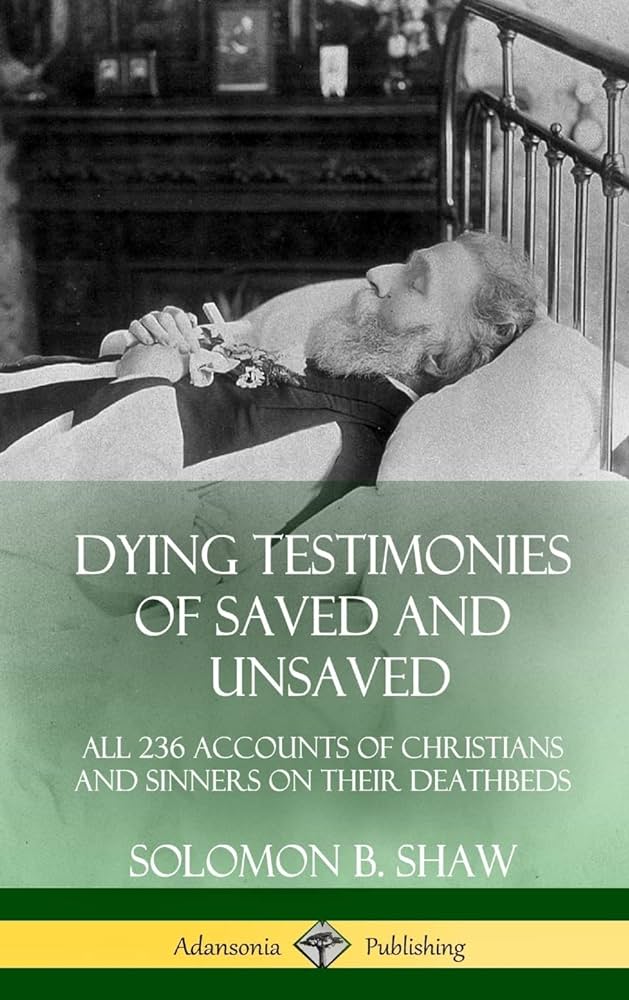
Picture
This shocking testimony is an excerpt from a book that was written and compiled by Solomon B. Shaw in 1898, entitled, "Dying Testimonies of the Saved and Unsaved". 

“Not only have millions upon millions of God’s children witnessed in life and death of Jesus’ power to save, but most infidels, skeptics, and sinners of every grade are constrained to acknowledge the truth of the Christian religion before they die.” - S.B. Shaw 

“Multitudes, while dying, see and hear things that are not seen or heard by others.” - S.B. Shaw 
0 Comments

The Awful End of a Backslider

2/13/2024

0 Comments

 
Picture
"But I keep under my body, and bring it into subjection: lest that by any means, when I have preached to others, I myself should be a castaway."  - 1 Cor. 9:27
The following is a short account of the life and death of William Pope, of Bolton, in Lancashire. He was at one time a member of the Methodist Society, and was a saved and happy man. His wife, a devoted saint, died triumphantly. After her death his zeal for religion declined, and by associating with back-slidden professors he entered the path of ruin. His companions even professed to believe in the redemption of devils. William became an admirer of their scheme, a frequenter with them of the public-house, and in time a common drunkard.

He finally became a disciple of Thomas Paine, and associated himself with a number of deistical persons at Bolton, who assembled together on Sundays to confirm each other in their infidelity. They amused themselves with throwing the Word of God on the floor, kicking it around the room, and treading it under their feet. God laid His hand on this man's body, and he was seized with consumption.

Mr. Rhodes was requested to visit William Pope. He says: "When I first saw him he said to me, 'Last night I believe I was in hell, and felt the horrors and torment of the dammed; but God has brought me back again, and given me a little longer respite. The gloom of guilty terror does not sit so heavy upon me as it did, and I have something like a faint hope that, after all I have done, God may yet save me.'

After exhorting him to repentance and confidence in the Almighty Savior, I prayed with him and left him. In the evening he sent for me again. I found him in the utmost distress, overwhelmed with bitter anguish and despair. I endeavored to encourage him. I spoke of the infinite merit of the great Redeemer, and mentioned several cases in which God had saved the greatest sinners, but he answered, 'No case of any that has been mentioned is comparable to mine. I have no contrition; I cannot repent. God will damn me: I know the day of grace is lost. God has said of such as are in my case, "I will laugh at your calamity, and mock when your fear cometh,"'

I said, 'Have you ever known anything of the mercy and love of God?'

'Oh, yes,' he replied; 'many years ago I truly repented and sought the Lord and found peace and happiness.'

I prayed with him after exhorting him to seek the Lord, and had great hopes of his salvation; he appeared much affected, and begged I would represent his case in our Society and pray for him. I did so that evening, and many hearty petitions were put up for him."

Mr. Barraclough gives the following account of what he witnessed. He says: "I went to see William Pope, and as soon as he saw me he exclaimed, 'You are come to see one who is damned forever!'

I answered, 'I hope not; Christ can save the chief of sinners.'

He replied, 'I have denied Him, I have denied Him; therefore hath He cast me off forever! I know the day of grace is past, gone -- gone, never more to return!'

I entreated him not to be too hasty, and to pray. He answered, 'I cannot pray; my heart is quite hardened, I have no desire to receive any blessing at the hand of God,' and then cried out, 'Oh, the hell, the torment, the fire that I feel within reel Oh, eternity.' eternity! To dwell forever with devils and damned spirits in the burning lake must be my portion, and that justly!'

On Thursday I found him groaning under the weight of the displeasure of God. His eyes roiled to and fro; he lifted up his hands, and with vehemence cried out, 'Oh, the burning flame, the hell, the pain I feel! I have done, done the deed, the horrible, damnable deed!'

I prayed with him, and while I was praying he said with inexpressible rage, 'I will not have salvation at the hand of God! No, no! I will not ask it of Him.'

After a short pause, he cried out, 'Oh, how I long to be in the bottomless pit -- in the lake which burneth with fire and brimstone!'

The day following I saw him again. I said, 'William, your pain is inexpressible.'

He groaned, and with a loud voice cried out, 'Eternity will explain my torments. I tell you again, I am damned. I will not have salvation.'

He called me to him as if to speak to me, but as soon as I came within his reach he struck me on the head with all his might, and gnashing his teeth, cried out, 'God will not hear your prayers.'

At another time he said, 'I have crucified the Son of God afresh, and counted the blood of the covenant an unholy thing! Oh, that wicked and horrible deed of blaspheming against the Holy Ghost! which I know I have committed!'

He was often heard to exclaim, 'I want nothing but hell! Come, O devil, and take me!' At another time he said, 'Oh, what a terrible thing it is! Once I might, and would not: now I would and must not.' He declared that he was best satisfied when cursing.

​The day he died, when Mr. Rhodes visited him, and asked the privilege to pray once more with him, he cried out with great strength, considering his weakness, 'No!' and passed away in the evening without God."

Backslider, do you know you are in danger of the fires of hell? Do you know you are fast approaching the...
​​​"Line by us unseen
That crosses every path,
That marks the boundary between
God's mercy and His wrath."
​You are, and unless you turn quickly, you with William Pope will be writhing in hell through all eternity. God says, "The backslider in heart shall be filled with his own ways." But He says again, "Return, ye backsliding children, and I will heal your backslidings." Oh, come back and be healed before God shall say of you, "He is joined to his idols, let him alone."

Picture
This shocking testimony is an excerpt from a book that was written and compiled by Solomon B. Shaw in 1898, entitled, "Dying Testimonies of the Saved and Unsaved". 

“Not only have millions upon millions of God’s children witnessed in life and death of Jesus’ power to save, but most infidels, skeptics, and sinners of every grade are constrained to acknowledge the truth of the Christian religion before they die.” - S.B. Shaw 

“Multitudes, while dying, see and hear things that are not seen or heard by others.” - S.B. Shaw 
0 Comments

Dead Orthodoxy?

2/3/2024

0 Comments


Article #1 on What is Revival? 

Picture

Empty Protestant Evangelicalism?  

"...I may know all the Doctrines in the Bible, but unless I know Christ, there is not one of them that can save me!" - C.H. Spurgeon

"...there is a world of difference between knowing the Word of God and knowing the God of the Word." - Leonard Ravenhill 
The historical exploits of Christ at the Cross in Death or at the Resurrection in newness of Life cannot be impersonal and impractical to you as an individual. For, the Crucifixion, Death, Burial, & Resurrection of Christ are not promoted in Scripture as mere historical facts to fondly remember, nor should they be memorialized by golden emblems of jewelry or divers sorts of decoration, neither should anyone craft or paint conceptualized images of these events to dote upon (Ex. 20:4-6). All this only invigorates the problem. Given the opportunity, the human heart will be inspired to pretentiously respond to Christ in religious fervor through dead ritualism (Judges 8:27). Even from an intellectual perspective this is a problem (1 Cor. 1:22-23). For, you may not be prone to commit such sins physically and exteriorly, but you can still act in the same hollow and idolatrous way intellectually, meditatively, and sacramentally.
“Search the Scriptures; for in them ye think ye have eternal life: and they are they which testify of Me. And ye will not come to Me, that ye might have life.” - John 5:39-40 [Jer. 8:7-9]
All that matters is if you are truly communing with the Spirit of God in your religious devotions (Jn. 6:63, 8:37, 43, 47; 1 Jn. 1:1-4). Perhaps you don't bow before a relic or kneel before an emblem of a Cross like Catholicism and Eastern Orthodoxy. Or perhaps you don't find religious serenity in a stately building of aesthetic appeal. Nevertheless, you can ritualistically practice the values and devotions of hollow and empty protestant evangelicalism just like these people do in Catholicism (2 Tim. 3:5). You can be completely void of the Spirit and acquiesce in a greater sense of "holiness" simply because you religiously read the Bible, all the while you don't truly have communion with God through the Bible (1 Jn. 1:1-7). Charles Spurgeon and Leonard Ravenhill spoke on this issue to warn the graceless parishioners of their day, saying, "...I may know all the Doctrines in the Bible, but unless I know Christ, there is not one of them that can save me!" (Spurgeon), and "...there is a world of difference between knowing the Word of God and knowing the God of the Word." (Ravenhill).
Even so, my reader, you can study the teachings of the Puritans with great admiration for their passion and wisdom, even while you stand outside the Temple of God (i.e. the Body of Christ) as one ritualistically looking at things you haven't personally experienced. This is the shocking reality for the vast majority of students who study Church History.
“Trust ye not in lying words, saying, The Temple of the LORD, The Temple of the LORD, The Temple of the LORD, are these.” - Jeremiah 7:4
Meditatively and intellectually you can act in the same hollow and ritualistic way as the Catholics do in their choice of genre in "worship". As Neo-Calvinists, you can submissively admire  the Puritans and Reformers just like the Catholics do "the Saints", the Popes, and Church Tradition; and, if this is the case, you will rashly and harshly anathematize anyone who would dare to question the puritanical interpretation of things. This is oppression. Redeemed men are hereby reduced into a state of false humility wherein the ministry of the Holy Spirit is regularly quenched and despised. 

Herein, there is a growing sense that we cannot understand the Bible without being immersed in the Doctrines of the Reformation. Albeit, this is a deviation from the fundamental convictions that empowered the Reformers to withstand the ecclesiastical rulers of their day, crying, “Sola Scriptura!”. Even so, my reader, you can submit to the ecclesiastical leaders of the modern Church and zealously promote the ministries of celebrity preachers, even though you aren't truly celebrating Christ or benefiting the Body of Christ.

Sola Scriptura? 

Sola Scriptura would fasten the eyes of earnest disciples upon “the Apostles' Doctrine” (Acts. 2:42). For, the apostles didn't speak about the Crucifixion, Death, Burial, & Resurrection of Christ as an impersonal thing of the past. They didn't treat these exploits of Christ as intellectual subjects of history limited to time and strictly personal to Christ. Rather, by faith, and herein through the quickening power of the Holy Spirit, these exploits of Christ are personalized to each and every believer. These exploits were accomplished completely and perfectly in the past, but we experience the transcending power of these acts at present as true believers. Christ accomplished redemption. Period. All of our hope resides in the Person and Work of Jesus Christ. Period. Notwithstanding, that's exactly why our reception of redemption does mystically and personally enjoin us to Christ's Person and Work. 

Do You Believe in the Crucifixion, Death, & Burial of Jesus Christ? 

A true believer in the Crucifixion & Death of Christ of old is vitally joined to this work personally insomuch that he is "crucified with Christ" at present (Gal. 2:20). The evidence of true faith in the Cross of Christ is a personal crucifixion. When Paul spoke of "the Cross of our Lord Jesus Christ", he was boasting in a personal experience of freedom wrought out in his own life, in declaring, “...by whom the world is crucified unto me, and I unto the world” (Gal. 6:14). Therefore, no one should suppose they are truly glorifying God for the work of Christ at the Cross of Calvary ("But God forbid that I should glory..." - Gal. 6:14) without personally undergoing the Baptism of Death that Jesus experienced in dying for our sins and rising again for our justification. Do you suppose that you glorify God for the Death of Christ? You must be “baptized into His Death” (Rom. 6:3). You must be “planted together in the likeness of His Death” (Rom. 6:5). Do you believe Christ died for Sinners? You must be “dead with Christ” in order to be saved from your sins (Rom. 6:8). Do you suppose you glorify God for the Burial of Christ? You must be “buried with Him by baptism into Death” (Rom. 6:4).

Do You Believe in the Resurrection of Jesus Christ? 

Do you suppose you glorify God for the Resurrection of Christ? The same question applies in every phase of the Gospel. For, by virtue of being vitally joined to the Crucifixion, Death, & Burial of Christ, one is also joined to Christ in His Resurrection. This is plain and pure Apostolic Doctrine described in Romans 6:1-14. “For if we have been planted together in the likeness of His Death, we shall be also in the likeness of His Resurrection” (Rom. 6:5). If you are truly “dead with Christ” then you will also “live with Him” in the power of His Resurrection to personally taste and see the victory of Jesus over death and hell (Jn. 5:21, 11:25, Rom. 6:8, 8:11, Php. 3:10, 1 Cor. 15:54-57, Rev. 1:8). This is what Paul calls, “Newness of Life” (Rom. 6:4). This is the only means that mankind can be “freed from sin” (Rom. 6:7). To be vitally joined to the Life that Jesus “liveth unto God” is the only means of practical, personal, and actual redemption from the penalty and power of sin (Rom. 6:10). In other words, this is a personal resurrection.

Accordingly, this operation of redemption is a spiritual baptism (Rom. 6:3, 1 Cor. 12:13, Gal. 3:27), a successful putting off of the Old Man and a putting on of the New Man that is created in righteousness and true holiness (Gal. 3:27, Col. 3:9-10). A real quickening of the soul takes place by the Resurrection power of Jesus Christ! Therefore, the man who was dead to God and alive in sin is made to die to sin and live unto God. Herein, the eyes of lost sinners are at once allowed to spiritually behold the glorious Gospel of Jesus Christ (Isa. 6:10, 29:10-12, Matt. 13:15, 2 Cor. 3:16-18), and suddenly all of what Christ has done becomes personal, powerful, and life changing (Rom. 1:16, 1 Cor. 1:18)! Suddenly, and instantly, the lost man is regenerated.

Looking to Jesus Christ in Real Time 

However, in truly seeing - and therein being converted through beholding the glory of the Crucifixion, Death, Burial, & Resurrection of Jesus Christ - newborn disciples must learn the importance of “looking unto Jesus” presently and progressively so as to experience the "grace" of this redemption steadfastly and without intermission (Heb. 12:1-2, 15). If one is positionally sanctified in Christ through conversion, one must “work out” this sanctification by walking in Christ (Php. 2:12-16); and, this walking in Christ is a present-progressive experience of self-mortification through the power of the Cross (Rom. 8:13, Col. 3:5, Gal. 5:19-24); a present-progressive experience of spiritual & positional newness through the power of the Resurrection (Col. 2:20, 3:1-2, Rom. 6:10-12, Php. 3:20, 2 Cor. 4:18, Matt. 6:21); a present-progressive filling of the Spirit that appropriates the power of the Gospel in real time (Lk. 24:49, Rom. 1:16, Eph. 1:23, 3:17, 19, 4:10, 13, 5:18; Col. 1:11, Eph. 1:19, 3:16, 20, 2 Thess. 1:11, Eph. 6:10) to put off the Old Man and put on the New Man (Col. 3:12, 14; Eph. 4:22, 24; Rom. 13:12, 14; Eph. 6:11).

This is the Normal Christian Life according to the Bible (1 Thess. 1:4-10). This experience is the promise and appropriation of what Christ has accomplished in the Gospel. This is what Christ is accomplishing at present in true believers through the freeness of God's grace (Isa. 55:1-3) being showered upon us abundantly (Rom. 5:5) at the cost of the atonement finished at the Cross (John 19:30; Hos. 13:14, Matt. 20:28, 1 Tim. 2:6). In other words, this is a constant experience of personal Revival. However, sadly, many people don't experience this because they have been deceived to think that Revival is an optional and superior form of spirituality that isn't required of all true Christians. Nevertheless, I must tell you: This is Salvation. 
​

Salvation in the Past, Present, & Future

Christians have been saved, are being saved, and will be saved. Herein, salvation is past, present, and future. Christians have been saved through conversion to Christ (Mk. 16:16, Lk. 7:50, 8:12, Jn. 10:9, Acts 2:21, 47, 4:12, 11:14, 15:11, 16:31; Rom. 5:9, 10:9, 13, 1 Cor. 1:18, Eph. 2:5, 8; 2 Tim. 1:9, Titus 3:5), are being saved through sanctification in Christ (Php. 2:12, Rom. 5:10, 1 Cor. 5:5, 15:2, 2 Cor. 1:6, 7:10-11, Eph. 6:17, Php. 1:19, 1 Thess. 5:8, 1 Tim. 2:15, Titus 2:11-14, 1 Pet. 4:17-18, 2 Pet. 3:14-18), and will be saved by persevering in faith until death or the coming of the Kingdom of God in the 2nd Advent of Christ (Matt. 10:22, 24:13, 22; Lk. 18:26-30; Rom. 5:10, 11:26, 13:11; 1 Thess. 5:9, Heb. 9:28; 1 Pet. 1:5, 9-10, 4:17-18; 2 Pet. 3:14-15; Rev. 7:10, 12:10, 19:1). 

In this sense, the Gospel is past, present, and future. For, the work of Christ in the Atonement was finished at Calvary (John 19:30), but our faith in the Atonement making possible conversion, sanctification, and ultimate glorification in the coming of the Kingdom of God is still unfinished (1 Pet. 1:5). Therefore, as believers, our hope is to persevere in salvation until the time when Christ will say, “It is done” (Rev. 21:6), by walking with God right now by faith because, Christ said, “It is finished” (Jn. 19:30; Php. 3:12-21, 2 Cor. 5:9-10). The plot of redemption that takes place between these two points in time has everything to do with our personal salvation in Christ according to the Gospel. 
​

The Narrow Way

Personally losing sight of the Gospel in all of its phases of glory has a blinding effect upon the soul (2 Pet. 1:5-15). In hopes that believers of the 1st Century would avoid the peril of this blindness, Peter said, “make your calling and election sure” (2 Pet. 1:10, Rev. 3:5). For, all such revival-less persons are in serious danger. Through this deviation they have veered off the Narrow Way (Matt. 7:14). Entering the Gate through conversion to Christ isn't enough; one must then keep the faith by walking the Narrow Way (Matt. 7:14). In other words, one must keep faith in Jesus Christ, because He is “the Way” (John 14:6). Literally. Our only hope is in Jesus Christ both now and forever (Heb. 12:1-2)!
“Looking unto Jesus the Author and Finisher of our faith; who for the joy that was set before him endured the cross, despising the shame, and is set down at the right hand of the throne of God…Looking diligently lest any man fail of the grace of God; lest any root of bitterness springing up trouble you, and thereby many be defiled;” - Hebrews 12:2, 15 [Deut. 29:18]
The Narrow Way is the experience of present-progressive salvation as described in the terms formerly outlined according to Apostolic Doctrine in the New Testament. This is not an affront to the power and sufficiency of salvation in Christ; for, only a lack of abiding in or looking to Christ can cause precious souls to swerve off the Narrow Way to their own damnation. Upon conversion to Christ the newborn believer is perfectly saved and blameless before God in the beauties of holiness through the spotless robes of Christ's righteousness. For, in Christ, the newly saved man is perfect (Col. 2:10, Heb. 10:14), blameless (Eph. 1:4, Col. 1:22), sanctified (Eph. 1:4, Col. 1:22, Heb. 10:10, 1 Pet. 1:2, 1 Cor. 6:11), and spotless (Zech. 3:4, Rev. 6:11, 7:9). Jesus Christ is a refuge for us (Ps. 62:7-8)! If redeemed men refuse to abide in Christ, only then could their perfection be compromised. Scripture is rife with terms that identify such men in this condition, calling them blamable, blemished, unholy, and the like (1 Thess. 3:12-13), because of a loss of faith in the Gospel through the presence of evil unbelief in their souls (Heb. 3:7-4:11).

The Judgment Seat of Christ 

Such men are not ready to stand before God on Judgment Day (2 Cor. 5:9-11; Luke 21:34-36). In this inglorious condition they are simply wretched and unpresentable to God (Rev. 3:15-18, Col. 1:28-29, Eph. 5:26-27, 2 Cor. 11:2, Jude 1:24-25). They are rendered unworthy for their defiance of the Gospel. Jesus Christ died for “a glorious Church” and this isn't it (Eph. 5:27)! A fallen Church is a filthy Bride! God’s grace is sufficient for holiness, purity, power, and glory (Heb. 12:14, John 17:22, Rom. 15:16), but revival-less persons do squander these riches for worldly lusts! Fearfully, this is what it means to be “fallen from grace” (Gal. 5:4). In dread terror of this (1 Cor. 9:27), the apostle Paul warned the believers at Corinth, saying, “take heed lest ye fall” (1 Cor. 10:12). Legally (Heb. 10:26-27), and in many ways spiritually (Gal. 4:19), this is a condition of spiritual death (Rev. 3:1). This is when a justified, regenerated, and righteous man is turned into an unjustified, wicked, sinner again (not to be confused with reprobation).

To be personally revived from this fallen condition would literally and spiritually mean that the individual is wrought upon by grace “to live again”. That's simply what the word revival means. To deny such things is to embrace an outlook of undue optimism and high-mindedness concerning one's own personal pilgrimage on the Narrow Way (1 Pet. 1:17, 2:11, Rom. 11:20, 1 Pet. 4:17-18, Heb. 4:1). This is a blatant denial of the teachings of Jesus concerning the two mutually exclusive fates of all the Branches that are connected to the Vine of Salvation (Jn. 15:1-7). We are warned not to be so fearless (Heb. 2:1-4, 4:1, 10:26-27) before the superior greatness of Jesus Christ, the one and only Prophet like unto Moses (Deut. 28:58, Acts 3:22-23). 

A Sick Church in a Dying World 

The Church is the Kingdom of God in all ages and Covenants. The Church is the Body of Christ. Therefore, there are implications to its poor and miserable estate (Rev. 3:17-18). Lamenting of this, Ravenhill said, "There is no greater tragedy than a sick Church in a dying world!". Would you agree? We can be sure that the Lord isn't coming back for a poor, ragged, and unbeautified Bride (Eph. 5:25-27). Nevertheless, the End of the World is coming quickly. As a witness against the Church, the spiritual climate of darkness is prevailing upon this generation. The Church is at a loss and without prevailing prayer. She is adulterously entertained by the world and thereby robbed of true joy. The virgins of God are sleeping (Matt. 25:1-13, Eph. 5:14)! Therefore, following the pattern exemplified in Paul among the Churches of the 1st Century (2 Tim. 1:15), those who are truly burdened for the Church are bound to be persecuted by it in times of backsliding. This kind of persecution is inevitable today when the very meaning of Revival has been altered to allow for fearless backsliders to continue on the path of destruction. 

False doctrines as these allow for a culture of contagious hypocrisy to flourish in the Church (Matt. 24:12, 1 Cor. 5:6, Gal. 5:9; Lk. 12:1). Ere long true sincerity becomes an illusive figment of imaginary ideals while sarcastic voices stand by and scorn the existence of biblical testimony (Matt. 23:29-30; Gen. 19:14). The most learned among men dim lights to set the mood in the Church, until earnest inquirers of biblical testimony become cynical instead of sincere with conviction. What more can be said but... “Ichabod”(1 Sam. 4:21). The Glory of God has departed from the Church. This is the ultimate goal of the Father of Lies as he works to steal the hearts of true Christians (Jn. 8:44, 1 Kings 11:3-4, 2 Cor. 6:14-7:1). For, a loss of the heart in this way among true Christians isn't just the compromise of mere individuals (James 4:4-10); worst case scenario, the spiritual essence of true Christianity is lost corporately among believers. The heavenly Candlestick that legitimizes a local Church is removed from the earth (Rev. 2:4-5), and all that's left is darkness. 

Earnestly Contend for the Faith 

Ultimately, this is a failure to emphasize “the Christ” of Christianity in how the spirituality of true communion with God is mutually experienced by all believers. In other words, this is a promotion of “Christ-less Christianity” - a shocking offence that profanes the purity and power of true religion. Likewise, this is a failure to emphasize “the Cross” of Christianity. The cross-less “Christians” of today are having their ears tickled with the idea that Revival is uncommon and extraordinary when in reality Revival is obedience (2 Tim. 4:1-5). This is the promotion of “Cross-less Christianity” - a shocking offence that allows the Church to flirtatiously enjoy the world while the backsliders feel justified in a lifestyle void of Revival (1 Jn. 2:15-17). This is a painless, powerless, and prayerless “Christianity” that is popular with the world (Lk. 16:15). Like a wolf in sheep's clothing this “Christianity” is damning souls and populating hell. Fearfully, "The fastest way to hell is down the center isle of the average Church." (Leonard Ravenhill). Therefore, we should labor to resurrect the biblical standard of true Christianity instead of aimlessly waiting for a brief season of "Revival" that comes and goes, and doesn't come back for another 50 years. 

True worshipers must stand up and stand out, even if they are cast out (Eph. 5:3-17, Prov. 1:20, Rev. 3:20). Love will always clash with hate (John 7:7). The glorious reality of heavenly vision must return to the Church (Acts 26:19). Only a militantly focused missionary Church is a Bride prepared for Marriage (Rev. 19:7-8). The silent toleration of a modern day spiritual holocaust simply cannot continue (Prov. 29:9). Those who are right with God must not be marginalized and silenced (Prov. 28:12). Lukewarmness must not be allowed to preach any longer (Rev. 3:17)! The cold and murderous indifference of lukewarmness must be seen for what it is in truth. For, humble watchfulness unto God has been replaced by high-minded preachers who are uncharitable, tribalistic, and pharisaical in the name of theological (Isa. 29:9-13). They rule by their means and the people love to have it so (Jer. 5:31, Isa. 29:9-13). 

A contagious lack of zeal for God's sake spreads among the common people as those in honor prefer each one's personal reputation in their pursuit of progress. The fear of man prevails inwardly while the spiritual abuses of power abound through an oppressive force of ministerial favors taking preeminence above justice, impartiality, biblical due process, and the fear of God (1 Tim. 5:20, Gal. 2:11). ​At such a time, the remnant of right-standing believers must learn to be patient in tribulation and courageous in the conflict of faith. As persecution mounts and slander increases, we must remain pure, sincere, and boldly defiant of hypocrisy and lies. Like our apostolic forefathers, whose ways were in Christ, we must embrace tribulation with the sentence of death within ourselves (2 Cor. 4:7-18). 

The Last Days 

Many true believers seek to hold out and stand strong against the growing influx of apostasy in the Church and over time they become discouraged. Loneliness and sorrow increase as the violators of biblical truth are promoted among the ranks of Christendom. The temptation can be to calm the fire and sheath the sword of salvific truth. Sorry attempts will be made to get along with backsliders who feel at home in this world. A pervading sense of disbelief and failure can break the heart and nearly extinguish the lamp of one's first love (Rev. 2:4-5). To all such hurting persons, I plead: consider Job (James 5:11). Cast yourself wholly upon the written word of God even while the multitudes of every divergent sector of Christianity does turn aside.

My plea is for the contrite ones who have been compromised and overcome by the likes of those who are settled in and happy in this world (1 Pet. 2:11), remember that Jesus Christ is your exalted Savior. God will yet again give you the eye-opening experience that you need to keep the faith in the beauties of holiness until the very end. There remains good hope through grace for the remnant of the Last Days. 

The LORD will renew and empower all those who sigh and cry for all the abominations of the Church (Ezek. 9:4). Recommit yourself to the LORD without hesitation or reserve as you once did (Rev. 2:4-5) and the LORD will renew your consecration to God. Call upon God as you remarry yourself to the glory of God (Jer. 33:3), and then waste your life for eternity until death. Renew your friendship with God and climb out of the slew of your despondency. The plans of sovereign mercy are yet to unfold before the eyes of this generation to the shock and astonishment of all mankind.

0 Comments

Speaking in Tongues: Is it Gibberish?

9/14/2022

0 Comments

 
Picture

Speaking in Tongues

Teaching #1: Is it Gibberish?  
​“And they were all amazed and marvelled, saying one to another, Behold, are not all these which speak Galilaeans? And how hear we every man in our own tongue, wherein we were born?” - Acts 2:7-8
Do you speak in Tongues? The word tongue literally means language. If you are not speaking in an intelligible and coherent language, then you are not speaking in tongues. 
Διάλεκτος (dialektos) = dialect or language
Most charismatic Christians are just speaking gibberish. They are deceived to think that they are speaking in tongues because they were coerced by their Pastor to just let their tongue wiggle loosely and run wild. The result of this is babble! It’s nothing at all really. It’s just noisy nonsense! If these people were speaking an actual language, then their speech would consist of syllables, vowels, and consonants in the sounding-out of real words in the utterance of complex sentences for the expression of deep and sincere thoughts. God created mankind with the unique ability of language because He desires a vibrant relationship with redeemed men and women by this means. 
“For if the trumpet give an uncertain sound, who shall prepare himself to the battle? So likewise ye, except ye utter by the tongue words easy to be understood, how shall it be known what is spoken? for ye shall speak into the air. There are, it may be, so many kinds of voices in the world, and none of them is without signification. Therefore if I know not the meaning of the voice, I shall be unto him that speaketh a barbarian, and he that speaketh shall be a barbarian unto me.” – 1 Cor. 14:8-11
Have you heard all these so-called Christians loudly babbling at the Church down the street? They are shouting in gibberish, and therefore no one understands anything that they are saying! In fact, they aren’t saying anything at all. Random sounds and incoherent slurs offered to God in prayer is nothing short of blasphemy. This is obviously contrary to the divine purpose of tongues according to Acts 2:7-8. On the Day of Pentecost, when the Apostles stood up and spoke in tongues, the bystanders heard and understood what was being said because they were hearing about the wonderful works of God in their own native languages, all of which were foreign to the Galilaeans. 
“…we do hear them speak in our tongues the wonderful works of God.” - Acts 2:11
This was an observable miracle that glorified God! While no miracle is required for men and women to speak babble! This is a modern invention of devils to trick mankind to behave like animals. Even animals can speak gibberish! Why would God want mankind to behave like animals? This debases mankind and distorts the image of God in which we were created (Gen. 1:26-27). It is offensive to God, humorous to devils, and alienating to people of other religions. 
“…will they not say that ye are mad?” – 1 Corinthians 14:23
If perhaps anyone does truly speak in tongues as a miraculous utterance from the Spirit of God, then unbelievers would hear and understand the Word of God in their own languages, or an interpretation would be given and the Word of God would be heard and understood, and God would be glorified (1 Cor. 14:19, 27-28). Those who are unbelievers wouldn’t be driven away from Christianity as a result; they would be drawn to Christianity (1 Cor. 14:22). The Muslims must think that all these tongue-speakers in Churches these days have gone crazy! This is a great reproach to the name of Christ. 
0 Comments

Are You Depressed?

9/6/2022

0 Comments

 
Picture

Revival For the Depressed 

"To appoint unto them that mourn in Zion, to give unto them beauty for ashes, the oil of joy for mourning, the garment of praise for the spirit of heaviness; that they might be called trees of righteousness, the planting of the LORD, that he might be glorified." - Isaiah 61:3
The Church on your street corner will tell you that the Book of Job is a philosophical masterpiece on why or how a good God allows so much human suffering to take place in the world. Sitting in the galleries, the Christian Academics of today would have you bow in reverence to such a thesis as this for the Book of Job. Nevertheless, something about it just doesn’t heal the hurt of sad and gloomy Christians (Jer. 6:14, 8:11). What amuses insensitive Scholars in seminaries then abuses suffering sinners who resort to Job for hope and comfort.
"They have healed also the hurt of the daughter of my people slightly, saying, Peace, peace; when there is no peace." - Jer. 6:14

"​For they have healed the hurt of the daughter of my people slightly, saying, Peace, peace; when there is no peace." - Jer. 8:11
Job is popular today, and referenced often by peace preachers, because it seems that people have never been more depressed than in modern times. Of course, they misinterpret Job! So, his story becomes nothing more than a dimly lit candle in the dungeon of despair to help the mourners cope with their misery. No cure is offered through an incorrect interpretation (2 Cor. 1:24). No freedom is granted through false peace. Job needed to repent! “Am I therefore become your enemy, because I tell you the truth?” (Gal. 4:16). Why else do you think Elihu and Jehovah so sorely rebuked Job in the end of the Book in Job 32-42. Likewise, may a correct interpretation of Job’s misery serve as a wakeup call to the tens of thousands of depressed and impenitent Christians of the modern era, even as they delight to trace their misery in Job’s experience to tell themselves that everything is going to be okay.

Depressed souls like these become sadder at the sound of preaching on repentance. They cannot suffer anyone to tell them about the faithfulness of God – how the LORD would certainly lift their spirits if only they would denounce and totally divorce their secret affection for iniquity. They don’t want anyone to tell them that their sadness is sin! For the record, the bible calls it worldly sorrow (2 Cor. 7:10-11).
"For godly sorrow worketh repentance to salvation not to be repented of: but the sorrow of the world worketh death." - 2 Cor. 7:10
​Coincidentally, modern readers also believe Eliphaz, Bildad, and Zophar to be the antagonists of the situation simply because they had a heavy burden for Job and were persuaded that he was in sin. They totally disregard the fact that Job was in total agreement with the doctrine and practice of his friends, even echoing them, and at times excelling them, which shows that these were universally recognized truths among all the saints of the Early Church, namely because they were all learning from the same sources of aged counselors and teachers.
​

Sadly, the most noble morals of ancient generations are totally disregarded by future generations. The most noble doctrines of former times are totally denounced in latter times. Even so, today, Christians are prone to grossly oversimplify the discourse between Job and his friends because they are totally ignorant of the Early Church in Genesis 1-11.
PictureA Commentary on the Book of Job
A book written about a controversy is bound to be controversial. A situation that confounded the most godly men of the Early Church will no doubt confuse readers today. Doubtful readers of the Book of Job would do well to put aside all preconceived notions, and let the Scripture interpret Scripture without any personal interference. 


Picture
 🎶 𝑻𝒉𝒆 𝑾𝒂𝒚 𝒐𝒇 𝒕𝒉𝒆 𝑳𝑶𝑹𝑫 🎶 - 𝐶𝑎𝑟𝑜𝑙𝑦𝑛 𝐵𝑟𝑖𝑒𝑟

𝘍𝘰𝘦𝘴 𝘵𝘰 𝘧𝘪𝘨𝘩𝘵 𝘢𝘯𝘥 𝘧𝘦𝘢𝘳 𝘵𝘰 𝘧𝘢𝘤𝘦
𝘉𝘶𝘵 𝘢𝘭𝘭 𝘪𝘴 𝘸𝘦𝘭𝘭 𝘸𝘩𝘦𝘯 𝘪𝘯 𝘛𝘩𝘺 𝘨𝘳𝘢𝘤𝘦
𝘛𝘩𝘦 𝘸𝘢𝘺 𝘰𝘧 𝘵𝘩𝘦 𝘓𝘰𝘳𝘥 𝘮𝘢𝘺 𝘭𝘦𝘢𝘥 𝘵𝘩𝘳𝘰𝘶𝘨𝘩 𝘴𝘯𝘢𝘳𝘦𝘴
𝘞𝘦 𝘴𝘩𝘢𝘭𝘭 𝘦𝘴𝘤𝘢𝘱𝘦 𝘸𝘪𝘵𝘩 𝘧𝘢𝘪𝘵𝘩 𝘢𝘯𝘥 𝘱𝘳𝘢𝘺𝘦𝘳𝘴.

𝘚𝘵𝘦𝘦𝘱 𝘸𝘪𝘵𝘩 𝘵𝘩𝘰𝘳𝘯𝘴, 𝘴𝘵𝘳𝘢𝘪𝘵 𝘢𝘯𝘥 𝘯𝘢𝘳𝘳𝘰𝘸
𝘞𝘪𝘵𝘩 𝘫𝘰𝘺 𝘢𝘯𝘥 𝘨𝘭𝘢𝘥𝘯𝘦𝘴𝘴, 𝘺𝘦𝘵 𝘨𝘳𝘪𝘦𝘧 𝘢𝘯𝘥 𝘴𝘰𝘳𝘳𝘰𝘸
𝘛𝘩𝘦 𝘸𝘢𝘺 𝘰𝘧 𝘵𝘩𝘦 𝘓𝘰𝘳𝘥 𝘪𝘴 𝘤𝘩𝘰𝘴𝘦𝘯 𝘣𝘺 𝘧𝘦𝘸
𝘉𝘶𝘵 𝘣𝘭𝘦𝘴𝘴𝘪𝘯𝘨𝘴 𝘣𝘦 𝘵𝘰 𝘵𝘩𝘰𝘴𝘦 𝘵𝘰 𝘥𝘰.

𝘈𝘨𝘢𝘪𝘯𝘴𝘵 𝘮𝘺 𝘸𝘪𝘭𝘭, 𝘢𝘨𝘢𝘪𝘯𝘴𝘵 𝘮𝘺 𝘸𝘢𝘺𝘴
𝘛𝘳𝘢𝘯𝘴𝘧𝘰𝘳𝘮𝘦𝘥 𝘵𝘰 𝘵𝘩𝘪𝘯𝘦 𝘧𝘰𝘳 𝘢𝘭𝘭 𝘮𝘺 𝘥𝘢𝘺𝘴
𝘛𝘩𝘪𝘴 𝘪𝘴 𝘵𝘩𝘦 𝘣𝘭𝘦𝘴𝘴𝘦𝘥𝘯𝘦𝘴𝘴 𝘰𝘧 𝘎𝘰𝘥.
𝘛𝘩𝘰𝘶𝘨𝘩 𝘪𝘵’𝘴 𝘢𝘤𝘤𝘰𝘮𝘱𝘭𝘪𝘴𝘩𝘦𝘥 𝘣𝘺 𝘵𝘩𝘦 𝘳𝘰𝘥

𝘖𝘶𝘳 𝘸𝘢𝘵𝘦𝘳 𝘵𝘰 𝘸𝘪𝘯𝘦, 𝘰𝘶𝘳 𝘴𝘵𝘰𝘯𝘦𝘴 𝘵𝘰 𝘣𝘳𝘦𝘢𝘥
𝘖𝘶𝘳 𝘴𝘱𝘪𝘳𝘪𝘵𝘴 𝘧𝘪𝘭𝘭𝘦𝘥, 𝘰𝘶𝘳 𝘴𝘰𝘶𝘭𝘴 𝘢𝘳𝘦 𝘧𝘦𝘥.
𝘉𝘶𝘵 𝘮𝘶𝘳𝘮𝘶𝘳 𝘯𝘰𝘵 𝘸𝘩𝘦𝘯 𝘨𝘳𝘢𝘤𝘦 𝘤𝘰𝘮𝘦𝘴 𝘴𝘭𝘰𝘸
𝘍𝘰𝘳 𝘰𝘶𝘵 𝘰𝘧 𝘵𝘩𝘦 𝘙𝘰𝘤𝘬 𝘸𝘢𝘵𝘦𝘳 𝘸𝘪𝘭𝘭 𝘧𝘭𝘰𝘸!

𝘛𝘩𝘦 𝘸𝘢𝘺 𝘰𝘧 𝘎𝘰𝘥 𝘤𝘰𝘮𝘦𝘴 𝘰𝘧𝘵 𝘸𝘪𝘵𝘩 𝘵𝘳𝘪𝘢𝘭
𝘉𝘶𝘵 𝘧𝘢𝘪𝘵𝘩 𝘴𝘩𝘢𝘭𝘭 𝘤𝘳𝘶𝘴𝘩 𝘵𝘩𝘦 𝘥𝘦𝘷𝘪𝘭’𝘴 𝘸𝘪𝘭𝘦𝘴
𝘛𝘩𝘰𝘶𝘨𝘩 𝘯𝘪𝘨𝘩𝘵 𝘩𝘦 𝘭𝘰𝘯𝘨 𝘢𝘯𝘥 𝘩𝘢𝘳𝘥 𝘵𝘰 𝘦𝘯𝘥𝘶𝘳𝘦
𝘖𝘶𝘳 𝘫𝘰𝘺 𝘴𝘩𝘢𝘭𝘭 𝘤𝘰𝘮𝘦 𝘺𝘦𝘵 𝘪𝘯 𝘵𝘩𝘦 𝘮𝘰𝘳𝘯𝘪𝘯𝘨.

𝘾𝙝𝙤𝙧𝙪𝙨
𝘛𝘩𝘦 𝘸𝘢𝘺 𝘰𝘧 𝘵𝘩𝘦 𝘓𝘰𝘳𝘥 𝘵𝘩𝘰𝘶𝘨𝘩 𝘳𝘰𝘶𝘨𝘩 𝘪𝘵 𝘣𝘦
𝘚𝘩𝘢𝘭𝘭 𝘭𝘦𝘢𝘥 𝘵𝘰 𝘨𝘳𝘢𝘤𝘦 𝘧𝘰𝘳 𝘺𝘰𝘶 𝘢𝘯𝘥 𝘮𝘦
𝘔𝘺 𝘩𝘦𝘢𝘳𝘵 𝘳𝘦𝘱𝘭𝘪𝘦𝘴 “𝘠𝘦𝘴 𝘓𝘰𝘳𝘥!” 𝘵𝘰 𝘵𝘩𝘦𝘦.
𝘛𝘩𝘦 𝘸𝘢𝘺 𝘰𝘧 𝘵𝘩𝘦 𝘓𝘰𝘳𝘥 𝘪𝘴 𝘣𝘦𝘴𝘵 𝘧𝘰𝘳 𝘮𝘦.

0 Comments

"Rules to Discern a True Work of God" - Jonathan Edwards

8/19/2020

0 Comments

 
Picture
Jonathan Edwards is very celebrated today. However, this wasn't always the case for the renowned American Theologian. When a sovereign move of God broke out among his people, and Edwards saw firsthand the working of the Holy Spirit through preaching to powerfully and suddenly get men lost and saved, something quite "unexpected" happened: PERSECUTION. 

It turns out that not all who prayed for a "Revival" leading up the the First Great Awakening were willing to welcome it once it came (Matt. 23:29-30, 1 Jn. 3:13). Many false accusers and slanderers outright denied the work of God that was underway and claimed it was of demonic origin. Therefore, Edwards, in the throes of a work of God in his city, was forced to make a formal defense of what was happening. In writing, he endeavored to establish before all certain biblical rules on how to discern if a work of revival in any location is of the Devil or from the Holy Spirit of God (Jn. 16:8-11). This is the point of emphasis in the following, as a counterargument, when Edwards wrote about "the Spirit that is at work" - in an excerpt taken from Section III from Marks of a Work of the Spirit of God. Furthermore, for simplicity, I have taken liberty to numerically format the argument of Edwards to emphasize 5 primary observations or characteristics that prove a work of religion to be of God by the Holy Spirit. 

“As to this work, there are many things concerning it that are notorious (commonly reported and known), and which, unless the apostle John was out (in an error) in his rules, are sufficient to determine it to be in general the work of God.
[1] The Spirit that is at work, takes off persons’ minds from the vanities of the world, and engages them in a deep concern about eternal happiness, and puts them upon earnestly seeking their salvation, and convinces them of the dreadfulness of sin, and of their own guilty and miserable state as they are by nature.

[2] It awakens men’s consciences, and makes them sensible of the dreadfulness of God’s anger, and causes in them a great desire and earnest care and endeavour to obtain his favour.

[3] It puts them upon a more diligent improvement of the means of grace which God has appointed; accompanied with a greater regard to the Word of God, a desire of hearing and reading it, and of being more conversant with it than they used to be.

[4] And it is notoriously manifest, that the Spirit that is at work, in general, operates as a Spirit of truth, making persons more sensible of what is really true in those things that concern their eternal salvation: as, that they must die, and that life is very short and uncertain; that there is a great sin-hating god, to whom they are accountable, and who will fix them in an eternal state in another world; and that they stand in great need of a Savior.

[5] It makes persons more sensible of the value of Jesus who was crucified, and their need of him; and that it puts them upon earnestly seeking an interest in him.” - Jonathan Edwards
This type of discernment is perfectly biblical (Matt. 7:16, 20; Jn. 7:24; 1 Cor. 5:13-14). We, as professors of Christianity, must examine ourselves to see whether we are in the faith. This is directly mandated by Paul under inspiration in 2 Corinthians 13:5, speaking to the backslidden Church of Corinth, saying, "Examine yourselves, whether ye be in the faith; prove your own selves. Know ye not your own selves, how that Jesus Christ is in you, except ye be reprobates?". Statedly, if the work of God in salvation must be verified through an examination, then there must be a certain way that fallible redeemed men can test and discern the authenticity of a certain work on the basis of concrete grounds. This vindicates what Jonathan Edwards set-out to prove in the First Great Awakening. In slightly different terms, Edwards affirmed the existence of "rules" that "are sufficient to determine" if something is "in general the work of God". 
"Beloved, believe not every spirit, but try the spirits whether they are of God: because many false prophets are gone out into the world." - 1 John 4:1

Prove Ye Every Spirit 
1. Prove ye, prove ye ev’ry spirit,
    As the Master did command it;
    Know their works, not words alone,
    Men, as trees, by fruits are known.
    Are their fruits, their works and teaching
    Based on doctrines Christ was preaching?
    Do they love and teach the truth?
    Will their wisdom God approve?
 
2. Thus their righteousness beholding,
    All in outward form unfolding,
    Inwardly they will appear
    Hostile to Thy children here.
    He who lives in true obedience
    Can discern the voice and presence
    Of such strangers which draw near;
    May we flee when they appear.
 
3. Though the wolves be ever raging,
    Thou Thy fold art still defending.
    When such spirits do assail,
    We, who know Thee, will prevail.
    Lord, do Thou dispel confusion,
    Erring ones free from delusion.
    Saviour, may Thy fold increase,
    Grant us comfort, joy and peace!
0 Comments

"A Personal Calvary" - Keith Daniel

1/8/2020

0 Comments

 
Picture
Keith Daniel has earned the admiration of Christians worldwide. With an unrivaled capacity to memorize and quote Scripture while preaching, his sermons have mightily impacted devout parishioners from all theological camps and denominations. 

​Nevertheless, such fame comes with a cost in wicked and adulterous generations (Mk. 8:38). ​The temptation is strong for preachers to diminish the intensity of what is written, or even apologize for what is demanded, because the masses of Christendom are increasingly intolerant of Biblical Christianity. Tragically, this is exactly what Keith Daniel does in the famous sermon, "Have You Had a Personal Calvary".

Setting the tone of the sermon, before opening in prayer, Keith humorously derides the vanity and foolishness of professional sports, as the people laugh. While acknowledging the fact that sports have "become a god for so many millions of people", and while refusing to be entertained by it himself, Keith says to the people: "I don't blame you if you are fanatical about a game." Keith is careful to tell the people, "Listen, I'm not judging you...". Then he challenges them, saying, "Let me ask you something now? ...when were you so excited about anything of God, how long ago?". 
The challenge that Keith delivers to the people is commendable. He is certainly trying to sober the people and direct their hearts into the will of God. However, Keith has no authority to dismiss the people from blame if they are fanatical and idolatrous about sports (2 Pet. 3:14), as the judgment of God is very clear about idolatry (1 Cor. 5:10, 6:9, 10:7, 14; Col. 3:5, Gal. 5:20). As a Preacher (Jas. 3:1), Keith shouldn't be excusing the "lightness" of whoredom rampant among sports fanatics in our generation (Jer. 3:9). Rather, he should be charging the people to subject themselves to the Word of God in however it judges them (Heb. 4:12-13; 1 Cor. 5:12-13; 1 Pet. 4:17-18), whether it accuses or excuses them (1 Cor. 11:31, Rom. 2:13-15). 
​Sadly, the tone doesn't change for the rest of the evening. To begin the sermon, Keith immediately quotes and expounds John 12:23-26, and then segues into a question that becomes the theme of the sermon: "What could make a man desperately seek God for vital reality in Christianity before he dies?". Of course, Keith will go on to emphasize the need for Christians to "die", as stated in John 12:24, but in order to motivate Christians to "die" Keith preaches a sermon on the pros and cons of having or not having "vital reality in Christianity", in violation of John 12:25. In other words, Keith preaches a sermon on what is to be gained or lost through having or not having "a Personal Calvary", while certainly denouncing the possibility that anyone would suffer the loss of "Life Eternal" (Jn. 12:25).
Keith is very bold to declare to his audience that they are undoubtedly "saved", assuring them that they "will be in heaven" when they physically die, even though it is apparent that they aren't "right with God" for want of having "a Personal Calvary". According to Keith, these people are characterized as follows:
  • They aren't "desperately" seeking God. 
  • ​There is no "hope" that God would answer their prayers immediately. 
  • ​They are a "grief" to God and man. 
  • There are "inconsistencies" and "shallowness" in their Christian lives. 
  • ​They have not "laid" their "all" on the altar of God. 
  • ​They have not ​"fully surrendered" their lives to God. 
  • They do not live "a life of fruitfulness" - such that "is born through a moment of death". 
  • They have refused to "lay down [their] lives no matter what the cost". 
  • They refuse to "seek God with all [their] heart". 
  • They have refused to "put God first before anything". 
  • They are not "desperate" to find a "true walk with God". 
  • ​They have not "absolutely surrendered" their lives to God. 
  • They are content with "second best" - "Seeing as [they] don't want this cost: a Crucified Life, a Personal Calvary." ​
Keith isn't even talking about the extraordinary requirements of the call to Preach or the unique sacrifices necessary for becoming a Missionary. The audience understands him to be speaking of "a Mediocre Christian Life" in contrast to a non-Mediocre Christian Life, as the Pastor openly admits in the closing prayer. Statedly, Keith says, "There are only two types of Christians, beloved, those who have had a Personal Calvary and those who have not." Then to drive the point home, Keith questions the people, asking them: "When did you have a Personal Calvary, child of God? When will you have a Personal Calvary?". Howbeit, even if they continue being Cross-less Christians who fight against a Personal Calvary, Keith is careful to assure them with a false peace (Jer. 23:17, Ezek. 13:10, 16, 22-23). Using Jacob as an example, Keith says, 
"[Jacob] was saved and would have been in heaven; don't doubt that - you are, you will be in heaven...but what would God have done, if you would stop the fight and had a Personal Calvary?" 
In a shocking departure from the fundamentals of the Gospel, Keith preaches a substandard version of Christianity that isn't Biblical. For, according to the Bible, all genuine Christians were truly converted at the instant they were "crucified with Christ" in a Personal Calvary (Gal. 2:20, Rom. 6:1-7, Col. 3:3, Gal. 5:24). This is consistent with what is commonly called, Lordship Salvation, as revealed in Scripture. The Cross is the instrument of execution that liberates the soul in absolute surrender to Jesus Christ as the Lord (Rom. 10:9, 1 Cor. 12:3). Absolute surrender in and through the Gospel is to seek God with all the heart so as to find Him (Jer. 29:13, Deut. 30:6, Col. 2:10-13, Php. 3:3) - all of which is the beginning of a true walk with God made possible by saving faith (Gen. 5:24, Heb. 11:5). This is the clear testimony of Scripture. 

​"Somebody said, 'It is so easy to get saved.' Yes, all it will cost you is a full surrender to the Lord Jesus Christ. All you've got to do to be saved is to die: that's all it costs to get to Christ."
- Rolfe Barnard 

"There's only two kinds of people in the world, those who are dead in sin and those who are dead to sin." - Leonard Ravenhill 
Marvelously, the best warning that Keith can muster up to tell the people comes in the question, "When will you seek God in a way that you will find vital reality before you die in Christianity?". Keith didn't warn the people of dying outside of Christ. No! Rather, he warned them about the possibility of dying "in Christianity". In respect to the Cross, and the doctrines of Personal Mortification and/or the denial of self, Jesus and the Apostles never warned anyone about dying "in Christianity" (Jesus: Matt. 8:18-22, 10:32-39, Mk. 8:34-38, Lk. 9:22-26, 57-62, 12:49-53; Apostles: Rom. 8:1, 13, Col. 3:5-6, Eph. 5:3-7, Gal. 5:17-25). The New Testament "altar" is the Cross, and it requires "all" or nothing (Php. 3:8), which is why Jesus gravely admonished his followers to count "the cost" by reckoning with the danger of eternal judgment impending overhead (Lk. 14:16-35; Rom. 12:1-2; 2 Thess. 1:4-12).
"Therefore seeing we have this ministry, as we have received mercy, we faint not; But have renounced the hidden things of dishonesty, not walking in craftiness, nor handling the word of God deceitfully; but by manifestation of the truth commending ourselves to every man's conscience in the sight of God." - 2 Corinthians 4:1-2
Sadly, irreverent violations of vast portions of biblical doctrine are commonplace today among Preachers. When quoting a term or phrase from Holy Scripture, we must not remove it from its original context - the framework in which it was definitively revealed - or else in giving it another definition, as seems good, we are disguising damnable heresies through promoting biblical terms. Neither should we romanticize the horrifying atrocity of committing sin against God by using modern terms - chalking it all up to be some kind of "second best" offering or experience that's commonplace in Mediocre Christianity. In reality, if God isn't "first", and Christians are satisfied with giving God "second best", they need to own the guilt of the crime being committed: Idolatry. As violators of the 1st Commandment (Ex. 20:3), they don't need a flattering description of outrageously unacceptable sin, such that men think it's just "second best" Christianity.

Inconsistent and shallow Christians, who lack desperation to change, and stubbornly continue without vital reality with God, are those to whom Jesus said, "thou art Lukewarm", but Keith doesn't call it what it is (Rev. 3:14-22). He radically deviates from the biblical motivators presented to backsliders in divine argumentation, eloquently giving the people incentives to get "right with God" contrary to the emphasis of  Scripture. Then Keith goes on to characterize what he called "the Crucified Preacher", only making things worse. 
  • "The Crucified Preacher is nailed to the Cross because of love for the lost." 
  • "He loses his life to win the lost for Christ. He denies himself what others call their legal rights." 
  • "He dies daily to things others regard as normal, legitimate, and even essential." 
  • "This world is not his home." 
  • "He lives to lay up himself treasures in heaven."
  • "He sets his affection on things above, not on things of the earth"
  • "For him to live is Christ and to die is gain."
All true Christians are "nailed to the Cross". All genuine Christians have lost their lives and denied themselves. Dying daily isn't an optional path, such that only Preachers must do it! According to Jesus, professing Christians who are otherwise minded are forfeiting their souls for what they hope to gain in this life (Lk. 9:23-26, Php. 3:7-21; Rom. 8:13; 1 Cor. 15:30-34). Such men are called "the enemies of the Cross of Christ" in Philippians 3:18. Why? Because feeling comfortable and at home in this world is the essence of apostasy (Heb. 11:8-16, 35-39; 1 Pet. 2:11, Heb. 12:14-15, 2 Thess. 1:4-5)! And apostasy is essentially hatred for God being expressed through loving the world (1 John 2:15-19, Php. 3:19, Col. 3:2, Titus 1:16; Rev. 12:11). Without controversy, those things that are anti-Cross are Antichrist! A love affair with life is adultery against God and war against Heaven (James 4:4-10, Rom. 8:5-8, Lk. 14:26, Rev. 12:11). Laying up for yourself treasures on earth forfeits heaven because it is hatred for God and slavery to mammon (Matt. 6:19-24).
What business does Keith have confounding this matter? God knows. As for me, it is neither right nor safe to keep silent on this matter (Job 32:21-22, Prov. 24:11-12). A lack of clarity here, in what the Bible exhaustively clarifies, is an unforgivable sin in the Pulpit that necessitates an open rebuke. No amount of love and gratitude for Keith, as a brother in Christ, should inspire me to disobey direct orders from God in such circumstances as these. Not even Peter was allowed to confound the Gospel without being openly rebuked before all (Gal. 2:11-14). No doubt the people would begin to desperately seek God if they knew their eternal destiny was on the line. 
​They do not live "a life of fruitfulness" - such that "is born through a moment of death". 
Keith Daniel is preaching about a life of fruitfulness - such that is born through a moment of death - but the conceptual essence of what it means to be fruitful according to the Scriptures is violated by Keith's preaching. Keith fails to deliver to the people the biblical warnings pronounced by God upon those who do not bear fruit. On the contrary, when the word fruit is used in the New Testament, or a derivative thereof, it is employed by God to teach us how to identify or discern TRUE CHRISTIANS from FALSE CHRISTIANS, while focusing on the miraculous and transformational power of true conversion to Christ, and fiercely pronouncing damnation upon those who are fruitless for want of true conversion or because they are backslidden from Christ.

​Without controversy, this is the case and point in 15 out of 16 times where the word fruit is used in Matthew (Matt. 3:8, 10, 7:16, 17-20, 12:33, 13:8, 23, 26, 21:19, 34, 41, 43, 26:29), 7 out of 8 times where the word fruit is used in Mark (Mk. 4:7-8, 20, 28-29, 11:14, 12:2, 14:25), 11 out of 15 times where the word fruit is used in Luke (Lk. 1:42, 3:8-9, 6:43-44, 8:8, 14-15, 12:17-18, 13:6-7, 9, 20:10, 22:18), 6 out of 7 times where the word fruit is used in John (Jn. 4:36, 12:24, 15:2, 4, 5, 8, 16), and 17 out of 23 times where the word fruit is used in the Epistles (Rom. 1:13, 6:21-22, 7:4-5, 15:28; 1 Cor. 9:7, 2 Cor. 9:10, Gal. 5:22, Eph. 5:9, Php. 1:11, 22, 4:17, Col. 1:6, 10, 2 Tim. 2:6, Heb. 12:11, 13:15, Jas. 3:17-18, 5:7, 18, Jude 1:12). That amounts to over 50 violations of Scripture in a topic that pervades the New Testament. 
"Them that sin rebuke before all, that others also may fear." - 1 Timothy 5:20
Too many voices of extra-biblical Church History have preached a substandard version of Christianity. Insincere parishioners are a plague to the Church (Ezek. 33:30-32). To keep them coming, famous expository Preachers tip-toe around the divine threats of Scripture. If only Keith would have been yoked together in the School of God with other equally gifted men with contrasting strengths and weaknesses, like the Apostles were raised up together, then this could have been prevented. No one is above it. I have long believed that if Leonard Ravenhill, Paul Washer, and Keith Daniel would have united together, and matured in unity, this generation would have seen the greatest revival to date since the 1st Century. 

0 Comments

"Some Have Fallen into Spiritual Darkness..." - Robert Murray M'Cheyne

12/23/2019

0 Comments

 
Picture
The decline of spiritual light within true Churches is so glaringly obvious… shouldn't we come to understand its significance? To the dismay of many Neo-Calvinists, Robert Murray M'Cheyne admitted that such was “the case of every Christian Church” in his time. When writing in defense of a move of God that happened in his parish, M'Cheyne was forced to affirm the frequency of backsliders as commonplace among all true Churches of authentic converts. In so doing, M'Cheyne said,

​“Some of those converted have now walked consistently for four years; the greater part from one to two years. Some have had their falls into sin, and have thus opened the mouths of their adversaries; but the very noise that this has made, shows that such instances are very rare. Some have fallen into spiritual darkness; many, I fear, have left their first love; but yet I see nothing in all this but what is incident in the case of every Christian Church. Many there are among us, who are filled with light and peace, and are examples to the believers in all things.” - M'Cheyne 
​

Any serious minded believer would agree with M'Cheyne's assessment. They would empathize as those beholden to the same situation in our time. However, in the process, many good men have succumbed to the pressure of a growing tumult of Neo-Calvinists who outright deny that it is even possible for a truly converted individual to fall into spiritual darkness or lose one's first love (Rev. 2:4-5). This is the sad reality. Therefore, I plead for caution to those standing in the crossfire of theological rivalry. I plead for a slow and studious consideration of the subject, rather than a hasty agreement with the norm. I plead for loyalty to the Scripture no matter the outcome! For, as you will soon see (God willing), this subject occupies a large portion of the Bible: Firstly, in describing the transformational experience of salvation in the change from spiritual darkness to spiritual light. Secondarily, in pastoral warnings to true believers that they would walk in the glory of salvific light lest the soul is once again overtaken in spiritual darkness through backsliding into sin. 
The Transformational Experience of Salvation in Christ 
Picture
“To open their eyes, and to turn them from darkness to light, and from the power of Satan unto God, that they may receive forgiveness of sins, and inheritance among them which are sanctified by faith that is in me.” - Acts 26:18 [2 Cor. 4:3-6]
As depicted in Acts 26:18, those who have been born again have been made “meet to be partakers of the inheritance of the saints in light" by virtue of God delivering us “from the power of darkness" and translating us "into the Kingdom of His dear Son” (Col. 1:12-13, Jn. 3:3). This translation is a conversion experience that happens by the indwelling of the Holy Spirit resulting in a "regeneration" (Rom. 8:1-11, Titus 3:5). Literally, this results in a new creation (2 Cor. 5:17) - a reconciliation of a lost and darkened soul to the Living God (2 Cor. 5:18-19, Heb. 9:14). Therefore, because “God is light, and in Him is no darkness at all” (1 John 1:5), a personal reconciliation to God means an illumination of one's darkness and lostness (2 Cor. 4:3-6). In this way we have become, by Spirit, nature, and law: “the Children of Light” (John 12:36, 1 Thess. 5:5, 2 Pet. 1:4); and because we are “the Children of the Day: we are not of the night, nor of darkness” (1 Thess. 5:5).

The moral and spiritual essence of God is light (1 Jn. 1:5); therefore, John said, “in Him was life; and the life was the light of men” (John 1:4, Rom. 8:10). This being the case, it is to be expected that “there shall be no night” in the Kingdom of God (Rev. 21:23-25). Why? Because "the glory of God [will] lighten it, and the Lamb is the light thereof” (Rev. 21:23-25); therefore, all those who “are saved shall walk in the light of it” (Rev. 21:23-25). Anything else is simply inexcusable in the past, the present, or the future. Everything else is unacceptable whether in the Old Testament, the New Testament, or in the Consummated form of the Kingdom of God in the End of the World. For, the spiritual essence of the Kingdom of God is opposed to sin as light to darkness. Therefore, in all ages, the divine mandate forbids darkness from the Church. However, sadly, the backsliders of the Church don't comply with these spiritual laws (Rom. 8:2, Jas. 1:25). 
Pastoral Warnings to Walk in the Light 
Even the laws of natural creation depict the spiritual rules of the Kingdom. For, at the Genesis of time, it was written, "God divided the light from the darkness" (Gen. 1:4). Even so, now, things are no different (2 Cor. 4:3-6). The voice of our Creator (Ps. 33:6-9, 148:5) is calling souls out of darkness into the light for the goodliness and loveliness of divine affection ("And God saw the light, that it was good..." - Gen. 1:4). Anything else but this is utterly unreasonable and indefensible. Therefore, because these divine ethics of goodness govern the Kingdom of God in Christ, when Paul encountered various transgressors of what is good in the Church, he objected with the question: "...what communion hath light with darkness?" (2 Cor. 6:14-7:1). Contrastingly, Peter affirmed, we “should shew forth the praises of Him Who hath called [us] out of darkness into His marvelous light” (1 Peter 2:9), which would mean that we are having "no fellowship" with what God forbids (Eph. 5:11). In doing so, we are simply walking in the Spirit (Gal. 5:16). 
“For ye were sometimes darkness, but now are ye light in the Lord: walk as Children of Light: (For the fruit of the Spirit is in all goodness and righteousness and truth;) Proving what is acceptable unto the Lord. And have no fellowship with the unfruitful works of darkness, but rather reprove them” - Eph. 5:8-11
If we are alive in the Spirit through being born of God, we should walk in the Spirit. Or, as Paul explained, "If we live in the Spirit, let us also walk in the Spirit" (Gal. 5:25). Harmoniously, according to Ephesians 5:8-11, this is the same thing as walking in the Light. Anything else would mean that we are walking in the flesh and for that we will have to suffer the consequences (Gal. 5:19-21, Rom. 8:13). On the contrary, we are exhorted to “continue in the faith grounded and settled, and be not moved away from the hope of the Gospel” (Col. 1:23). This is our only hope. We must live, move and have our being in Jesus Christ (John 15:1-7, Rom. 6:1-23). Of course, this is because the Gospel liberates us from the flesh (Rom. 8:1-11) - the life of a normal human being! - making us radically abnormal and saintly in a fallen world of sinners (Heb. 12:14, Lk. 6:20-26).

Therefore, in describing the fallen estate of mankind, Paul warned that we should "henceforth walk not as other Gentiles walk, in the vanity of their mind, having the understanding darkened", for all such things are a product of being "alienated from the life of God" for want of true salvation in Christ (Eph. 4:17-18). Hence, true Christians are obliged to live on the contrary by virtue of being in Christ (Jn. 16:33, Rev. 2:26-27). This is exactly why Paul exhorted the Christians of Colossae, “as ye have therefore received Christ Jesus the Lord, so walk ye in Him” (Col. 2:6). He wanted them to walk in the Spirit by faith in the Gospel instead of the alternative; for, to "walk as men" (1 Cor. 3:3), or, if any true Christian is found out to be a backslider who "walketh in darkness" (1 Jn. 2:11, Num. 32:23), he or she is doomed to suffer the divine verdict: "...if ye live after the flesh, ye shall die" (Rom. 8:13). In other words, according to 1 John 3:14, this is as good as abiding in death (Rom. 8:6). This is why the pastoral epistles make urgent appeals to all such backslidders, saying, "Awake thou that sleepest, and arise from the dead, and Christ shall give thee light" (Eph. 5:14). 

The Spirit of God rouses men from the spiritual slumber of human depravity! Howbeit, the spirits of demons will cast men into the deep sleep of fearless disobedience against God. This is exactly what it means to be overcome by "the rulers of the darkness of this world" (Eph. 6:12), or, to be "taken captive by [the Devil] at his will" (2 Tim. 2:25-26, Eph. 2:1-3, 6:12). This miserable condition of spiritual darkness and sleep has been spoken about for ages (Isa. 29:9-10, Rom. 11:7-10). Furthermore, with Babylon approaching and therewith the End of the World, things will only get darker from hereon out (Matt. 25:1-13). Illustriously, and urgently, Paul speaks of this hazardous situation of unprecedented darkness in Romans 13:11-14. We would do well to take heed. 
"And that, knowing the time, that now it is high time to awake out of sleep: for now is our salvation nearer than when we believed. The night is far spent, the Day is at hand: let us therefore cast off the works of darkness, and let us put on the armour of light. Let us walk honestly, as in the day; not in rioting and drunkenness, not in chambering and wantonness, not in strife and envying. But put ye on the Lord Jesus Christ, and make not provision for the flesh, to fulfil the lusts thereof." - Rom. 13:11-14
Urgently, Paul was speaking as one who was aware that time was running out for those who were walking in darkness. Therefore, with reference to the spiritual warfare at hand, he appealed to all sleepers to wake up and put on the whole armor of God so as to overcome the opposing adversaries of darkness (Eph. 5:8-17, 6:10-18). However, fittingly, in speaking of this in Romans 13:11-14, Paul called the divine vestments of war "the amour of light" (Rom. 13:12). He speaks in the same manner in 1 Thessalonians 5:4-8. For, to put the armor on, and thereby win the war, one is essentially putting on the Lord Jesus Christ (Rom. 13:14; "The LORD is a Man of War: the LORD is His Name." - Ex. 15:3). In other words, as formerly stated, this is to "walk as Children of Light" (Eph. 5:8). This isn't a secondary issue (1 John 1:5-7).

​A day of reckoning is coming for the "Sons of God" sooner rather than later (Php. 2:15-16); and, therein, God will judge the truthfulness of our profession by discerning the blamelessness of our walk before God - whether or not we are truly shining as "lights in the world" (Php. 2:12-16), or whether or not "the salt of the earth" has already lost is savor (Matt. 5:13-16, Rev. 2:1-7). At such a prospect, I bid the reader to soberly reflect upon the following pastoral warnings with a renewed understanding. For, if things are really as bad as Robert Murray M'Cheyne openly confessed, when he said, "Some have fallen into spiritual darkness...", we would do well to look to ourselves and discover if we, like others, have fallen into spiritual darkness. 
“But the Day of the Lord will come as a thief in the night; in the which the heavens shall pass away with a great noise, and the elements shall melt with fervent heat, the earth also and the works that are therein shall be burned up. Seeing then that all these things shall be dissolved, what manner of persons ought ye to be in all holy conversation and godliness, Looking for and hasting unto the coming of the Day of God, wherein the heavens being on fire shall be dissolved, and the elements shall melt with fervent heat? Nevertheless we, according to His promise, look for new heavens and a new earth, wherein dwelleth righteousness. Wherefore, beloved, seeing that ye look for such things, be diligent that ye may be found of him in peace, without spot, and blameless.” - 2 Peter 3:10-14

“Then Jesus said unto them, Yet a little while is the light with you. Walk while ye have the light, lest darkness come upon you: for he that walketh in darkness knoweth not whither he goeth. While ye have light, believe in the light, that ye may be the Children of Light. These things spake Jesus, and departed, and did hide himself from them.” - John 12:35-36

“But ye, brethren, are not in darkness, that that Day should overtake you as a thief. Ye are all the Children of Light, and the Children of the Day: we are not of the night, nor of darkness. Therefore let us not sleep, as do others; but let us watch and be sober. For they that sleep sleep in the night; and they that be drunken are drunken in the night. But let us, who are of the day, be sober, putting on the breastplate of faith and love; and for an helmet, the hope of salvation,” - 1 Thess. 5:4-8

“For the Son of Man is as a man taking a far journey, who left his house, and gave authority to his servants, and to every man his work, and commanded the porter to watch. Watch ye therefore: for ye know not when the master of the house cometh, at even, or at midnight, or at the cockcrowing, or in the morning: Lest coming suddenly He find you sleeping. And what I say unto you I say unto all, Watch.” -Mark 13:34-37

 “Let your loins be girded about, and your lights burning; And ye yourselves like unto men that wait for their lord, when He will return from the wedding; that when He cometh and knocketh, they may open unto him immediately. Blessed are those servants, whom the lord when He cometh shall find watching: verily I say unto you, that He shall gird himself, and make them to sit down to meat, and will come forth and serve them. And if He shall come in the second watch, or come in the third watch, and find them so, blessed are those servants. And this know, that if the goodman of the house had known what hour the thief would come, he would have watched, and not have suffered his house to be broken through. Be ye therefore ready also: for the Son of Man cometh at an hour when ye think not.” -Luke 12:35-40 
0 Comments
<<Previous

    What Is Revival?

    Article #1: Dead Orthodoxy? 
    ​

    Article #2: Speaking in Tongues: Is it Gibberish? 
    ​

    Article #3: ​Are you Depressed? 

    Article #4: ​"Rules to Discern a True Work of God" - Jonathan Edwards
    ​

    Article #5: ​"A Personal Calvary" - Keith Daniel

    Article #6: ​"Some Have Fallen into Spiritual Darkness..." - Robert Murray M'Cheyne
    ​

    Article #7: ​"The Unquestionable Progress of Grace to Sin" - John Wesley

    Article #8: ​A Voice Clarified - Leonard Ravenhill

    Article #9: ​Jonathan Edwards & Charles Spurgeon - Revival, Do You Need It?
    ​

    Article #10: ​The Scottish Covenanters - Mind Zion's Breaches & Mourn With Her

    Article #11: ​Leonard Ravenhill - The Presentation of the Bride
    ​

    Article #12: ​Duncan Campbell - He that hath Clean Hands and a Pure Heart

    Article #13: ​Ian Paisley - Revival is an Awakening out of Spiritual Sleep

    Article #14: ​What is Revival? 

    Article #15: "O Martha, Martha, You Have Sealed My Everlasting Damnation!" 

    Article #16: The Awful End of a Backslider 

    ​
    Article #17: The Revival of King Solomon! 

    ​
    Article #18: The Revival of Job? 

    Archives

    July 2025
    February 2024
    September 2022
    August 2020
    January 2020
    December 2019
    January 2014
    November 2013
    October 2013

    Categories

    All
    And Blind
    A True Expression Of The Church
    Biblical Perfection
    Blamelessness
    Breach Of Promise
    Burden For Revival
    Can God Break His Promises?
    Can Revival Be Taught
    Charles Spurgeon
    Conference Speaker
    Dallas Theological Seminary
    Does God Speak?
    Don Courville
    Do We Have Vision?
    Duncan Campbell
    Dylan Mccabe
    Eternal Security
    Fallen From Perfection
    Family Camp
    How Do I Know If I Am Right With God?
    How Do We Obtain The Lewis Revival Now03921fd356
    How Is Revival Started
    How Is Revival Sustained
    Ian Paisley
    Ireland
    I Remember Thee
    Israelite Victory At War
    Jonathan Edwards
    Keith Daniel
    Leonard Ravenhill
    Lewis Revival
    Lukewarm
    Maranatha Baptist
    Masters Seminary
    Miserable
    Missouri
    New Testament Breaches Of Promise
    Open Your Eyes
    Prayer Brings Revival
    Ravenhill Compliations
    Ravenhill Prayed 8 Hours A Day
    Ravenhill Rebuking Pastors
    Ravenhill's Burden
    Remember From Whence Thou Art Fallen
    Revival
    Scotts Worthies
    Seminary
    Sermon Index
    Spew You Out Of My Mouth
    Spurgeon
    Standing On The Promises Of God
    Steve Smith
    The Abrahamic Covenant
    The Bride Made Ready
    The Bride Of Christ
    The Condescension Of God
    The Davidic Covenant
    The Exodus Generation
    The Kindness Of Thy Youth
    The Love Of Thine Espousals
    Theology For The Sanctified
    The Presentation Of The Bride
    The Revival Hymn
    The Revival Hymn Unpacked
    The Scots Worthies
    The Scottish Covenanters
    Tozer
    Wake Up Your Sleepy Christians
    What Can Wash Away My Sins
    What Does It Mean To Be Poor
    What Does It Mean To Be Without Spot Or Blemish
    What Does It Mean To Have Clean Hands And A Pure Heart
    What Does It Mean To Mourn For With The Bride
    What Hinders Revival
    What Hinders The Bride
    What Is A Breach
    What Is Lukewarm?
    What Is Perfection
    What Is Personal Revival07160f484c
    What Is Revival
    What Is Revival2b720a2752
    What Is Spiritual Darkness
    What Is Spiritual Sleep34f899284a
    Why Are The Promises Of God Being Hindered?
    Wretched

    RSS Feed

    Author 

    Sean Michael Morris 

HOME   |   THE PASSION OF JESUS CHRIST | CALVINISM VS. ARMINIANISM   
 WHAT IS REVIVAL? | ARE YOU SAVED? | FOLLY IN ISRAEL | SEMINARY  
CHURCH HISTORY  | PERSECUTION  | THE LAST DAYS   |   ​CONTACT

Copyright © YouMustBeBornAgain.org | All rights reserved.

Related Sites:
You Must Be Born Again
The Revelation of Jesus Christ 
Years of Ancient Times