BIBLICAL THEOLOGY: SCRIPTURE INTERPRETING SCRIPTURE


  • Home
  • Are You Saved?
  • The Passion of Jesus Christ
  • What Is Revival?
  • Folly in Israel
  • Calvinism vs. Arminianism
  • Seminary, Academia, Psychology, & Science
  • Church History
  • Persecution, Suffering, Mortality, & Immortality
  • The Last Days
  • The Descension, Resurrection, & Ascension of Jesus Christ
  • Contact

Gethsemane to Calvary: The Passion of Jesus Christ from Beginning to End

4/21/2023

0 Comments

 
Picture

Article #6 on the Passion of Jesus Christ 

“And I, if I be lifted up from the earth, ​will draw all men unto me.” – Jn. 12:32
​In a downpour of divine wrath that no other living being could survive, beginning in Gethsemane, the newly resolved Spirit of our Lord emerged out of the Garden more determined than ever (Heb. 9:14). Upon being legally and ceremoniously burdened with the sins of the whole world, Jesus Christ was determined to take it to the Cross and hang there on display as an embodiment of divine love for all to gaze upon – “lifted up” – to personally absorb all of the wrath of God for sinners. In being spiritually perceptive of these things, Christ knew when the time had come when the work of Atonement was complete; literally, down to the very second, the Son of God knew that the wrath of God was about to be exhausted, therefore He said: “It is finished” (Jn. 19:30). 
"There was no rebellion in His heart against the will of the Father to whom He had so completely subjected Himself. But unreservedly He cried, “Not as I will, but as You will.” No clarion blast, nor firing of cannons, nor waving of flags, nor acclamation of the multitudes ever announced such a victory as our Lord achieved in Gethsemane! He there won the victory over all the griefs that were upon Him and all the griefs that were soon to roll over Him like huge Atlantic billows! He there won the victory over death and even over the wrath of God which He was about to endure to the utmost for His people’s sake! There is true courage, there is the highest heroism, there is the declaration of the Invincible Conqueror in that cry, “Not as I will, but as You will.”

With Christ’s perfect resignation, there was also His strong resolve. He had undertaken the work of His people's redemption and He would go through with it until He could triumphantly say from the Cross, “It is finished!” A man can sometimes dash forward and do a deed of extraordinary daring, but it is the long-sustained agony that is the real test of courageous endurance.” – C.H. Spurgeon, Christ in Gethsemane
Neither men nor angels have ever seen anything like this before. This was a collision of love and wrath, and love prevailed; “…and mercy rejoiceth against judgment.” (James 2:13). Historically speaking, divine wrath was famously known to remove mountains; literally, the LORD overturned whole mountains in His anger through a worldwide flood in Noah’s day (Job 9:5; Gen. 6:5-7). Nevertheless, the Messiah encountered something much worse than earthly floods of water and yet remained unmoved! In a spiritual flood of divine wrath, the Eternal Spirit of the Son of God arose from underneath the water and marched forward until death.

Theoretically speaking, the fire of divine wrath is so fierce that it could easily devour the ocean and dry-up the great deep (Amos 7:4-5). Even so, at the end of the world, a great fire will fall from heaven and devour every sinner upon the face of the earth, and in the aftermath of this fiery consumption a new earth will emerge that has no more sea (Rev. 20:9, 21:1; 2 Thess. 1:7-10, 2 Pet. 3:1-14). However, even if the whole world is consumed in the fire of divine wrath, as the mighty forest of Lebanon, it would be insufficient for a burnt-offering, nor could it satisfy divine justice (Isa. 40:15-17)! Even after all this burning the wrath of God is unfinished. The Lake of Fire will still be burning in the heat of divine anger against the very same sinners, as hot as it ever was, and it will go on like this forever and ever (Rev. 20:15, 21:8). Nevertheless, when the fire of divine wrath was rained down upon Jesus Christ (let all the world know!), it was absorbed in full and completely exhausted. 

“He suffered all the horror of Hell – in one pelting shower of iron wrath it fell upon Him with hailstones bigger than a talent. And He stood until the black cloud had emptied itself completely. There was our debt, huge and immense. He paid the utmost farthing of whatever His people owed.” C.H. Spurgeon, The Death of Christ
This should give sinners some pause. If the everlasting torment of thirty billion sinners in the Lake of Fire cannot ever satisfy the justice of God, or solicit compassion from the heart of the Father, so that the fires of the Lake continue to burn without intermission, everyone should be awestruck with amazement at every detail of suffering endured by Jesus Christ. If the eternal cries of billions cannot quiet divine anger, nor reduce the force of divine wrath, the world should marvel at how the cries of one Man were able to silence Heaven and bow the heart of the Father. Salvation isn’t cheap! The forgiveness of sinners was bought and paid for by Jesus Christ. If the timeless and everlasting fire of divine anger cannot ever be quenched, even though sinners are eternally tormented, everyone should take a closer look at the victorious ≈15 to 17 hours of unspeakable torment endured by the Son of God. 
“But please observe…the dignity of His sacred Person made Him the most proper person for a Substitute. A mere man could at most only be a substitute for one other man. Crush him as you will, and make him feel in his life every pang which flesh is heir to, but he can only suffer what one man would have suffered. He could not, I will venture to say, even then have suffered an equivalent for that eternal misery which the ungodly deserve. And if He were a mere man, he must suffer precisely the same.

A difference may be made in the penalty, when there is a difference in the person, but if the person be the same, the penalty must be precisely and exactly the same in degree and in quality. But the dignity of the Son of God, the dignity of His nature, changes the whole matter. A God bowing His head, and suffering, and dying in the person of Manhood, puts such a singular efficacy into every groan and every pang, that it needs not that His pangs should be eternal, or that He should die a second death.” – C.H. Spurgeon, Expiation

Prophetically speaking, heaven and earth can and shall be shaken, but not even the full force of divine wrath could shake the Son of God as the Man braved the power of it until it became silent and still. This most perfect Man, whose Spirit is inexhaustible, and whose power is unstoppable, died for sinners; and therefore, the shedding of this blood is a priceless offering of reconciliation to condemned sinners. 
“For there is one God, and one Mediator between God and men, the Man Christ Jesus; Who gave Himself a ransom for all, to be testified in due time.” – 1 Tim. 2:5-6
Being wiser than Solomon, the Anointed One knew exactly what needed to be done (Matt. 12:42). The Lord of the Sabbath had work to do (Matt. 12:8). No man has ever possessed the power or bravery to absorb the wrath of God! Nevertheless, as One greater than the Temple (Matt. 12:6), what was formerly impossible to mankind was then feasible by the Son of God (Mk. 10:27; Matt. 9:6, Mk. 2:10, Lk. 5:24). 
“How much more shall the blood of Christ, who through the Eternal Spirit offered Himself without spot to God, purge your conscience from dead works to serve the Living God?” – Heb. 9:14
Every second of the next ≈15 to 17 hours from Gethsemane to the Cross was totally unprecedented: the Arrest, the Prison, the Judgment, the Bruises, Wounds, Stripes, Crown of Thorns, & Crucifixion. Why? Not because men had never been arrested, unjustly condemned, beaten, bruised, scourged, and crucified. Tragic things happen in a fallen world. However, what the Savior of the world encountered was different. 

Physically & Spiritually: The Passion of Jesus Christ in Body & Spirit

Sometimes the physical realm is employed by God in the ministry of spiritual things. Take the experience of Israel in the Old Testament as an example, at a time when the people were affectionately called: “the Church in the Wilderness” (Acts 7:38). Mysteriously, the manna of the wilderness that Israel enjoyed was called a “spiritual meat” (1 Cor. 10:3; Neh. 9:20; Jn. 6:32-33, 35), and the water from the rock was called a “spiritual drink” (1 Cor. 10:4; Jer. 2:13; Neh. 9:15; Deut. 32:18), because the mere physical things were being used by God to minister spiritual things (in conjunction with each Israelite person’s faith in the LORD).

Even so, it stands to reason that this two-dimensional reality can exist in the mysterious experience of both salvation and condemnation, as a minister of divine love or divine wrath. Surely, the love of God in Christ was being manifested to Israel in the wilderness, even as Paul said, “and that Rock was Christ” (1 Cor. 10:4, Deut. 1:31, 32:18). However, contrastingly, the wrath of God was being manifested in the physical things that Jesus Christ suffered. In this comparison: statedly, Israel was saved (Jude 1:5, Ex. 15:1-2, Isa. 63:14, Deut. 32:7-14, Jer. 2:2-3) and Christ was condemned (Rom. 8:3; Lk. 24:19-20, Acts 13:27-28).

This is exactly why the events that followed Gethsemane are of infinite significance. The details provided by the Evangelists, Matthew, Mark, Luke, and John, are recorded to bear witness of one thing: the Passion of Jesus Christ. Literally, the arrangement of the historical events, totaling in 1 appearance before the Sanhedrin, 1 appearance before Herod, and 3 appearances before Pilate, ultimately resulting in two sentences of condemnation by the Jews & the Romans, are ordered in such a way to enforce this one thing upon the reader: Jesus Christ was not condemned by men. This wasn’t an ordinary situation of tragic injustice by corrupt earthly powers. Illustriously, in the forthcoming events the Son of God willingly surrendered to the condemnation of God. 
“Him, being delivered by the determinate counsel and foreknowledge of God, ye have taken, and by wicked hands have crucified and slain: Whom God hath raised up, having loosed the pains of death: because it was not possible that he should be holden of it.” - Acts 2:23-24
God so loved the world,
that He gave His Son as a gift!

Sinners didn’t steal God Incarnate
because they were swift.

This plan was not determined
by the freewill actions of men!

Even if the people misbehaved,
did wickedly, & committed sin.
Therefore, the physical things suffered had a spiritual power behind them. Faith sees the invisible (Heb. 11:1)! Can you see it? A spiritual arena of divine judgment was transcending over and manifest within the earthly acts of judgment that were taking place. It all adds up! Every judgment of condemnation by sinners against the sinless One was proportionate to the desert of condemnation due to all of mankind. When weighed in the balances of justice the verdict is settled. Everything done to this royal Man weighs more than the sins committed by all of mankind. In other words, justice is served in what the Son of God suffered. 
“He shall see of the travail of His soul, and shall be satisfied: by His knowledge shall my righteous Servant justify many; for He shall bear their iniquities.” - Isa 53:11
Do you see the travail of Jesus Christ? This is the condemnation of One for the salvation of all! The worthiness of this exchange is increasingly realized when you see how each physical blow that Jesus Christ endured struck with a spiritual force of divine power that cut deep into the soul. This is the real pain of the Passion that killed the Man. It can be medically proven that neither the scourging nor the crucifixion killed the Son of God, which is to say that our Lord didn’t die of blood loss or suffocation. Rather, the Son of God died of a broken heart. Jesus Christ was publicly condemned by both the Jews and the Romans; however, every act in the whole process was endowed with the full force of divine condemnation. This is how Jesus Christ died for sinners. 
0 Comments

HEMATIDROSIS: “Exceeding Sorrowful Even Unto Death” – Matt. 26:38

4/21/2023

0 Comments


Article #5 on the Passion of Jesus Christ 

Men will never know the full extent of what Christ was beholden to when He was submerged underneath the floods of sorrow in the Garden of Gethsemane. Suddenly, our Lord became spiritually aware of the wrath of God descending upon His sacred head, and therefore the Son of God became “exceeding sorrowful even unto death” (Matt. 26:38). At once, for the first time ever, the sweet communion of the Trinity was interrupted! This had never happened before. 
“Our Lord Jesus, moreover, meant us to see that our sin changed everything about Him into sorrow–it turned His riches into poverty, His peace into travail, His glory into shame–and so the place of His peaceful retirement, where, in hallowed devotion He had been nearest Heaven in communion with God, our sin transformed into the focus of His sorrow, the center of His woe. Where He had enjoyed most, there He must be called to suffer most.” – C.H. Spurgeon, The Agony in Gethsemane
​

“But the soul-suffering of our Lord was more intense than all. This was inconceivable, indescribable. Listen to the cry in Gethsemane, “My soul is exceeding sorrowful, even unto death.” The billows of God’s wrath began now to penetrate His nature, the storm to break in upon His soul. Oh, that was a terrible moment! It was only now that He began to succumb to the woe. Before this He had maintained a comparatively calm and uncomplaining demeanor.” – C.H. Spurgeon, Christ’s Finished Work 
All throughout the earthly life of Jesus Christ, the Son of God was spiritually aware of everything the Father was doing. The marvelous details of this unique relationship leading up to the Garden of Gethsemane are explicitly stated in John 5:19-20. Therefore, an interruption of divine love from the Father – in the manifestation of divine wrath – would have been spiritually seen by the Son of God with infinite clarity. 
“Then answered Jesus and said unto them, Verily, verily, I say unto you, The Son can do nothing of himself, but what he seeth the Father do: for what things soever he doeth, these also doeth the Son likewise. For the Father loveth the Son, and sheweth him all things that himself doeth: and he will shew him greater works than these, that ye may marvel.” - John 5:19-20
Every moment of the Humanity of the Messiah was drenched in divine blessing until Gethsemane (John 3:34-35; Gal. 3:13). Continuously, without intermission, Jesus Christ was standing directly under an endless downpour of divine love coming from the Father in Heaven, until the exact moment sin was imputed. 

The Consciousness, Sinlessness, & Omniscience of the Sacrifice

If sin was indeed placed upon the Son of God in Gethsemane, and borne by Him from thereon out (“being made a curse for us” – Gal. 3:13), as Jesus courageously took it to the Cross, credit should be given to the Divine part of our Lord’s Humanity. In becoming a Human, the Son of God could not ever cease to be Divine. Otherwise, it would have been impossible for the Messiah to carry the weight of sin to the Cross while spiritually suffering the wrath of God the Father as it was abiding upon Him (Jn. 3:36). 
“For, first, He is perfectly adapted for the work of saving. The singular constitution of His Nature adapts Him to His office. He is God. It was necessary that He should be so. Who but God could sustain the enormous weight of human guilt? What but Divinity was equal to bear the awful load of wrath which was to be carried upon His shoulders? What knowledge but Omniscience could understand all the evil, and what power but Omnipotence could undo that evil? That Christ is God must ever be a theme for grateful admiration to His people.” – C.H. Spurgeon, Christ-Perfect Through Sufferings
In being God manifest in human flesh, Jesus Christ was uniquely capable of understanding what neither men nor angels can comprehend. It is the omniscient part of the Man that allowed for the boundless and incomprehensible torment of soul portrayed in Gethsemane. The sacrifice of animals for an Atonement is one thing. Theoretically speaking, the sacrifice of men for an Atonement is something categorically different than what animals are capable of experiencing in becoming a Substitutionary Sacrifice. Nevertheless, the sacrifice of the God-Man is something else altogether! The Divine part of the Man changes everything.
​
When the sins of Israel were confessed and ceremoniously imputed into the bulls and goats of the sacrifices in the Old Testament (Lev. 4:15, 16:21, 26:40), these amoral beasts had no consciousness of the reason for which they were about to die, and they were slain regardless of whether or not they accepted the guilt of the immoral man who was confessing sin over the animal. This is not the case with Jesus Christ! For an eternity before the incarnation, Jesus Christ knew exactly the reasons for which he would be born into the race of Mankind as the Only Begotten Son of the Father (“…that He by the grace of God should taste death for every man.” – Heb. 2:9; John 10:17-18, 12:27-33). Furthermore, in being God (manifest in human flesh), Jesus Christ would have had an omniscient understanding of what was happening to Him during the imputation process in the Garden of Gethsemane. 
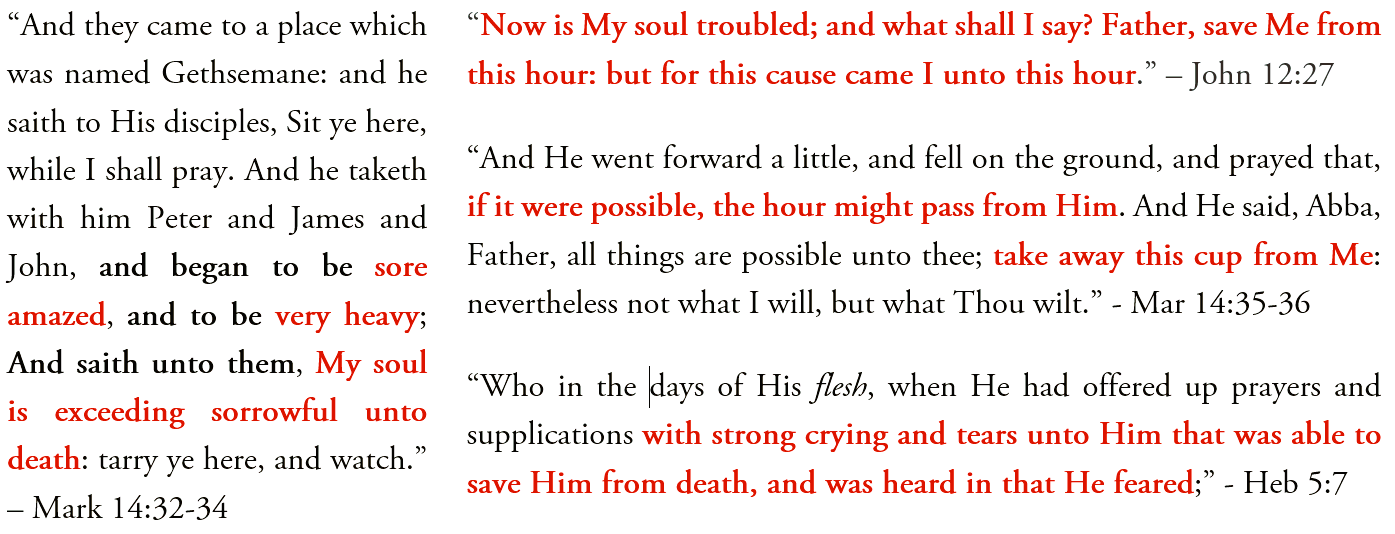
“Then cometh Jesus with them unto a place called Gethsemane, and saith unto the disciples, Sit ye here, while I go and pray yonder. And he took with him Peter and the two sons of Zebedee, and began to be sorrowful and very heavy. Then saith he unto them, My soul is exceeding sorrowful, even unto death: tarry ye here, and watch with me. And he went a little further, and fell on his face, and prayed, saying, O my Father, if it be possible, let this cup pass from me: nevertheless not as I will, but as thou wilt.” – Matt. 26:36-39

“And they came to a place which was named Gethsemane: and he saith to his disciples, Sit ye here, while I shall pray. And he taketh with him Peter and James and John, and began to be sore amazed, and to be very heavy; And saith unto them, My soul is exceeding sorrowful unto death: tarry ye here, and watch. And he went forward a little, and fell on the ground, and prayed that, if it were possible, the hour might pass from him. And he said, Abba, Father, all things are possible unto thee; take away this cup from me: nevertheless not what I will, but what thou wilt.” - Mark 14:32-36

Even though it is impossible for us to grasp a day in the life of an omniscient God, nevertheless, with a worshipful posture, and a bowed heart, the Lord of Glory beckons your attention to Gethsemane that you might gaze upon the Passion of Jesus Christ with understanding. The passionate agony began the moment that the sins of the past, present, and future were placed upon the Lamb of God! At once, an internal conflict of deliberation ensued, which is why the Messiah began to ask the Father that “this cup” would pass from Him. Not even Peter, James, and John were allowed to peer into this intimate moment between the Son and the Father. Nevertheless, this prayer was never intended to be mysterious. What was in the cup? The wrath of God. 
The internal conflict commenced in the Son of God when,
for the love of sinners the Lord Jesus Christ became sin.
For the love of God the Father, the Son deliberated within,
because for the first time ever their relationship was disrupted by sin.

Nothing could compare to God the Father’s love for the Son,
and yet now the LORD burned in wrath against this very One.
In love for sinners God was pleased to satisfy justice & bid men come,
otherwise this painful transmission of sin would not have been done.
“It [the cup] was a something inconceivably terrible and amazingly full of dread – which came from the Father’s hand. This removes all doubt as to what it was…” – C.H. Spurgeon, The Agony in Gethsemane
Jesus Christ was fully Man. Nevertheless, He could not ever cease to be God. Therefore, in being God as a Man, Jesus Christ was able to look upon the situation at hand with omniscient eyes. Through an omniscient comprehension of the past, Jesus Christ knew exactly what kinds of sins and how many of them were committed since the beginning of the world. Through the infinite power of divine foresight, Jesus Christ knew exactly what kinds of sins and how many of them would be committed in the future. Think about the horror of all that was easily perceivable with the eyes of omniscience in the fateful hours of agony spent in Gethsemane. The depravity! In its totality! The crushing sense of its enormity! It would have been enough to kill the Man. 
“And he was withdrawn from them about a stone's cast, and kneeled down, and prayed, Saying, Father, if thou be willing, remove this cup from me: nevertheless not my will, but thine, be done. And there appeared an angel unto him from heaven, strengthening him. And being in an agony he prayed more earnestly: and his sweat was as it were great drops of blood falling down to the ground.” - Luke 22:41-44
Every minute of the dark night in Gethsemane, second by second, was momentous from the personal vantage point of Jesus Christ; when moments earlier the sinless Son of God enjoyed the undimmed brightness of the Father’s happy countenance, ever looking down upon Him from above, and then in an instant the Face of God became angry, and the full force of divine wrath was being projected toward the Person of Jesus Christ from this point onward until death. What a dreadful sight was in the eye of the beholder! One mortal man’s sins alone are strong enough to drown a person in sorrow and sink the soul into hell through divine wrath. Literally, what happened to the rebellious prophet Jonah (Jonah 2:1-10) did spiritually and emotionally happen to David (Ps. 18:4-6, 31:9-10, 40:12, 116:3), and many others (Ps. 88:1-18, 102:1-12). Therefore, what should we expect to see when the sins of all mankind are placed upon one Man? 

Sins in Totality, Individually, Personally, Situationally, Historically, Timelessly, & Quantifiably

The quantifiable total of sins committed throughout all time would have been known in a literal number by the Son of God while in the throes of Gethsemane. The vast and unimaginable quantity would have been collectively perceived in a single numerical figure. Meanwhile, and simultaneously, there would have been an abiding sense of omniscience enabling the Son of God to have a present and timeless awareness of the acute horror of every sin committed individually all throughout time. This is an infinite power of divine knowledge that is so profound and clear, it is as if nothing at all that has ever been thought, said, or done by sinners is something that is removed from God, in the sense that it is a past tense event.

Nothing fades with time or becomes blurry in the memory of God. No relief is given to an omniscient God with the passing of time. The thoughts, feelings, and emotions in the words and acts of every sinner who has ever existed in every second, minute, and hour of every day of their mortal lives, is as real today as it was in the moment that these sins were committed in the past. The same could be said about the personal experience of God today concerning the sins that will be committed in the future. The weight and enormity of what took place at Gethsemane, and in the forthcoming events, climaxing in the Cross of Calvary, cannot be compared to the thoughtless amorality of a beast who is forcibly slain as an Atoning sacrifice. As the spiritual eyes of the Lamb of God looked backward, forward, and upward – in a unique moment of Humanity, when this Man peered into the things of infinity – the Messiah deliberated in the throes of sorrow and learned obedience by the things which He suffered (Heb. 5:8). 

“He went away again the second time, and prayed, saying, O my Father, if this cup may not pass away from me, except I drink it, thy will be done.” – Matt. 26:42

“Though he were a Son, yet learned He obedience by the things which He suffered; And being made perfect, He became the author of eternal salvation unto all them that obey Him;” – Heb. 5:8-9
In a flash the eternal fire of divine wrath was visibly ignited, while the Son of God was looking up, He agonized to see it excited! Then as hesitation turned into determination Jesus Christ became frightened, lest the mortal body of the Man should fail before salvation was merited.
The human body of the Son of God simply could not endure the sorrow of it all. Literally, the Messiah began to suffer from a rare medical condition called, Hematidrosis, or bloody sweat. Credible medical documentation about this condition was available even in the 1800’s during Spurgeon’s time. 
“The old physician, Galen, gives an instance in which, through extremity of horror, an individual poured forth a discolored sweat, so nearly crimson as, at any rate, to appear to have been blood. Other cases are given by medical authorities.” – C.H. Spurgeon, The Agony in Gethsemane
We don’t need to rely upon old physicians and ancient records in the medical field. The research of modern science confirms the same findings about Hematidrosis. 
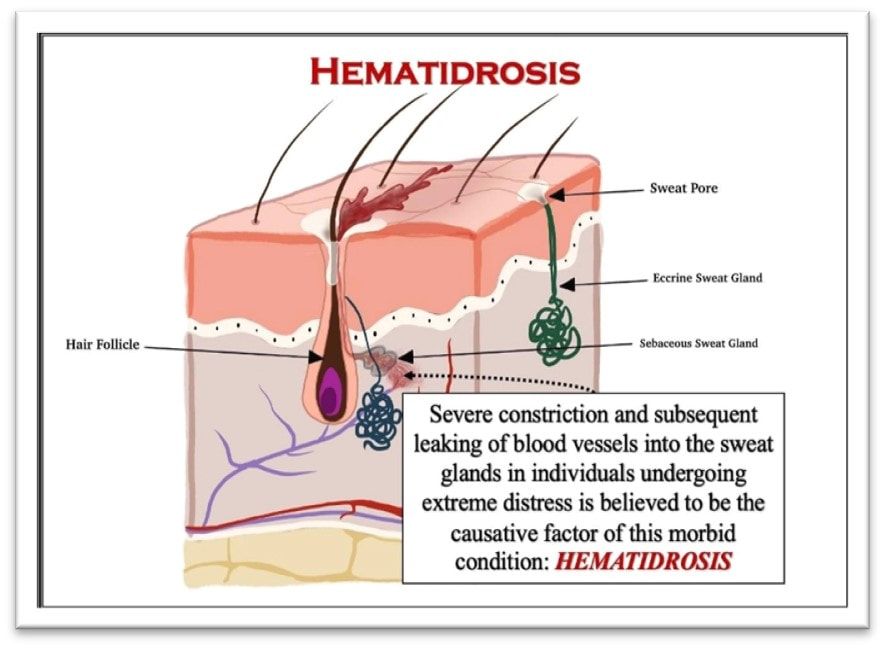
“Hematidrosis is a well-documented physical condition characterized by at least one occurrence of bloody-sweat excretion from intact skin. Hemoglobin concentration in the blood sweat is lower than that which would typically be found in blood, which indicates a dilution of blood through the contents of sweat (Wang (2021)). The bleeding is thought to originate from blood leakage from ruptured capillaries into sweat glands (Kluger (2018)). Bleeding from other causes, and clotting and blood platelet disorders are often ruled out in case study examinations, and is seen to occur from various locations including the face, forehead, eyes, ears, umbilicus, upper and lower limbs, abdomen, extremities, mouth, and tongue (Kluger (2018)). Intense fear, stress, and mental complications, such as that experienced through the breaking apart of families, the loss of a loved one, or within inmates on death-row, are said to be the significant causative factors according to an older study of 76 cases, as well as a systematic review of 25 known cases of hematidrosis occurring from 1996 to 2016 (Holoubek (1996), Kluger (2018)).”
Picture
“When a person is undergoing intense emotional distress, fear, or anguish, the amygdala in the brain is activated, leading to the release of stress hormones cortisol and adrenaline which dilate the airways and constrict the blood vessels so as to target more blood to vital organs. Severe constriction and subsequent leaking of blood vessels into the sweat glands in individuals undergoing extreme distress is believed to be the causative factor of this morbid condition (Duffin, 2017). The fact that the sweat of Jesus was as “great drops of blood” supports His declaration that His soul was “exceeding sorrowful, even unto death”, in that the magnitude of His sorrow was affecting the physical estate of His body so much that it would kill Him, if not for divine intervention, as is indicated by the angel from heaven which appeared to strengthen Him (Lk. 22:43).” – Dr. Preethi Morris
As a deadly force of unimaginable sorrow was distressing the Man, the Son of God recognized what was happening to Him, and said, “My soul is exceeding sorrowful, even unto death” (Matt. 26:38). The Lord was honestly describing what was happening without exaggeration. “The travail was enough to kill Him…” (C.H. Spurgeon, The Suffering of Christ Satisfied). Therefore, literally, not figuratively, as Jesus agonized in prayer, “His sweat was as it were great drops of blood falling down to the ground” (Lk. 22:44). 
“‘Tis midnight, and on Olive’s brow
the star is dimmed that lately shone.
‘Tis midnight; in the Garden now
the suff'ring Savior prays alone.
 
‘Tis midnight, and from all removed,
Immanuel wrestles ’lone with fears.
E’en that disciple whom he loved
heeds not his Master’s grief and tears.
 
‘Tis midnight, and for others’ guilt
the Man of Sorrows weeps in blood.
Yet he who hath in anguish knelt
is not forsaken by his God.”
– William B. Tappan

In suffering Hematidrosis, Jesus Christ was brought beyond the threshold of sorrow that a mortal Man could endure. Therefore, in realizing that He was about to die, the Messiah prayed to God for a supernatural strengthening of His mortal body, lest He fail to take the sins of the world to the Cross. 
“Who in the days of his flesh, when he had offered up prayers and supplications with strong crying and tears unto him that was able to save him from death, and was heard in that he feared;” – Heb. 5:7

“And there appeared an angel unto Him from Heaven, strengthening Him.” – Lk. 22:43
“Scripture implies that our Lord was assailed by the fear that his strength would not be sufficient. He was heard in that he feared. How, then, was he heard? An angel was sent unto him strengthening him. His fear, then, was probably produced by a sense of weakness. " – C.H. Spurgeon, Gethsemane
The prayers recorded in Hebrews 5:7 are categorically different than the wrestle about the cup. The requests being made in Hebrews 5:7 are not the same requests as the three times Christ asked about the possibility of not drinking the cup. There was a moment in Gethsemane when the Son of God came into full subjection to drink the cup (Matt. 26:42, Jn. 18:11-12), and thus the internal conflict within our Lord was over. It was then that the earnest prayers of Hebrews 5:7 were offered for fear of dying from sorrow prematurely, before making it to the Cross. 
“As the mighty mass of their guilt came rolling upon Him, His Father saw that the Human soul and the Human body both needed to be upheld, otherwise they would have been utterly crushed before the Atoning work had been accomplished.” – C.H. Spurgeon, The Weakened Christ Strengthened 
Thus did God send an angel to miraculously uphold the failing body of Jesus Christ as the weight of the whole world was put upon His shoulders. If Jesus would not have prayed to be saved from an untimely death in Gethsemane, He would have died right then and there! The brave and perfect soul of our Redeemer feared this outcome and by the grace of God it was prevented. Conclusively, the Son of God was not praying to be saved from the Cross; rather, He was praying to be saved from death in Gethsemane so that He could take the sin of the world to the Cross for the accomplishment of an Atonement. 

Internal Conflicts in the Godhead

While peering into Gethsemane, Spurgeon described what he saw by saying that Christ was wrestling in a contest of terrible combat. Do you agree? At the same time, Spurgeon asked an important question: “With whom did He wrestle?”. Spurgeon very boldly answered the question, saying, “I believe it was with Himself.”. This is an internal conflict. 
“He did not die in the Garden, but He suffered as much as if He had died. He endured death intensively, though not extensively. It did not extend to the making His body a corpse, but it went as far in pain as if it had been so. His pangs and anguish went up to the mortal agony and only paused on the verge of death. Luke, to crown all, tells us in our text, that our Lord was in an agony. The expression, “agony,” signifies a conflict, a contest, a wrestling. With whom was the agony? With whom did He wrestle? I believe it was with Himself. The contest here intended was not with His God – no – “not as I will but as You will,” does not look like wrestling with God. It was not a contest with Satan, for, as we have already seen, He would not have been so sorely amazed had that been the conflict. It was a terrible combat within Himself, an agony within His own soul.” C.H. Spurgeon, The Agony in Gethsemane
​

“Nothing causes a man more torture than to be dragged here and there with contending emotions. As civil war is the worst and most cruel kind of war, so a war within a man’s soul, when two great passions in him struggle for the mastery, and both noble passions, too, causes a trouble and distress which none but he that feels it can understand.” – C.H. Spurgeon, The Agony in Gethsemane

Any sensible reader of Gethsemane will immediately realize that Jesus Christ was struggling with some kind of internal conflict in the Garden. However, this thought can be troublesome to some believers because they have no concept of this ever happening to God in the Bible. This oversight then forces the hand of interpreters to provide an explanation without focusing on the Divinity of Christ in this awful moment of struggle. Theologians then oversimplify the issue by focusing solely on the Manhood of Christ. However, clearly, the internal conflict of Jesus Christ originated from Divinity, while being brought to the brink of death (as a consequence of the Passion) originated from Humanity.

Internal conflicts in the Godhead happen when there is a tension between two contrary righteous desires in the holy heart of God. Some people deny that this is even possible, even though it happened all throughout biblical history. On one such occasion, the LORD said: “Mine heart is turned within Me, My repentings are kindled together.” (Hos. 11:8-9). This turning of the divine heart, or kindling of repentances, reveals a holy indecisiveness in the heart of God. 

“How shall I give thee up, Ephraim? how shall I deliver thee, Israel? how shall I make thee as Admah? how shall I set thee as Zeboim? mine heart is turned within me, my repentings are kindled together. I will not execute the fierceness of mine anger, I will not return to destroy Ephraim: for I am God, and not man; the Holy One in the midst of thee: and I will not enter into the city.” – Hos. 11:8-9
In this case, God was wavering between two contrary desires: wrath & love. The wrath was motivated by justice. The love was motivated by mercy. Firstly, the LORD desired to totally annihilate Israel in a consumption, making her like the cities of Admah and Zeboim; these were neighboring cities of Sodom and Gomorrah that were annihilated by fire. Secondarily, the LORD desired to have mercy upon Israel for the greater good of the Name of God.

The same thing can be observed in Exodus 32:1-34:35. Firstly, the LORD desired to totally annihilate Israel in a consumption (Ex. 32:10); with great restraint the LORD refused to come into “the midst” of the people for fear that He would “consume” them in a moment (Ex. 33:3, 5). Secondarily, the LORD desired to have mercy and revive the Mosaic Covenant for the greater good of the Name of God (Ex. 32:11-14); this revival will be signified by the remaking of what was broken, which of course is the Tables of the Covenant (Ex. 32:15-20, 34:1-2, 27). Explicitly, this situation was described by God to be a period of divine indecisiveness, in the word delivered to Israel: 

“For the LORD had said unto Moses, Say unto the children of Israel, Ye are a stiffnecked people: I will come up into the midst of thee in a moment, and consume thee: therefore now put off thy ornaments from thee, that I may know what to do unto thee.” – Ex. 33:5
Literally, the repentings of God were kindled together, and therefore the LORD was turning or wavering amidst two strong contrary righteous desires. As the LORD thought and said one thing (Ex. 32:10), and then turned again in repentance (Ex. 32:12, 14), though not fully to the restoration of the Mosaic Covenant (Ex. 33:1-6), Moses was determined to intercede: to stand before the wrath of God and settle the internal conflict of the LORD. Amazingly, as a type of Christ, Moses ascended the holy Mount and tried to offer himself as an atoning sacrifice (Ex. 32:30-35)! 
“And it came to pass on the morrow, that Moses said unto the people, Ye have sinned a great sin: and now I will go up unto the LORD; peradventure I shall make an atonement for your sin. And Moses returned unto the LORD, and said, Oh, this people have sinned a great sin, and have made them gods of gold. Yet now, if thou wilt forgive their sin; and if not, blot me, I pray thee, out of thy book which thou hast written.” – Ex. 32:30-32
In respect to Christology, this is the most important moment of the whole ordeal recorded in Exodus 32:1-34:35. Why? The man, Moses, was willing to sacrifice himself! But of course, his request was denied by the Father. This will prove to be an important divine message as it directly precedes the events which follow; not the least of which is the very first divine declaration of sovereign mercy, in the words, “I…will be gracious to whom I will be gracious, and will shew mercy on whom I will shew mercy.” (Ex. 33:19); the same statement that the apostle Paul quoted in Romans 9:15. Suffice it to say, this whole episode was orchestrated by God to shed light on the desire of all ages: Jesus Christ the Righteous (1 Jn. 2:1-2; Jer. 23:6). The storyline of these events bears witness to the coming of one greater than Moses (Deut. 18:15-19).

Sinai and Gethsemane present to us two scenes that are in striking contrast. Lo, and behold, Moses was willing and Jesus Christ was momentarily unwilling! Can you believe it? Furthermore, the Father denied the former and encouraged the latter. There must be something vastly different in the two scenarios. Right? Make no mistake about it! Moses’s request was not courageous; it was ignorant. Even the most saintly men sometimes speak amiss on holy mountains (Lk. 9:32-36). Nevertheless, we can be sure that Moses’ reckless request was motivated by love (Rom. 9:1-3), even though he didn’t know what he was asking for.

How could he have known that he was unfit for the task? Moses supposed that even animals could make an Atonement for men. Therefore, logically speaking, seeing that he was much more valuable than a beast, Moses thought he could make an Atonement on behalf of others. Of course, he didn’t even know that none of the animal sacrifices of history were meritoriously successful in making an Atonement. Nevertheless, a heartbroken God made Moses desperate enough to push the limits of what was conceivably possible. A staggering account of intercession follows.

Moses’ ascension up Mount Sinai was far too low an altitude for the job (Heb. 8:1-5, 9:23-28), and his life as an intercessor was far too short (Heb. 7:25). Nevertheless, the clumsy and ignorant Prophet proceeded to ascend Mount Sinai yet again (Matt. 11:11), after being denied at the first, and this time he saw God (Ex. 33:18-23). Then Moses continued there in intercession for 40 days & 40 nights without food or water before the burning heat of the divine wrath (Ex. 34:28; Deut. 9:18-19, 25, 10:10; Ps. 106:23)! Only then was the internal conflict of God settled. How can it be? 
“And I fell down before the LORD, as at the first, forty days and forty nights: I did neither eat bread, nor drink water, because of all your sins which ye sinned, in doing wickedly in the sight of the LORD, to provoke him to anger. For I was afraid of the anger and hot displeasure, wherewith the LORD was wroth against you to destroy you. But the LORD hearkened unto me at that time also.” – Deut. 9:18-19

“Therefore he said that he would destroy them, had not Moses his chosen stood before him in the breach, to turn away his wrath, lest he should destroy them.” – Psalm 106:23

Credit should be given to Jesus Christ for this ancient exploit of intercession. Jehovah would not have countenanced Moses at all without the coming of Jesus Christ! This being the case, how do you think Moses felt during these 40 days & nights of intercession before the fury of divine wrath? Earlier, Moses felt well able to face the wrath of God in the sacrifice of himself for an Atonement (Ex. 32:30-32), and so it stands to reason that the man felt okay. The situation was mild in comparison to what was happening to Jesus Christ in the Garden of Gethsemane. Apparently, no intercessory experience that Moses had leading up to this point would have made him believe he couldn’t face the wrath of God; otherwise, he wouldn’t have asked for it. The man couldn’t even fathom what he was asking.

Moses had not ever endured even 1 second of divine wrath on behalf of anyone. Literally the experience was personally unimaginable to the man. Intercession is the act of standing in between the wrath of God and the endangered targets, so as to turn it away, or pacify it; and Moses along with all the saints of the Old Testament were saved and subsequently used by God solely on the basis of faith in Christ (presented to them in typological shadows). Therefore, neither Moses, nor any other intercessor throughout history, could endure even one second of the divine wrath that Jesus Christ suffered.

Legally, spiritually, and meritoriously, their intercessory experiences were categorically different. Moses, the Seer, had never seen anything like what happened to Jesus Christ. Emmanuel is the one and only Intercessor ever to exist that absorbed the wrath of God! This is a categorially different kind of intercession through personally becoming a Substitutionary Sacrifice. Everyone else is just a sinner saved by grace. Even the most noble Prophets, like Moses, needed protection from the Glory of God just to survive it (“Behold, there is a place by Me…I will put thee in a clift of the rock, and will cover thee with My hand while I pass by” – Ex. 33:21-22). However, Jesus Christ was the sinless Son of God, who alone was capable of legally and ceremoniously receiving into His body the imputation of sin; and hereby Jesus Christ embodied everything that God hated about sinful mankind and thus became an Atoning Sacrifice that received and satisfied divine wrath.

Harmoniously, nothing that any Prophet ever suffered was meritorious on behalf of anyone else. Not even Moses’ fasting and praying for 40 days & nights before the burning heat of divine wrath on Sinai! Why? Because only the merit of Jesus Christ can pacify the wrath of God. In other words, Moses’s prophetic intercession on Sinai was void of any legal merit before the throne of God. Therefore, Moses’ intercession for 40 days & nights without food & water was easy in comparison to the ≈15 to 17 hours of Jesus from Gethsemane to the Cross. 

The Sinless Son of God Legally Became a Sinner

The mystery of the Passion is diffused when the situation is viewed as a legal arrangement in which justice dictates that sinners deserve wrath. The legal framework of justice governed every detail of the Atonement. 
“Do you wonder that His infinite purity started back from that? Would He have been what He was if it had not been a very solemn thing for Him to stand before God in the position of a sinner? Yes, and as Luther would have said it, to be looked upon by God as if He were all the sinners in the world, and as if He had committed all the sin that ever had been committed by His people – for it was all laid on Him and on Him must the vengeance due for it all be poured. He must be the center of all the vengeance and bear away upon Himself what ought to have fallen upon the guilty sons of men. To stand in such a position, when once it was realized, must have been very terrible to the Redeemer’s holy soul.” – C.H. Spurgeon, The Agony in Gethsemane
However, some important questions may arise when people begin to think about the sinless Son of God legally becoming a sinner. We have all read about the imputation of sin that took place in the animal sacrifices of the Old Testament. People know it exists. However, things are radically different when thinking about how an immaculately born Savior legally became a sinner in our stead. 
“For He hath made Him to be sin for us, who knew no sin…” – 2 Cor. 5:21

“For what the law could not do, in that it was weak through the flesh, God sending His own Son in the likeness of sinful flesh, and for sin, condemned sin in the flesh:” – Rom. 8:3

“By the which will we are sanctified through the offering of the body of Jesus Christ once for all.” – Heb. 10:10

“Who His own self bare our sins in His own body on the Tree…” – 1 Pet. 2:24

The imputation of sin into Jesus Christ was a real event of human history that should be understood as something objective, dogmatic, and factual. It is not fantastical, hypothetical, theoretical, or philosophical. Therefore, the counsel of God in Scripture will act as a microscope to bring unseen things into focus. Legally becoming a sinner in this way should not be mistaken with the personal experience of sinners in the world. Understandably, things are different when the sinless Son of God was made “to be sin” through imputation (2 Cor. 5:21). 
Did Jesus Christ legally become a sinner and suffer the wrath of God in a nominal way, just like everyone else who has sinned suffers the wrath of God? No.

Did Jesus Christ legally become a sinner in a unique way that is exclusively possible for the one and only sinlessly perfect Man? Yes. 

The Apostle Paul put emphasis on the condemnation of sin “in the flesh” to provide clarity on this important issue (Rom. 8:3). The Apostle Peter made the same emphasis when describing how sin was borne by Jesus Christ “in His own body” (1 Pet. 2:24). Literally, this means that the imputation of sin went into the body of Jesus Christ, and in the process of transmission the soul of the Son of God remained untouched, untainted, and without pollution. The sin that was put upon the sacred body did not defile the soul. In legal terminology, we are talking about the “putting” or the placement of sin upon the body through imputation (Lev. 16:21).

Ordinarily, sinners are spiritually blind haters of the LORD, and in suffering divine wrath they are alienated from God (Jn. 3:19-20; Rom. 8:7-8; Eph. 4:17-19). Not so with Christ! Once again, this is because Jesus Christ was sinless. Therefore, sin did not turn the heart of the Son against the Father, nor did it blind the eyes of Jesus Christ from spiritual things. Experientially, this is a night and day difference (Jn. 12:35)! Sinners hate God and suffer divine wrath without even knowing it! Whereas Christ loved God and suffered divine wrath while fully seeing, knowing, and embracing everything that was happening to Him. Howbeit, even He was made to stagger for a brief time before coming to this unwavering resolve. 

The Eternal Spirit of the Son Made the Offering: Upon Legally Becoming a Sinner, Jesus Christ Courageously Faced the Wrath of God!

The Eternal Spirit of the Son deserves the credit for courageously facing the wrath of God on our behalf. So much is said about the Manhood of Christ in the Passion, but it was the Divinity of Christ that made everything possible. 
“How much more shall the blood of Christ, who through the Eternal Spirit offered Himself without spot to God, purge your conscience from dead works to serve the Living God?” – Heb. 9:14
The reasons for the internal conflict of the Son of God are evident. This situation in Gethsemane was totally unprecedented, even for the 2nd Person of the Trinity (Heb. 5:8-9), and this was just the beginning of the Passion. The suffering would continue until the Atonement was completed in death on the Cross. 
The Internal Conflict of Jesus Christ: God had never become a Man before until the incarnation; and this Man had never legally become a sinner before until the imputation (2 Cor. 5:21). With an infinite hatred for sin, Jesus Christ didn’t want to legally become a sinner; with an infinite love for the Father, Jesus Christ didn’t want to come under divine wrath; contrastingly, in love for the Father, Jesus Christ wanted to follow through with the divine plan that they had agreed upon since before the foundation of the world; and, in love for sinners, Jesus Christ wanted to save them from divine wrath to the uttermost. 
This conflict is apparent when viewing this scene with the legal arrangement of divine justice in mind. Justice dictates that sinners deserve wrath. This internal conflict came to an end when the Son of God submitted to the Father with unwavering resolve. The Eternal Spirit of the Son was lionlike in courage and fully capable of facing the wrath of God even when the human body of Jesus wasn’t cooperating because it was physically incapable of enduring the anguish. In other words, it was the Lionlike Spirit of the Son that prevailed in the throes of divine wrath by bringing the body and soul of Jesus Christ into subjection to the will of the Father. “Behold, the Lion of the Tribe of Judah, the Root of David, hath prevailed…” (Rev. 5:5)! Neither men nor angels deserve any credit in this dreadful moment between the Son and the Father. Credit should be given to the Godhood of Jesus Christ for persevering even when the Manhood collapsed and was ready to die. 
“He was enduring, at that time, what we ought to have endured – and He was draining the cup which Justice had mingled for us. Did He start back from it? Oh, no! When He first came to drink of that wormwood and gall in the Garden, He put it to His lips and the draught seemed, for an instant, to stagger even His Strong Spirit. His soul was exceedingly sorrowful, even unto death. He was like one demented, tossed to and fro with inward agony. “My Father,” He said, “if it is possible, let this cup pass from Me.” Three times did He utter that prayer, while every portion of His Manhood was the battlefield of legions of griefs! His soul rushed out at every pore to find a vent for its swelling woes! His whole body became covered with gory sweat.

After that tremendous struggle, the strength of Love mastered the weakness of Manhood – He put that cup to His lips and never shrank – He drank right on till not a drop was left! And now the cup of wrath is empty – no trace of the terrible wine of the wrath of God can be found within it! At one tremendous draught of love the Lord drank destruction dry, forever, for all His people. “Who is he that condemns? It is Christ that died, yes, rather, that has risen again.” And “there is therefore now no condemnation to them that are in Christ Jesus, who walk not after the flesh but after the Spirit.” – C.H. Spurgeon, The Crown of Thorns

The intimate moments of divine anguish in Gethsemane are breathtaking. The Son of God did not run away from the Father in distress; rather, while knowing that the fiery sword of divine justice had been unsheathed by the Father, the Man went directly to the Father; even though the mighty sword was visibly reared for the slaughter, the Son of God acquiesced to the stroke of justice, only that the sword might be buried in His bosom and forever quenched! Neither did the Father turn away from the Son. For, it was written, 
“Then saith Jesus unto them, All ye shall be offended because of me this night: for it is written, I will smite the Shepherd, and the sheep of the flock shall be scattered abroad.” – Matt. 26:31 (Mk. 14:27, Jn. 8:28-29, 16:32; Zech. 13:7)

“Behold, the hour cometh, yea, is now come, that ye shall be scattered, every man to his own, and shall leave Me alone: and yet I am not alone, because the Father is with Me.” - John 16:32
“The sheep were all scattered and the Shepherd was left alone, thus fulfilling the ancient prophecy, ‘Smite the Shepherd and the sheep shall be scattered.’ And that other word, ‘I have trodden the winepress alone; and of the people there was none with me.’ – C.H. Spurgeon, Jesus in Gethsemane 
​
“Yet is pleased the LORD to bruise Him; He hath put Him to grief:” - Isa. 53:10

As you can see, the Father turned toward the Son: the furious eyes of divine justice were focused upon the Son in the pouring out of divine wrath in full force! However, even it, being poured out in full, and exhausted, could not stop the Son of God! The Man emerged victorious, and proceeded forth out of Gethsemane, and the face of divine justice smiled to see the Champion of Mankind absorb it all until it was finished at the Cross (Jn. 19:30). 
“Who hath believed our report? and to whom is the arm of the LORD revealed?” – Isa. 53:1

“And He saw that there was no man, and wondered that there was no intercessor: therefore His arm brought salvation unto Him; and His righteousness, it sustained Him.” – Isa. 59:16

Credit should be given where it is due. No one else, neither men nor angels, could face the wrath of the Father and absorb it! Literally, it is impossible. Only the Son of God could do it! Therefore, in Gethsemane, Jesus Christ came into subjection to the Father by Himself, alone, without anyone else helping Him (Jn. 10:17-18). Like an immovable granite mountain, the righteous, eternal, and uncreated soul of the Son of God sustained the Man, Jesus Christ, in the decisive moment of subjection to the Father in Gethsemane, and from thereon out for the next ≈15 to 17 hours until it was finished on the Cross (Heb. 9:14).

Without controversy, neither men nor angels even understood what Jesus Christ was personally reckoning with – face to face – in the Garden of Gethsemane. How could they (Jn. 1:18)? Furthermore, theoretically speaking, even if they could, no one else would ever face the wrath of God as a Lamb to the slaughter. Only the Son of God would do it! The myriads of angels in Heaven are in resounding agreement. Just one glimpse of what the Messiah was personally seeing and feeling would have been enough to annihilate anyone who would dare to face it. Therefore, not even an angel sent from Heaven could help strengthen the spiritual resolve of Jesus Christ. This would be an affront to the Gospel.

“And there appeared an angel unto Him from Heaven, strengthening Him.” – Lk. 22:43
​
“This was the Father’s reply to the cry of His fainting Son who was enduring an infinity of sorrow because of His people’s sin and who must, therefore, be Divinely upheld as to His Manhood, lest He should be utterly crushed beneath the terrible weight that was pressing upon His holy soul.” – C.H. Spurgeon, The Weakened Christ Strengthened

The fine details of what really happened here reinforces the message of the Gospel, rather than undermining it. Jesus Christ was in dire need of physical strength. A physical problem was manifesting because of the spiritual storm of divine wrath that was descending upon the Man in Gethsemane. However, Jesus had not yet suffered any physical wounds or bodily ailments at the hands of sinners. Nevertheless, His body was already failing! The Messiah was sorely suffering under divine wrath, and it was already pummeling Him to the ground. “And He went forward a little, and fell on the ground…”  (Mk. 14:35)! Therefore, an angel flew swiftly to meet the physical need that was besetting the weakened Man of omnipotence. The mortal body of Jesus Christ was not cooperating because it could not endure the spiritual force of crushing wrath amidst the throes of unspeakable sorrow.
“And as they came out, they found a man of Cyrene, Simon by name: him they compelled to bear His cross.” – Matt. 27:32
Neither the actions of this angel nor that of Simon the Cyrenian are an affront to the Gospel. Even though this is an unworthy comparison, as we can be sure that the angel helped Jesus Christ much more than Simon of Cyrene; nevertheless, they both offered physical aid to the body of our Lord in a time of need. However, when the angel miraculously strengthened the failing body of Jesus Christ, while rendering no aid or benefit to the Man spiritually, this expanded the physical possibilities of what the Son of God could endure in a human body, further revealing the deadly force of what was being spiritually experienced at the time. The scope of human suffering was hereby physically enlarged to absorb what no other man could endure.

From Gethsemane to Calvary, the Son of God proceeded to wade through a fatal force of divine wrath, while physically being debilitated in the sorrow of it, until He expired in it on the Cross. Literally, what almost killed the Son of God in the beginning, at Gethsemane, is what finally killed Him in the end, at Calvary. This speaks volumes about the signature death of Jesus Christ according to the Gospel of the Evangelists in Matthew, Mark, Luke, & John. This near-death-experience happened at the very beginning, so that we would be in no doubt about what happened in the end. This is how Jesus Christ died for sinners. 

0 Comments

The Passion Began in the Garden of Gethsemane

4/19/2023

0 Comments

 
Picture

Article #4 on the Passion of Jesus Christ 

“…I am persuaded that the Passion began in Gethsemane.”
– C.H. Spurgeon, Christ in Gethsemane

The scenes of Gethsemane presented by the Evangelists are shocking. Stop and look here for a little while and you will find many learned men silently gazing in admiration and wonder. Famous orators are speechless to explain the mysteries of Gethsemane. 
“We have thus come to the gate of the Garden of Gethsemane, let us now enter – but first, let us take off our shoes, as Moses did, when he saw the bush which burned with fire and was not consumed. Surely we may say with Jacob, ‘How dreadful is this place!’” – C.H. Spurgeon, The Agony in Gethsemane

“May we not conceive that as in a garden Adam’s self-indulgence ruined us, so in another Garden the agonies of the second Adam should restore us? Gethsemane supplies the medicine for the ills which followed upon the forbidden fruit of Eden. No flowers which bloomed upon the banks of the four-fold river were ever so precious to our race as the bitter herbs which grew hard by the black and sullen stream of Kidron.” – C.H. Spurgeon, The Agony in Gethsemane

The Garden of Gethsemane was chosen by God. Readers of the Gospels are made to pass through here before ascending Calvary to gaze upon the Cross. Behold, the suffering of One who is mighty in battle! “Who is this King of glory? The LORD strong and mighty, the LORD mighty in battle.” (Psalm 24:8). There is a fight in every conflict. There is a battle in every war! But there is a beginning and ending to every one of them. The last battle of the war often brings to bare the most dangerous and destructive weapons in the arsenal. The onslaught is so gory and gruesome that the warriors wouldn’t dare to write down the details.

If indeed, here, in the Garden of Gethsemane, the sins of the world were imputed into the body of Jesus Christ for the very first time, then this is the beginning of the greatest conflict the world has ever seen. It begins at Gethsemane and ends at Calvary. However, mysteriously, the Garden of Gethsemane was conspicuously absent of any human adversary when Jesus Christ entered into the throes of sorrow! No wonder. The legal proceeding of imputation isn’t something that brings conflict man to man. This is where the conflict between God and man is shifted to a Substitutionary Sacrifice. The divine wrath which was restrained will then be suddenly released, and in the annihilation of the Sin-Burdened Sacrifice it will be exhausted; this brings the holy heart of an angry God to a place of sweet and solemn satisfaction at justice being served. 
“Now the mere dying you could bear, as martyrs have done, but not the dying with all that weight of sin legally placed upon you! Oh, who can tell what must have been the horror which took hold upon the Savior, and how true must have been His expression when He said, “My soul is exceedingly sorrowful, even unto death”? The Holy One in the sinner’s place! An angel in a dungeon! The God of Heaven veiled in human flesh to be hung upon the gallows as a malefactor–start as you think of it and then try to conceive, if you can, what must have been the horror of His soul!” – C.H. Spurgeon, The Suffering Christ Satisfied
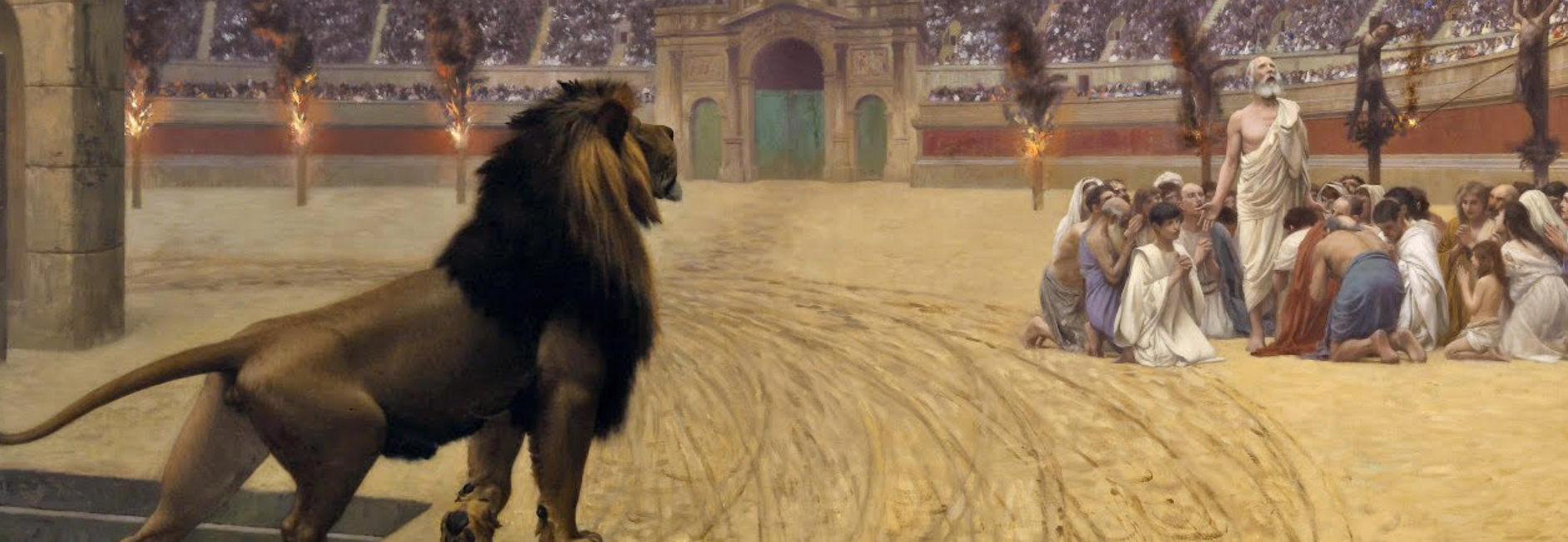
Consider the circumstances from the vantage point of the sinless Son of God. Every stormy tempest has its first clap of lightning and then the roaring of thunder. The flash of the same can be seen from east to west. The imputation of sin in the Garden marks the beginning of something men and angels had never seen before! Something changed in the heaven above. A great storm of divine wrath suddenly began to break upon the head of the Son of God! Even so, a comprehension of this divine storm is needed to correctly interpret what was happening on earth below from Gethsemane to Calvary. The suffering and death of Christ and the martyrs of Church History is a helpful comparison. 
Picture
Granted, the earthly elements of suffering weren’t pleasant to the righteous soul of Jesus Christ. This is clearly visible during the Passover Feast, how the Messiah was “troubled” in part because of the imminent betrayal of Judas (John 13:21), and how all the other disciples would soon be offended in the process (Matt. 26:31, Mk. 14:27). The fact that the Son of God was “despised and rejected of men” certainly contributed to the sorrow of the whole ordeal (Isa. 53:3, 4). However, the sorrow that was felt coming from the horizontal circumstances is unworthy to be compared to the crushing weight of the vertical situation at hand.

The earthly and human injustice suffered in martyrdom is a load that was easy to be borne by martyrs, for they have seen and beheld the satisfaction of divine justice in Jesus Christ. No matter what they suffer! “If God be for us, who can be against us?” (Rom. 8:31). One man with God is a majority. Earthly hate cannot breach the impregnable gates of Heaven’s love, when God has taken up residence in the souls of redeemed men and women (Jn. 21:18-19). 
“Ye are of God, little children, and have overcome them: because greater is He that is in you, than he that is in the world.” – 1 Jn. 4:4

“Nay, in all these things we are more than conquerors through Him that loved us.” – Rom. 8:37

If sinners raise their hands in violence against martyrs, horizontally, and the physical harm of such brings about death, it pales in comparison to the Arm of God being reared against sinners. When sinners are angry with the saints, man to man, it’s nothing compared to when God is angry with sinners. Even so, martyrdom is mild in this respect, only because “the love of God is shed abroad in our hearts by the Holy Ghost which is given unto us” (Rom. 5:5). However, if the sin of the whole world could be placed upon one sinless Man, then the Arm of God would be raised in violence against that Man! If the full volume of divine wrath against sinners could be concentrated on one Man, vertically, no matter the earthly circumstances of the situation, horizontally, how do you think this Man would feel at such a time? It all began in the scenic and otherwise peaceful Garden of Gethsemane. 
“Tell me, ye who hear Him groaning,
Was there ever
grief like His?
Friends through fear His cause disowning,
Foes insulting his
distress:
Many hands were raised to wound Him,
None would interpose to save;

But the deepest stroke that pierced Him
Was the stroke that Justice gave
.” 

As we approach this dreadful moment in time where Jesus Christ formally and legally became a sinner in the sight of God, and hereby began to justly suffer under the wrath of God, we must come to understand the legal and ceremonious process of imputation according to the Law. 

​Animal Sacrifices in the Old Testament

The transition of the legal identity of the Son of God happened instantly, upon the imputation of sin, as demonstrated in the animal sacrifices of the Old Testament. A basic understanding of this legal process in the Law will enable us to realize the enormity of what took place when the Lamb of God took away the sin of the world. 
“Behold the Lamb of God, which taketh away the sin of the world.” - John 1:29

“And He is the propitiation for our sins: and not for ours only, but also for the sins of the whole world.” – 1 John 2:2

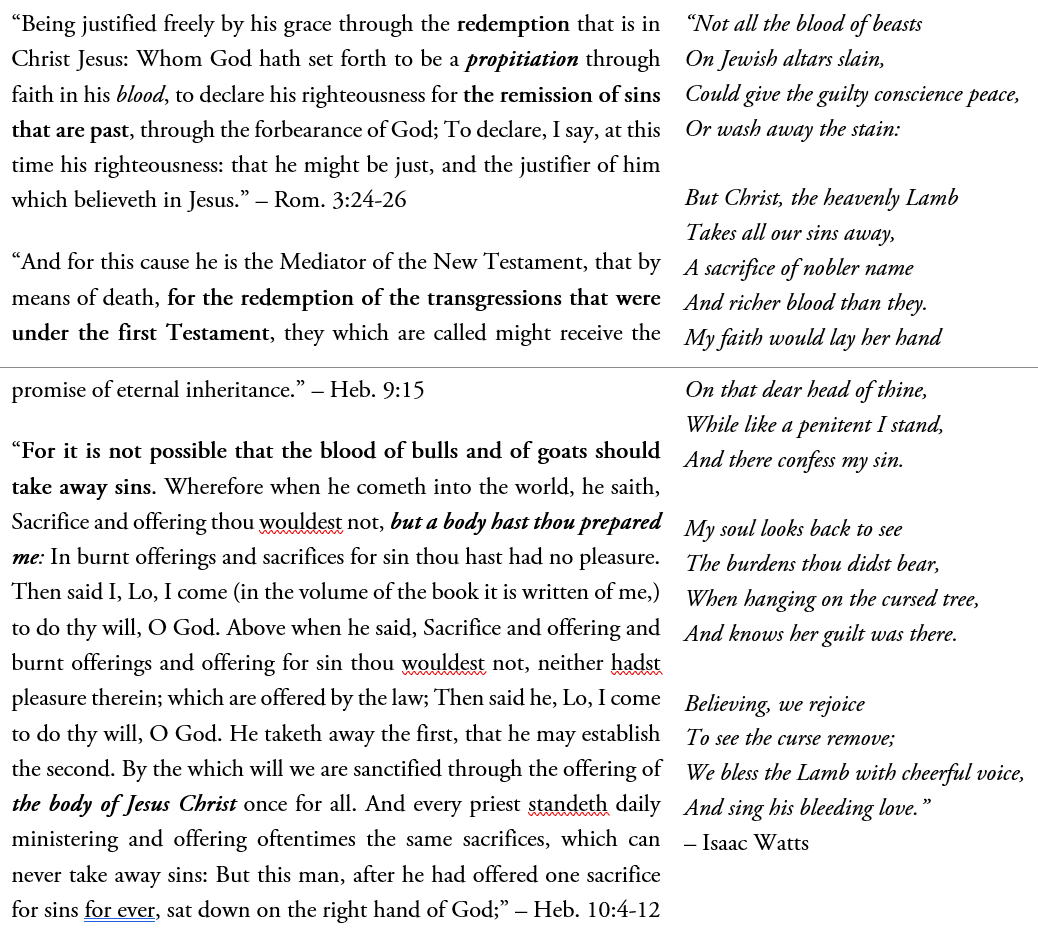
The animal sacrifices of the Old Testament never truly redeemed anyone (Heb. 9:15). Legally speaking, the blood of animal sacrifices never remitted anyone’s sins in the accomplishing of a real atonement before God. However, that doesn’t mean that the LORD didn’t really forgive anyone. Rather, every occasion in which real divine forgiveness was granted at the offering of an animal sacrifice for an atonement (Lev. 4:20, 26, 31, 35; Num. 14:19, 15:25-26), the LORD truly forgave the believers of the Old Testament because they were putting their faith in a message of the Gospel communicated through typological shadows – and hereby they were unknowingly putting their faith in Jesus Christ.

The merit was in the message being communicated to believers, not the actual blood of the beasts being slain. Therefore, God was providentially forgiving mankind by looking ahead – through the power of divine foresight – to the coming of Jesus Christ, who alone has the ability to “take away sins” in an atonement (Heb. 10:4, 11) for the accomplishing of a true and lasting “reconciliation” (Heb. 2:17). 

Picture
The Old Testament sacrificial system was fundamentally problematic (Gal. 3:19). If indeed all the sins of the “past” (Rom. 3:25), namely those which were committed under “the first Testament” (Heb. 9:15), were never truly atoned for or taken away from mankind for the first 4,000 years of Church History, this clearly means that the animal sacrifices of the Old Testament were fundamentally insubstantial. Mere shadows and figures of the real thing would not settle the conflict of divine justice for an eternity (Col. 2:17, Heb. 8:5, 9:9, 24, 10:1, 11:19, Rom. 5:14, 1 Peter 3:21). 
“For the Law having a shadow of good things to come, and not the very image of the things, can never with those sacrifices which they offered year by year continually make the comers thereunto perfect.” – Heb. 10:1
The restraint of the Godhead in these times could be characterized as the divine forbearance of justice. Even though forgiveness was granted, the LORD still had the desire to execute justice; through restraint God withheld His hand in preference to mercy. As long as justice wasn’t truly served, then the inward turmoil of the Godhead persisted until the appointed time when justice would be satisfied at the Cross (Rom. 3:25-26). 

This provisional forgiveness of God was a temporary grant in the middle of an unsolved problem – an allowance that could not continue for too long because it would eventually warrant an accusation of injustice – calling into question the righteousness of God in forgiving sinners. Nothing else but the precious blood of Jesus Christ, the spotless Lamb of God, could substantiate forgiveness for sinners (Rom. 3:25-26, 5:9, Eph. 1:7, 2:13, Col. 1:14, 20, Heb. 9:14, 22, 12:24, 13:12, 20, 1 Pet. 1:2, 19, 1 Jn. 1:7, Rev. 1:5, 5:9, 12:11). Therefore, in the fullness of time, the Son of God was “set forth to be a propitiation through faith in His blood”, and this became a public declaration of two things: 
#1. “[God’s] righteousness for the remission of sins that are past,
through the forbearance of God
” – Rom. 3:25

#2. “[God’s] righteousness: that He might be just,
​and the justifier of [sinners] which believe in Jesus”
– Rom. 3:26 
Jewish believers in Jesus have come to believe that God never respected the death of animals on behalf of humans. Nor did the LORD esteem the blood of animals as something that is substantially precious and legally capable of remitting the sins of mankind. Therefore, from eternity past, and for the first 4,000 years of Church History, it was always the plan of God that “the sins of the whole world” throughout all time would be borne by the Man, Jesus Christ. 
“Wherefore, as by one man sin entered into the world, and death by sin; and so death passed upon all men, for that all have sinned: (For until the law sin was in the world: but sin is not imputed when there is no law. Nevertheless death reigned from Adam to Moses, even over them that had not sinned after the similitude of Adam's transgression, who is the figure of Him that was to come. But not as the offence, so also is the free gift. For if through the offence of one many be dead, much more the grace of God, and the gift by grace, which is by one Man, Jesus Christ, hath abounded unto many. And not as it was by one that sinned, so is the gift: for the judgment was by one to condemnation, but the free gift is of many offences unto justification.” – Rom. 5:12-16

“For since by man came death, by Man came also the resurrection of the dead. For as in Adam all die, even so in Christ shall all be made alive.” – 1 Cor. 15:21-22 

Sin was not brought into the world through animals, and neither can it be taken out of the world by animals. The sin problem didn’t begin with animals, and neither will it end with animals. Since by man came sin and death, through the 1st Adam, even so by Man comes justification, righteousness, life, and the resurrection of the dead through the 2nd Adam (1 Cor. 15:45-49). Animals cannot impose themselves into the equation to solve the problem. The writer of Hebrews is very bold to say, “it is not possible” (Heb. 10:4)! However, the possibilities that have now been achieved through the incarnation and sacrifice of Jesus Christ are realized through the same framework of laws institutionalized in the Old Testament. 

The Legal & Ceremonious Process of Imputation in the Old Testament

“Wherefore the Law was our Schoolmaster to bring us unto Christ,
that we might be justified by faith.”
– Gal. 3:24

Even though animal sacrifices are unworthy to be compared to the sacrifice of Jesus Christ, this comparison is made for the purpose of instruction, so that the true meaning of the Cross would be effectively communicated to those who are ignorant of the Doctrine of Justification by faith in a legal atonement. Specifically speaking, through Scripture we are enabled to see how the Old Testament imputation process sheds light on the Passion of Jesus Christ.
“And if the whole congregation of Israel sin through ignorance, and the thing be hid from the eyes of the assembly, and they have done somewhat against any of the commandments of the LORD concerning things which should not be done, and are guilty; When the sin, which they have sinned against it, is known, then the congregation shall offer a young bullock for the sin, and bring him before the tabernacle of the congregation. And the elders of the congregation shall lay their hands upon the head of the bullock before the LORD: and the bullock shall be killed before the LORD.” - Lev 4:13-15

“And Aaron shall lay both his hands upon the head of the live goat, and confess over him all the iniquities of the children of Israel, and all their transgressions in all their sins, putting them upon the head of the goat, and shall send him away by the hand of a fit man into the wilderness:” - Lev 16:21 (Lev. 26:40) 

The imputation process of animal sacrifices in the Law was gravely ceremonious before the LORD. If anything was amiss the provisional forgiveness granted in the shadow atonement would be null and void. In either of the two cases cited, with bulls or goats (Heb. 10:4; Lev. 4:13-15, 16:21), the men had to lay their hands upon the head of the animal and confess the sins for which they wanted an atonement before the LORD, and this symbolized the passing of the sin by imputation into the animal. Literally, this was a solemn and ceremonious act of legal proportions where the men were “putting” the iniquities, transgressions, and sins of the people “upon the head” of the animal (Lev. 16:21). Fearfully, when the transmission of sin was complete, then the killing of the animal commenced before the LORD (Lev. 4:15). 
“The act of transference of sin to the victim next calls for our attention. You will have noticed, in reading the chapter, that our Lord’s being made sin is set forth to us by the very significant transfer of sin to the bullock, which was made by the priest, or by the elders of the people, as the case might be.” – C.H. Spurgeon, The Sin Offering

“This laying of the hand does not appear to have been a mere touch of contact, but in some other places of Scripture has the meaning of leaning heavily, as in the expression, “Your wrath lies hard upon me” (Ps. 88:7). Surely this is the very essence and nature of faith, which does not only bring us into contact with the great Substitute, but teaches us to lean upon Him with all the burden of our guilt, so that if our sins are very weighty, yet we see Him as able to bear them all. And mark, the whole weight of our iniquity taken off from us, who must have been crushed to the lowest hell thereby, and laid on Him who took the weight and bore it all, and then buried it in His sepulcher forever.” – C.H. Spurgeon, The Sin Offering
Considering the circumstances, imagine the painstaking effort of Aaron the High Priest on the Day of Atonement, as is detailed in Leviticus 16:1-34, when the annual responsibility to confess over the animal “all the iniquities of the children of Israel” fell upon his shoulders. A comprehensive account of the annual sins of the Israelites would have been kept by the Priesthood for this very purpose. With great concern each sin of every kind would have been recorded throughout the year so that it might be recollected and confessed on the Day of Atonement. Furthermore, with the sacrificial blood coming from “the goat of the sin-offering” (Lev. 16:15-16), Aaron was required to go into the sacred grounds of the Most Holy Place to sprinkle the Mercy Seat to make an atonement.

Howbeit, we know that Aaron the High Priest, and the Priesthood, and all the sacrifices of every ceremonious process of atonement contained in the Law, and especially those of the Day of Atonement and the Passover, were only shadows of a reality which was to be realized in Christ. Herein, the Schoolmaster directs us to open our eyes and see the enormity of what was taking place in the Passion of Jesus Christ. 

“For He hath made Him to be sin for us, who knew no sin; that we might be made the righteousness of God in Him.” – 2 Cor. 5:21

“Here be careful to observe who transferred the sin. God the Father laid on Jesus the iniquities of us all. Man could not make Christ sin. Man could not transfer his guilt to another.’ – C.H. Spurgeon, Christ-Our Substitute

Knowing that it is impossible for mindless animals to intercede on behalf of men, whether in dying or in living, we can look with a discerning eye to behold the real thing happening with Jesus Christ the Righteous (1 Jn. 2:1). The Son of God was born into “the likeness of sinful flesh, and for sin” (Rom. 8:3), that through “the body of Jesus Christ” there might be an Atonement (Heb. 10:10). The imputation of sin into the body of Jesus Christ is the key to understanding the Passion of Jesus Christ. Without controversy, this legal transmission of sin is exactly what brought unspeakable anguish upon “the Man of Sorrows” in the Garden of Gethsemane (Isa. 53:3). 
“Thou shalt make His soul an offering for sin” – Isa. 53:10

“He shall bear their iniquities” – Isa. 53:11

“He bare the sin of many and made intercession for the transgressors” – Isa. 53:12

“the LORD hath laid on Him the iniquity of us all” – Isa. 53:6

“He is brought as a Lamb to the slaughter” – Isa. 53:7

“for the transgression of My people was He stricken” – Isa. 53:8 

“Will not your love be excited when you think of the difficulty of this imputation? ‘He has made Him to be sin.’ None but God could have put sin upon Christ. It is well said that there is no lifting of sin from one person to another. There is no such thing, as far as we are concerned, but things which are impossible with man are possible with God.” – C.H. Spurgeon, Christ Made Sin

Everything else Jesus Christ ever suffered is peripheral compared to the very moment of imputation and the following ≈15 to 17 hours from Gethsemane to the Cross. With the physical and earthly torments of the Cross directly in view, Jesus Christ would not have prayed to be saved from it, when in fact He came unto this hour for the expressed purpose of it (John 12:27). The incarnation is for the crucifixion. Even though the Cross was a brutal instrument of execution, it did not intimidate the Son of God! The imputation of sin was the real cause of sorrow and anguish in the Passion of Jesus Christ. 
“Surely He hath borne our griefs, and carried our sorrows” – Isa. 53:4

“[God] hath put Him to grief” – Isa. 53:10

“[God] shall see the travail of His soul, and shall be satisfied” – Isa. 53:11 

In the bearing of the sins of the whole world, as a sin-burdened sacrifice, Jesus Christ was simultaneously burdened with the sorrow, grief, and travail of sinners. Not only did Jesus Christ take our sins to the Cross, but he also took our sorrows. The very moment Jesus Christ became a sinner in the sight of God the Father by imputation, He would have spiritually perceived the wrath of God directed toward His Person. This is a vertical situation that only the Lamb of God could behold. The imputation of sin at that moment necessarily meant that Jesus Christ must face the wrath of God for the next ≈15 to 17 hours, from the Garden of Gethsemane to the very moment of death on the Cross. 
View my profile on LinkedIn
0 Comments

Historical Accounts of Martyrdom Compared to the Passion of Jesus Christ

4/19/2023

0 Comments

 
Picture

Article #3 on the Passion of Jesus Christ 

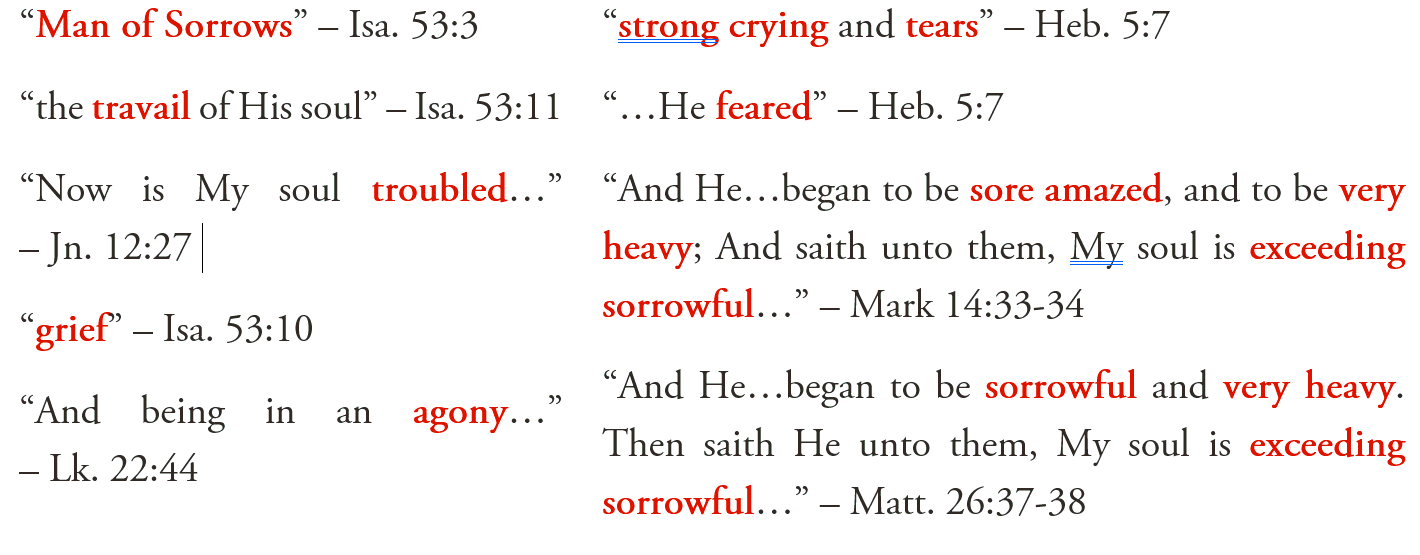
Clearly, Jesus Christ wasn’t feeling what everyone else was feeling in any given circumstance. Readers of Matthew, Mark, Luke, and John should be wondering what, if anything, could ever make Jesus Christ experience sorrow and fear while suffering. This question is absolutely vital to a personal discovery of the Passion of Jesus Christ. 

The Sore Amazement of the Man of Sorrows

Picture
Sorrow, travail, trouble, grief, agony, crying, tears, fear, amazement, and heaviness! All such feelings are something we might expect from your average sinner. Yet, this is talking about the sinless Son of God! How can it be? This is an invaluable question.
Picture
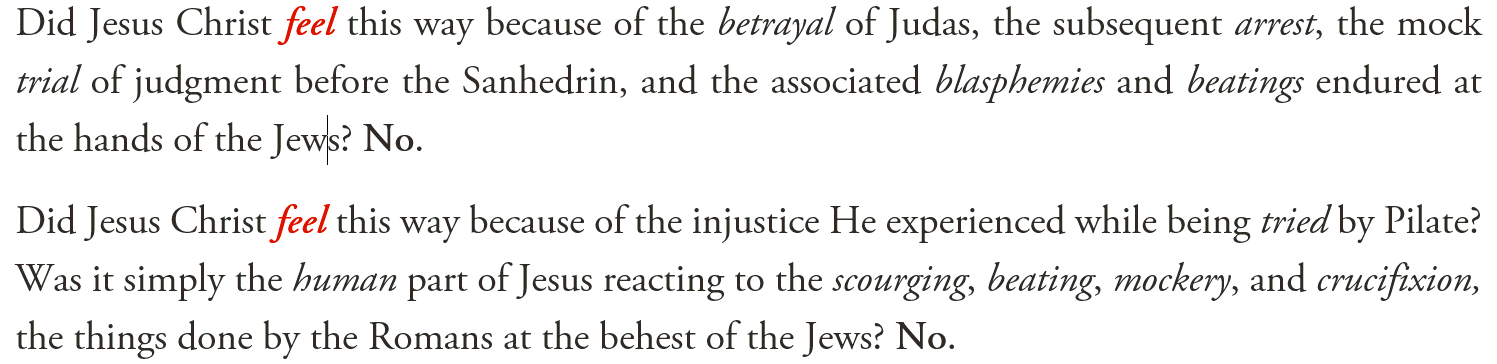
After just a brief survey of the ministry of Jesus Christ, do not the words of the apostles resonate within us when they said, “What manner of Man is this…?” (Matt. 8:27). Even so, this begs the question: What manner of suffering could make this Man feel this way? 
Picture
In respect to the Passion of Jesus Christ, we can be sure that none of these feelings of sorrow and fear were coming from a foresight of physical pain and fleshly suffering, or even death, combined with the emotional trauma of being forsaken by all men at the Cross. Why? The KING of Kings wasn’t cowardly! Nor were the Christians of the Early Church. 
“It is dishonoring to our Lord to imagine Him less brave than His own disciples, yet we have seen some of the most feeble of His saints triumphant in the prospect of departing. Read the stories of the martyrs and you will frequently find them exultant in the near approach of the most cruel sufferings. The joy of the Lord has given such strength to them that no cowardly thought has alarmed them for a single moment–they have gone to the stake, or to the block with songs of victory upon their lips! Our Master must not be thought of as inferior to His boldest servants! It cannot be that He should tremble where they were brave. Oh, no! The noblest spirit among yon band of martyrs is the Leader, Himself, who in suffering and heroism surpassed them all!” – C.H. Spurgeon, The Agony in Gethsemane
Innumerable martyrs suffered and died gruesome deaths with joy and peace, and even celebration, singing and worshipping the Lord before all as they were being publicly tortured and killed. This had no small effect upon the audience and executioners standing by. Such events would have had a felt impact upon society. The unforgettable details were then written down in history. Therefore, even though martyrs like Laurentius of Rome are dead, they are still speaking today. 
“…the governor ordered him to be immediately scourged. He was then beaten with iron rods, set upon a wooden horse, and had his limbs dislocated. These tortures he endured with fortitude and perseverance; when he was ordered to be fastened to a large gridiron, with a slow fire under it, that his death might be the more lingering. His astonishing constancy during these trials, and serenity of countenance while under such excruciating torments, gave the spectators so exalted an idea of the dignity and truth of the Christian religion, that many became converts upon the occasion, of whom was Romanus, a soldier.” (Laurentius; in the eight persecution, under Valerian in A.D. 257; Foxe’s Book of Martyrs) 
When untrained and weak men, women, and children brave the torments of execution, it captivates the attention of hardened soldiers as something obviously supernatural (Heb. 11:35-38). In seeing the invisible, unbelievers like Romanus the soldier then became believers (Heb. 11:1). They were compelled to look beyond the physical elements of the execution in wonder at the spiritual. Even so, in every period of persecution since the 1st Century, the bravery and excitement of the martyrs became the real spectacle of public executions. Lo and behold, the cruelty of tyranny was eclipsed by the character of Christianity! “But the more they afflicted them, the more they multiplied and grew. And they were grieved because of the children of Israel.” (Ex. 1:12). Much to the dismay of persecutors, instead of hurting Christianity, the execution platform promoted its witness.

The same testimonies of history appear everywhere, under the tyranny of anyone, regardless of the race or culture of the people. On the cross or at the stake, on the rack or at the block, in Jerusalem, Rome, Italy, Spain, Portugal, Bohemia, Scotland, and beyond – this one thing remained constant: 

“…the patience with which they met death: they seemed all resignation and piety, fervently praying to God, and cheerfully encountering their fate." (Persecution in Italy under Pope Pius the Fourth; Foxe’s Book of Martyrs) 
Normally, when various people groups of history were faced with genocide, the victims didn’t encounter their fate with joy. Understandably, these were times of misery and sadness! Maybe you’ve seen some photographs of slaves or prisoners in the labor camps of history. It’s an unforgettable sight! Why? Sorrow is visibly stricken across the faces of the people. However, apparently, things were different for Christians, starting with the Apostles. 
“…and when they had called the Apostles, and beaten them, they commanded that they should not speak in the name of Jesus, and let them go. And they departed from the presence of the council, rejoicing that they were counted worthy to suffer shame for His Name.” - Acts 5:40-41
The governmental decrees of persecution and annihilation were a cause of “rejoicing” among the Apostles (Acts 5:40-41). Some of them could even be seen leaping for joy amidst the punishment (Lk. 6:22-23)! The excitement was palpable. These weren’t days of doom and gloom as the Church was defeated under the lash of persecution and death. Rather, just the opposite happened! Believers even coveted after the martyr’s crown. Speaking of this, Sir Gaspar Kaplitz of Bohemia said: 
“‘…I would not be separated from this noble company of martyrs:’ so saying, he cheerfully resigned his neck to the block.” (Persecutions in Bohemia under the Papacy)
Such cheerful resignation is abnormal and unusual for the average victim of some tragic form of death in the pages of history. Nevertheless, for true Christians this was normal. When the hour of death finally arrived, a noble company of Christian martyrs could be seen leaving the prison with gladness. 
“On the morning of the day appointed for the execution, a cannon was fired as a signal to bring the prisoners from the castle to the principal market-place, in which scaffolds were erected, and a body of troops were drawn up to attend the tragic scene. The prisoners left the castle with as much cheerfulness as if they had been going to an agreeable entertainment, instead of a violent death.” (Persecutions in Bohemia under the Papacy) 
Happy thoughts were ringing in the breasts of these martyrs, and thus were their countenances markedly cheerful. The uncontainable joy could not be quenched by horror. Nor could the pain of martyrdom silence the praise. Even while burning alive at the stake, songs of gladness could be heard ringing out amidst the flames! 
“He embraced the stake with great cheerfulness, and when they went behind him to set fire to the fagots, he said, "Come here, and kindle it before my eyes; for if I had been afraid of it, I had not come to this place." The fire being kindled, he sung a hymn, but was soon interrupted by the flames; and the last words he was heard to say these:—'This soul in flames I offer.’” (Jerome of Prague; Persecutions in Bohemia under the Papacy) 
The searing sting of fire could not solicit uninterrupted cries from its subjects of torment. Nor could it overpower the outbursts of worship. The feeling of pain could not overrule the feeling of praise! The terribleness of the flame could not take over the tongue: literally, Jesus Christ is the sung hero of the amazing spectacle of martyrdom all throughout history. 
“And Jesus answered them, saying, The hour is come, that the Son of man should be glorified. Verily, verily, I say unto you, Except a corn of wheat fall into the ground and die, it abideth alone: but if it die, it bringeth forth much fruit. He that loveth his life shall lose it; and he that hateth his life in this world shall keep it unto life eternal. If any man serve Me, let him follow Me; and where I am, there shall also My servant be: if any man serve Me, him will My Father honour.” - John 12:23-26
The martyrs could do nothing without the Master. Jesus Christ was the trailblazer! Without Him there would be no path to martyrdom nor purpose in it. Doing the work of an Evangelist, Matthew, Mark, Luke, and John produced a detailed account of everything that happened to the crucified One. For the Messiah was the first one to “steadfastly set His face to go to Jerusalem” (Lk. 9:51); and everyone else who died a martyr’s death simply answered the call of Christ, when He said, “If any man serve Me, let him follow Me…” (John 12:26). Even so, the martyrs of history bore witness that their strength in dying came from the death of Christ. 
“The next day they were led to the place appointed for them to suffer; in their way to which, Russel, seeing his fellow-sufferer have the appearance of timidity in his countenance, thus addressed him: "Brother, fear not; greater is he that is in us, than he that is in the world. The pain that we are to suffer is short, and shall be light; but our joy and consolation shall never have an end. Let us, therefore, strive to enter into our Master and Saviour's joy, by the same straight way which he hath taken before us. Death cannot hurt us, for it is already destroyed by Him, for whose sake we are now going to suffer."
​

When they arrived at the fatal spot, they both kneeled down and prayed for some time; after which being fastened to the stake, and the fagots lighted, they cheerfully resigned their souls into the hands of Him who gave them, in full hopes of an everlasting reward in the heavenly mansions.” (Jerom Russel & Alexander Kennedy; an account of the persecution in Scotland during the reign of King Henry VIII) 
​
Confessedly, the mysterious strength of these martyrs came from Christ; not that their martyrdom was impressive, for it was lackluster in comparison to the impression made by the suffering and death of Jesus Christ. The martyrs are telling us that there is something more to be seen about the Passion of Jesus Christ – something more than what the Modern Church is telling everyone; otherwise, Modern Christianity wouldn’t be so weak in comparison to the Early Church.

As Evangelists, Matthew, Mark, Luke, and John are pointing out the way for us, this is why they focused upon where Jesus Christ was, and what He was doing, and what was being done to the Man, in the days and hours leading up to the Cross: 6 days, 2 days, and 1 day beforehand, and then hour by hour from Gethsemane to Calvary (John 12:1, 12, 13:1; Matt. 26:1-5, Mk. 14:1-2). The secrets of the Passion are unveiled in the fine details.

There should be no controversy about the Passion. The eyewitnesses bear record that Jesus Christ spoke for Himself on this matter. Who else could better explain how He felt at the time? Two days before the Cross, on the 13th of Abib, the Son of God publicly testified of His undaunted resolve to die in the manner foretold in Scripture (Ps. 22:12-18); however, simultaneously, He took the occasion to emphasize that an unusual feeling was coming upon Him. 

“And Jesus answered them, saying, The hour is come, that the Son of man should be glorified. Verily, verily, I say unto you, Except a corn of wheat fall into the ground and die, it abideth alone: but if it die, it bringeth forth much fruit. He that loveth his life shall lose it; and he that hateth his life in this world shall keep it unto life eternal. If any man serve me, let him follow me; and where I am, there shall also my servant be: if any man serve me, him will my Father honour. Now is My soul troubled; and what shall I say? Father, save me from this hour: but for this cause came I unto this hour. Father, glorify thy name. Then came there a voice from heaven, saying, I have both glorified it, and will glorify it again. The people therefore, that stood by, and heard it, said that it thundered: others said, An angel spake to him. Jesus answered and said, This voice came not because of me, but for your sakes. Now is the judgment of this world: now shall the prince of this world be cast out. And I, if I be lifted up from the earth, will draw all men unto me. This he said, signifying what death he should die.” – John 12:23-33
The Son of God said, “Now is My soul troubled…” (John 12:27). Nevertheless, Jesus of Nazareth was courageously prepared to die! Affectionately, He called it a glorification (Jn. 12:23, 28, 33). So far from being afraid of it, the Lord of Glory was publicly and unashamedly calling for all true disciples to follow Him to the death (John 12:25-26). Embracing the Cross with unflinching determination and deep personal satisfaction enabled the Lord to make this public invitation without pretense.

The call was often heralded in the Cities of Israel in the following words: “If any man will come after Me, let him deny himself, and take up his Cross, and follow Me” (Matt. 16:24, Mk. 8:34, 10:21, Lk. 9:23). Among other things, this was a genuine call to martyrdom (Heb. 13:11-14). To be a “witness” for Christ literally meant martyrdom in the Greek (μάρτυς, martus; Acts 1:8). Even so, every true Christian knows that the Cross is an indispensable part of following Christ. 

“Looking unto Jesus the Author and Finisher of our faith; who for the joy that was set before him endured the Cross, despising the shame, and is set down at the right hand of the throne of God.” – Heb. 12:2 
While being courageously prepared, unafraid, affectionately committed, and sincerely joyful, with the Cross directly in view (according to John 12:23-33), Jesus Christ was troubled at the same time. Why? Once again, this otherworldly Man would not have been troubled about the earthly and horizontal aspects of the Cross. This is the whole point of the personal declaration made in John 12:27. This trouble of soul only increased as time went on. Then on the evening of the next day, the 14th of Abib, the feeling was overwhelming. The affliction became so great that Jesus Christ resorted to prayer in the Garden of Gethsemane (James 5:13). 
“And they came to a place which was named Gethsemane: and he saith to His disciples, Sit ye here, while I shall pray. And he taketh with him Peter and James and John, and began to be sore amazed, and to be very heavy; And saith unto them, My soul is exceeding sorrowful unto death: tarry ye here, and watch.” – Mark 14:32-34​
Lo! at midnight, who is He,
Prays in dark Gethsemane?
Who is He on yonder Tree,
Dies in grief and agony?
 
’Tis the Lord! oh wondrous story!
’Tis the Lord! the King of glory!
At His feet we humbly fall,
Crown Him! Crown Him, Lord of all!

The disciples had no idea what was happening to the Messiah! Do you? Preachers nowadays just blame it on the humanity of Jesus. They say it was the one and only human moment of God incarnate as far as they can tell. People like to believe that Jesus, as a mere Man, was afraid and sorrowful at the thought of betrayal, torture, and death, as any other man would feel, and this is why such prayers were offered in the Garden of Gethsemane. However, this interpretation isn’t biblical or historical. Not even the martyrs of history were made to feel thus when faced with similar circumstances.

One thing is for sure! Redeemed sinners cannot outshine the Redeemer in a public execution. Nor could saved sinners appear saintlier than the Savior! So why was Stephen’s countenance so marvelously peaceful in the throes of martyrdom, when that of our Lord was stricken with grief and trouble? 

“And all that sat in the council, looking stedfastly on him, saw his face as it had been the face of an angel.” - Acts 6:15
Both the martyrs and the Messiah were baptized with a baptism of suffering and death; nevertheless, they exhibited radically different behaviors in the experience. Undoubtedly, they both drank of a bitter cup, but that of the martyrs seemed mild in comparison. 
“Then came to him the mother of Zebedee's children with her sons, worshipping him, and desiring a certain thing of him. And he said unto her, What wilt thou? She saith unto him, Grant that these my two sons may sit, the one on thy right hand, and the other on the left, in thy kingdom. But Jesus answered and said, Ye know not what ye ask. Are ye able to drink of the cup that I shall drink of, and to be baptized with the baptism that I am baptized with? They say unto him, We are able. And he saith unto them, Ye shall drink indeed of my cup, and be baptized with the baptism that I am baptized with: but to sit on my right hand, and on my left, is not mine to give, but it shall be given to them for whom it is prepared of my Father.” – Matt. 20:20-23
Modern Theologians need to rethink their interpretations of the humanity of Jesus Christ. A simple comparison of the humanity of the martyrs and that of Christ proves to be problematic. The difference between the two baptisms is purposefully provocative! Credit should be given to divine genius.

Providentially, when the LORD arranges the preservation of certain portions of history, it is because this record of history will contribute to His-Story. This proves true with the painstaking records of martyrdom in the Foxe’s Book of Martyrs, written in 1563 by the English historian John Foxe. Perhaps this is the only reason that these testimonies of martyrdom were preserved in the first place: so that the following generations can look back and behold the spectacle – something that would be otherwise incomprehensible – how nominal believers of history triumphed gloriously while enduring the most barbaric forms of torture and death. Let the testimony of Faninus of Italy drive home the point. 

“Being asked why he would obstinately persist in his opinions and leave his wife and children in distress, he replied, I shall not leave them in distress; I have recommended them to the care of an excellent trustee. What trustee? said the person who had asked the question, with some surprise: to which Faninus answered, Jesus Christ is the trustee I mean, and I think I could not commit them to the care of a better. On the day of execution he appeared remarkably cheerful, which one observing, said, it is strange you should appear so merry upon such an occasion, when Jesus Christ himself, just before his death, was in such agonies, that he sweated blood and water. To which Faninus replied; Christ sustained all manner of pangs and conflicts, with hell and death, on our accounts; and thus, by his sufferings, freed those who really believe in him from the fear of them. He was then strangled, and his body being burnt to ashes, they were scattered about by the wind.” (Faninus; an account of the persecution in Italy under the papacy) 
These words were prophetic. The situation was choregraphed by sovereignty. The plot is a testimony to the Passion. Amazingly, Faninus was merry while the Messiah mourned (Mk. 14:32-34)! A baser kind of human was cheerful when faced with execution when a far nobler One was crying in Gethsemane in the 1st Century (Heb. 5:7). Faninus was remarkably fearless only because the Second Adam was afraid (Heb. 5:7). Why? Spurgeon was also struck with amazement at this contrast in behavior. However, he was particularly interested in the doctrine of “the cup” that was being promoted from the lips of this triumphant martyr. Therefore, Spurgeon spoke directly about Faninus and commented on this doctrine in a sermon entitled, Christ in Gethsemane. 
“The bitterness of sin was there, but He has taken that away for all who believe in Him. His Father’s wrath was there, but He drank that all up and left not a single drop for any of His people. One of the martyrs, as he was on his way to the stake, was so supremely happy that a friend said to him, ‘Your Savior was full of sorrow when He agonized for you in Gethsemane.’ ‘Yes,’ replied the martyr, ‘and for that very reason I am so happy, for He bore all the sorrow for me.’ – C.H. Spurgeon, Christ in Gethsemane
Clearly, Faninus was seeing something about the Passion of Christ that people today aren’t seeing, and so he described the unique and unparalleled suffering of the Messiah to be, “all manner of pangs and conflicts, with hell and death, on our accounts”, while declaring himself the glad recipient of freedom. These pangs began in Gethsemane and climaxed at the Cross! Do you remember the prayers of Christ in Gethsemane? 
Picture
Modern Christians would be wise to take a closer look at this intimate moment of passion between Jesus and the Father. Those who wonder at the martyrs are blind to the secret of their composure. “Having eyes, see ye not? And having ears, hear ye not? And do ye not remember?” (Mark 8:18; Matt. 13:15). Theologians should compare their interpretation of Gethsemane to the vast record of prophetic utterances that came from the lips of martyrs throughout history. Why? Because the most famous Theologians of our time attribute the agony of Gethsemane to the humanity of God-incarnate, while marveling at the supernatural, inhuman, and otherworldly courage of the martyrs! They strain at a gnat and swallow a camel (Matt. 23:24). 
“Gardiner himself was then tormented in the most excruciating manner; but in the midst of all his torments he gloried in the deed. Being ordered for death, a large fire was kindled near a gibbet, Gardiner was drawn up to the gibbet by pulleys, and then let down near the fire, but not so close as to touch it; for they burnt or rather roasted him by slow degrees. Yet he bore his sufferings patiently and resigned his soul to the Lord cheerfully.” (William Gardiner who was martyred by the King of Portugal) 

“This Nicholas Burton by the way, and in the flames of fire, had so cheerful a countenance, embracing death with all patience and gladness…” (the martyrdom of an English Merchant in Spain)

“At Revel, Cateline Girard being at the stake… submitted cheerfully to the flames.” (Catelin Girard; an account of the persecutions the Waldenses in the Valleys of Piedmont) 

Could the resignation of William Gardiner to die at the hand of the King of Portugal exceed that of our Lord Jesus Christ before the Romans? If Nicholas Burton of Spain was able to embrace death with gladness, why didn’t the Son of God do the same in the Garden of Gethsemane? Or why didn’t the Lord appear cheerful at the scourging block in Jerusalem, or on the Cross of Calvary, like Catelin Girard cheerfully submitted to the flames in the Valleys of Piedmont? The uncircumcised ears of Modern Christians are deaf to the loud proclamations of history (Acts 7:51)! Namely, in that the Spirit of the Father has been speaking of these very things throughout history. 
“Behold, I send you forth as sheep in the midst of wolves: be ye therefore wise as serpents, and harmless as doves. But beware of men: for they will deliver you up to the councils, and they will scourge you in their synagogues; And ye shall be brought before governors and kings for my sake, for a testimony against them and the Gentiles. But when they deliver you up, take no thought how or what ye shall speak: for it shall be given you in that same hour what ye shall speak. For it is not ye that speak, but the Spirit of your Father which speaketh in you.” – Matt. 10:16-20
The things spoken by triumphant martyrs should be taken seriously by the neo-Christians of today. God is glorified in the granting of divine utterance at such times. “Precious in the sight of the LORD is the death of his saints.” (Psalm 116:15). If only men would take heed! Like when George Wishart of Scotland prophesied while burning at the stake. 
“The governor of the castle, who stood so near that he was singed with the flame, exhorted our martyr, in a few words, to be of good cheer, and to ask the pardon of God for his offences. To which he replied, "This flame occasions trouble to my body, indeed, but it hath in nowise broken my spirit. But he who now so proudly looks down upon me from yonder lofty place (pointing to the cardinal) shall, ere long, be as ignominiously thrown down, as now he proudly lolls at his ease." Which prediction was soon after fulfilled. The executioner then pulled the rope which was tied about his neck with great violence, so that he was soon strangled; and the fire getting strength, burnt with such rapidity that in less than an hour his body was totally consumed.” (George Wishart of Scotland, Foxe’s Book of Martyrs; an account of the persecution in Scotland during the reign of King Henry VIII) 
Prophetic utterances accompanied a personal revelation of the Passion. Though the martyrs of history endured great torment of body, that which burned, bruised, and broke their bodies could not do any harm to them spiritually. This is the bold profession of George Wishart, while burning alive, and in the next breath he prophesied concerning the death of the onlooking Cardinal who was directly involved in the persecution of true Christians; evidently, according to Matthew 10:16-20, the Spirit of the Father was speaking through the Wishart in this hour. The same could be said of John Huss, who glorified the Passion of Jesus Christ, while deglorifying himself. 
“After the ceremony of degradation was over, the bishops delivered Dr. Huss to the emperor, who put him into the hands of the duke of Bavaria. His books were burnt at the gates of the church; and on the 6th of July, he was led to the suburbs of Constance, to be burnt alive. On his arrival at the place of execution, he fell on his knees, sung several portions of the Psalms, looked steadfastly towards heaven, and repeated these words: "Into thy hands, O Lord! do I commit my spirit: thou hast redeemed me, O most good and merciful God!"

When the chain was put about him at the stake, he said, with a smiling countenance, "My Lord Jesus Christ was bound with a harder chain than this for my sake, and why then should I be ashamed of this rusty one?"

The flames were now applied to the fagots, when our martyr sung a hymn with so loud and cheerful a voice, that he was heard through all the cracklings of the combustibles, and the noise of the multitude. At length his voice was interrupted by the severity of the flames, which soon closed his existence.” (John Huss; Persecutions in Bohemia under the Papacy) 
​
The Spirit of Christ in the martyrs was loudly proclaiming the secret of their heavenly composure. While being chained at the stake in preparation for burning, John Huss spoke of a much heavier and harder chain that bound the Son of God as he perceived in himself the enormity of what Christ suffered in comparison to the light affliction he was about to endure, and thus he exploded into a celebration of worship before everyone. This otherwise miserable moment became merry at the remembrance of the Passion! In sheer gratitude Huss loudly and cheerfully sang a hymn as he began to burn, and he continued until he expired in the flames. Such testimonies should give modern readers some pause. Why wasn’t the Garden of Gethsemane filled with songs and cheerful celebration rather than intense sorrow and agony?

Let every man settle it in their own heart: the Christ who was there all throughout history sustaining these martyrs (Php. 1:20) could not have been reduced to tears and unspeakable agony at the thought of being tortured and crucified by Rome. At last, let the reader understand! Mere physical things could not bring such sorrow, anguish, and trouble upon the Son of God. Something was different about the baptism of death that Jesus Christ endured. Something else was in the cup that the Son of God was given to drink! The taste of the drink was far worse (Heb. 2:9). Otherwise, Jesus Christ would have behaved courageously and undaunted in the Garden of Gethsemane when the hour came for Him to take the cup, rather than melting in sorrow for the dread of it (Ps. 22:14). The testimonies of the Apostle James and Tobias Steffick bear witness. 

“…as James was led to the place of martyrdom, his accuser was brought to repent of his conduct by the apostle's extraordinary courage and undauntedness, and fell down at his feet to request his pardon, professing himself a christian, and resolving that James should not receive the crown of martyrdom alone. Hence they were both beheaded at the same time. Thus did the first apostolic martyr cheerfully and resolutely receive that cup, which he had told our Saviour he was ready to drink.” 

“Tobias Steffick was remarkable for his affability and serenity of temper. He was perfectly resigned to his fate, and a few minutes before his death spoke in this singular manner, "I have received, during the whole course of my life, many favours from God; ought I not therefore cheerfully to take one bitter cup, when he thinks proper to present it? Or rather, ought I not to rejoice, that it is his will I should give up a corrupted life for that of immortality!" (Foxe’s Book of Martyrs) 

If James was ready & able to drink the cup, why was Christ hardly able to do it? If the Apostle James drank the cup with cheerfulness, what is the reason for such sadness in Gethsemane? Obviously, something different was in the two cups. Both were bitter as death but the latter ones were infinitely mild in comparison to what Christ took at the hand of the Father; even so, as you will soon see, the Son of God was fatally smitten to death by spiritual blows, while all other men throughout history died being smitten by mere physical blows. This is exactly why Steffick was compelled with joy to say, “ought I not therefore cheerfully to take one bitter cup”, and Christ was moved with sadness to ask the Father, “take away this cup from Me” (Matt. 14:36).

Remember, James said that he would take and drink of the cup in Matthew 20:20-23; and he did what he said he would do! The historian of The Foxe’s Book of Martyrs remembered this very thing, in the remark, “Thus did the first apostolic martyr cheerfully and resolutely receive that cup, which he had told our Saviour he was ready to drink.” Even so, if James did what he said he would do, should we expect anything less of Jesus Christ? 

“Now is My soul troubled; and what shall I say? Father, save Me from this hour: but for this cause came I unto this hour.” – John 12:27

“And He went forward a little, and fell on the ground, and prayed that, if it were possible, the hour might pass from Him. And He said, Abba, Father, all things are possible unto thee; take away this cup from Me: nevertheless not what I will, but what Thou wilt.” - Mar 14:35-36

Did Jesus Christ say and do the very thing that He said that He wouldn’t? This matter wouldn’t be so controversial if only readers would give reverence to the divine words of the Son of God, who alone had the ability to interpret the mysterious situation that was unfolding. Of course, Jesus Christ would not have said and done in Gethsemane the very things that He declared that He wouldn’t say or do! All true believers should agree on that. Otherwise, this would be lying or bearing false witness (Matt. 5:37, 2 Cor. 1:17-18, James 5:12; Prov. 14:5).

When the Son of God declared, “…what shall I say? Father, save Me from this hour: but for this cause came I unto this hour”, while verbally acknowledging that He was indeed “troubled”, the Messiah was hereby intentionally provoking the people to wonder exactly why the Man was troubled at this very moment (John 12:27); because apparently the Lord of Glory would never ask to be saved from earthly threat of the Cross from a human perspective. Actually, according to John 10:17-18, the Son of God had a constant sense of loving communion with the Father, explicitly because Jesus was fully ready at any moment to “lay down” His life on the Cross. 

“Therefore doth my Father love me, because I lay down my life, that I might take it again. No man taketh it from me, but I lay it down of myself. I have power to lay it down, and I have power to take it again. This commandment have I received of my Father.” - John 10:17-18
Jesus had a choice to make of His own volition. This choice, on whether or not to lay down His life to meet with death at the Cross, had already been made long before the incarnation. Jesus of Nazareth, who alone came from the Bosom of the Father in Heaven before the incarnation (John 1:14-18, 3:13, 31-36, 16:27-28), and as a possessor of eternal glory since before the world began (John 17:5, 24), existed for an eternity before becoming a Man. Therefore, the Son of God was poised to meet with death at the Cross from eternity past as the uncreated 2nd Person of the Trinity. Meanwhile, apparently, this choice was an agreement between the Father and the Son; and herein the loving communion of the Godhead flourished all throughout time (John 10:17-18). 
“And we have seen and do testify that the Father sent the Son to be the Saviour of the world.” – 1 John 4:14

“What shall we then say to these things? If God be for us, who can be against us? He that spared not his own Son, but delivered him up for us all, how shall he not with him also freely give us all things?” – Rom. 8:31-32

God the Father had a significant role in the agreement. The Son of God wasn’t the only One making the sacrifices. “For God so loved the world, that He gave His only begotten Son, that whosoever believeth in him should not perish, but have everlasting life.” (John 3:16). Not only did Jesus of Nazareth give Himself, of His own volition as the Son of God, but God the Father was moved with love independently, and sacrificially, and gave His Only Begotten Son to the world. 
“And Abraham took the wood of the burnt offering, and laid it upon Isaac his son; and he took the fire in his hand, and a knife; and they went both of them together. And Isaac spake unto Abraham his father, and said, My father: and he said, Here am I, my son. And he said, Behold the fire and the wood: but where is the lamb for a burnt offering? And Abraham said, My son, God will provide himself a Lamb for a burnt offering: so they went both of them together. And they came to the place which God had told him of; and Abraham built an altar there, and laid the wood in order, and bound Isaac his son, and laid him on the altar upon the wood. And Abraham stretched forth his hand, and took the knife to slay his son.” – Gen. 22:6-10 [The Gospel = The Quintessential Expression of Sovereignty]
The divine title, the Only Begotten Son, has a very specific meaning that should not be diluted or confounded. From our vantage point, this is a title that declares to mortal men the majesty and divinity of Jesus Christ. However, from the Father’s vantage point, this is a title of personal endearment and paternal affection. The Son of God is precious to the Father! Similar to how Isaac was precious to Abraham, howbeit infinitely more treasured. Therefore, the giving of the Son came at great personal cost to the Father (Jn. 3:16, 10:29). 
“I want your imaginations for one minute to picture a scene of olden times. There is a bearded Patriarch who rises early in the morning and awakes his son, a young man full of strength, and bids him arise and follow him. They hurry from the house silently and noiselessly, before the mother is awake. They go three days' journey with their men until they come to the mountain, of which the Lord has spoken. You know the Patriarch. The name of Abraham is always fresh in our memories. On the way that Patriarch speaks not one solitary word to his son. His heart is too full for utterance. He is overwhelmed with grief. God has commanded him to take his son, his only son, and slay him upon the mountain as a sacrifice. They go together. And who shall paint the unutterable anguish of the father’s soul, while he walks side by side with that beloved son of whom he is to be the executioner?

The third day has arrived. The servants are bid to stay at the foot of the hill, while they go to worship God yonder. Now, can any mind imagine how the father’s grief must overflow all the banks of his soul, when, as he walked up that hillside his son said to him, “Father, behold the fire and the wood. But where is the lamb for a burnt-offering?” Can you conceive how he stifled his emotions and, with sobs, exclaimed, “My son, God will provide himself a lamb”? Look! The father has communicated to his son the fact that God has demanded his life. Isaac, who might have struggled and escaped from his father declares that he is willing to die if God has decreed it. The father takes his son, binds his hands behind his back, piles up the stones, makes an altar, lays the wood and has his fire ready. And now where is the artist that can depict the anguish of the father’s countenance when the knife is unsheathed and he holds it up–ready to slay his son?

But here the curtain falls. Now the black scene vanishes at the sound of a Voice from Heaven. The ram caught in the thicket supplies the substitute and faith’s obedience needs go no further. Ah, my Brethren. I want to take you from this scene to a far greater one. What faith and obedience made man do, that love constrained God Himself to do. He had but one Son, that Son His own heart’s delight. He covenanted to yield Him up for our redemption, nor did He violate His promise. For, when the fullness of time was come, He sent His Son to be born of the Virgin Mary that He might suffer for the sins of man.
Oh, can you tell the greatness of that love which made the everlasting God not only put His Son upon the altar but actually do the deed and thrust the sacrificial knife into His Son’s heart? Can you think how overwhelming must have been the love of God towards the human race when He completed in act what Abraham only did in intention? Look there and see the place where His only Son hung dead upon the Cross–the bleeding Victim of awakened Justice! Here is love indeed. And here we see how it was that it pleased the Father to bruise Him.

This allows me to push my text just one point further. Beloved, it is not only true that God did design and did permit with willingness the death of Christ. It is, moreover true, that the unutterable agonies that clothed the death of the Savior with superhuman terror, were the effect of the Father’s bruising of Christ in very act and deed.

There is a martyr in prison: the chains are on his wrists and yet he sings. It has been announced to him that tomorrow is his burning day. He claps his hands right merrily and smiles while he says, “It will be sharp work tomorrow. I shall breakfast below on fiery tribulations, but afterwards I will sup with Christ! Tomorrow is my wedding day, the day for which I have long panted, when I shall sign the testimony of my life by a glorious death.”

The time is come. The men with the halberds precede him through the streets. Mark the serenity of the martyr’s countenance. He turns to some who look upon him and exclaims, “I value these iron chains far more than if they had been of gold. It is a sweet thing to die for Christ.” There are a few of the boldest of the saints gathered round the stake and as he unrobes himself, before he stands upon the fire wood to receive his doom, he tells them that it is a joyous thing to be a soldier of Christ–to be allowed to give his body to be burned. And he shakes hands with them and bids them “Good bye,” with merry cheer.

One would think he were going to his wedding, rather than to be burned. He steps upon the fire wood. The chain is put about his middle. And after a brief word of prayer, as soon as the fire begins to ascend, he speaks to the people with manful boldness. But hark, he sings while the fire wood is cracking and the smoke is blowing upward. He sings and when his nether parts are burned he still goes on chanting sweetly some Psalm of old. “God is our refuge and strength, a very present help in trouble; therefore will we not fear, though the earth be removed and the mountain be carried into the midst of the sea.”

Picture another scene. There is the Savior going to His Cross, all weak and wan with suffering. His soul is sick and sad within Him. There is no Divine composure there. So sad is His heart that He faints in the streets. The Son of God faints beneath a Cross that many a criminal might have carried. They nail him to the Tree. There is no song of praise. He is lifted up in the air and there He hangs preparatory to His death. You hear no shout of exultation. There is a stern compression of His face, as if unutterable agony were tearing His heart – as if over again Gethsemane were being acted on the Cross – as if His soul were still saying, “If it is possible let this Cross pass from Me. Nevertheless, not as I will, but as You will.”

Hark! He speaks. Will He not sing sweeter songs than ever came from martyr’s lips? Ah, no–it is an awful wail of woe that can never be imitated. “My God, My God, why have You forsaken Me?” The martyrs said not that – God was with them. Confessors of old cried not so when they came to die. They shouted in their fires and praised God on their racks. Why this? Why does the Savior suffer so? Why, Beloved, it was because the Father bruised Him. – C.H. Spurgeon, The Death of Christ 

Consider again the solemn declaration of Jesus Christ, when He publicly said, “for this cause came I unto this hour.” (John 12:27). The coming of the Son of God was from eternity into time, in coming from Heaven to earth – through the incarnation – and the hour that was at hand would ultimately climax in the crucifixion. Hence, the Lord of Glory could not be made to waver when staring at the finish line of the race from an earthly perspective. The real cause of sorrow and fear in the Son of God was neither horizontal, physical, nor earthly. Rather, it was vertical, spiritual, and heavenly. It was not a horizontal situation, man to Man, but it was a vertical situation, Man to God. 
0 Comments

The Unshakable Rock of Our Salvation: Even the Most Uncommon & Deadly Circumstances Couldn’t Trouble the Son of God

4/19/2023

0 Comments

 
Picture

Article #2 on the Passion of Jesus Christ 

“And the Word was made flesh, and dwelt among us, (and we beheld his glory, the glory as of the only begotten of the Father,) full of grace and truth.” - John 1:14
Commonly, when most people think about suffering, what immediately comes to mind is something physically painful to the human body. Others imagine something emotional or psychological coming from bad relationships with family, friends, acquaintances, or peers. Neither of these things are what brought the Son of God into the throes of unimaginable suffering. Jesus Christ was no common Man! Even the most uncommon circumstances couldn’t trouble this extraordinary Man: starving to death, getting murdered by an angry mob, encountering a legion of devils, or being overtaken by a deadly storm in the middle of the sea. 

Luke 4:1-4

God Incarnate showed no signs of distress while going 40 days without food. Suffering hunger in the brutal heat of an uninhabited wilderness for this long would have driven the human body of Jesus to the brink of death. In fact, the vast majority of people would have already died after so many days. Nevertheless, after 40 days had passed, the Son of God was not at all swayed by the feeling of hunger in the belly. While being completely assured that He could command the rocks to become bread, by choice, Jesus Christ demonstrated a perfect composure of restraint as one who was wholly satisfied with the Father. Such an unusual temptation speaks volumes about the greatness of this Man. It is simply impossible for us to understand all the temptations that would be suggested by the Devil in a day in the life of Jesus Christ (Heb. 4:15). For, a fallen Cherubim would have had unique insight into the scope of divine ability that the Son of God consciously possessed on earth –the same which He meekly relinquished for the whole duration of His Manhood (Ezek. 28:14; Matt. 11:29, Php. 2:5-11). 

Luke 4:14-30

An angry mob from Nazareth trying to kill Jesus couldn’t dismay the Lord of Glory. Not even a crowd from His own earthly hometown (with family, friends, acquaintances, and peers in company), could get the adrenaline of Jesus Christ pumping as they tried to throw Him off a cliff. The end of this ordeal didn’t go as planned for the Nazarenes. “But He passing through the midst of them went His way.” (Lk. 4:30). What happened? The tumult of raging sinners was likely disarmed by the heavenly peace shining from the earthly face of Jesus Christ, while He stood there fearlessly on the edge of the cliff. No one had the audacity to push the Man over the ledge! No wonder. The quietness and confidence of the Man was confounding to everyone (Isa. 30:15). So, with the tumult hushed into amazement for a little while, the Anointed One simply passed on through their midst and went His way. 

Luke 8:26-39

Suddenly, when Jesus Christ was faced with a Legion of Devils, He just stood there regal and completely unphased. Fear and trembling came upon all as they watched this infamous madman come running up to the Son of God, only for him to FALL DOWN before Jesus of Nazareth and beg for mercy! In being possessed by so many demons, it was widely known that the man had otherworldly strength. Literally, the demoniac could not be bound, arrested, or forbidden from mischief! Nevertheless, with one word from the mouth of Jesus, the naked man who haunted the graveyards at night – crying and cutting himself – was made completely sane. Raging and untamable sinners find rest when encountering the Righteous One. Hereafter, just one look at the man, being clothed and in his right mind, seated before the Messiah, struck fear in everyone who saw it. 

Matthew 8:23-27

It seemed totally outrageous to Jesus Christ that He would be afraid of anything at all! Even upon waking up out of a dead sleep in a boat, in the middle of a mighty storm, as the disciples were crying out, exclaiming: “Lord, save us: we perish” (Matt. 8:25)! This extraordinary Man responded as usual in these uncommon circumstances. “And He saith unto them, Why are ye fearful, O ye of little faith? Then He arose, and rebuked the winds and the sea; and there was a great calm.” (Matt. 8:26). The disciples marveled at the sight of it, saying, “What manner of Man is this, that even the winds and the sea obey Him!” (Matt. 8:27). Not even a hint of fear resided in the breast of the sinless Son of God during this whole ordeal. So much the rather, as Jesus Christ arose into a standing position in the boat, while in the middle of the storm, even the torrential winds and raging sea were made afraid of Him (Ps. 77:16, 114:3-6)! Creation was seen bowing before the Creator (Col. 1:16-17). 

Matthew 14:22-33

A Man who casually walks on water in the middle of a storm is capable of walking into any earthly situation with a staggering degree of serenity. Even so, Jesus Christ strongly disapproved of fear in the most chaotic circumstances. When Peter attempted to join Jesus on the water, and became afraid at the boisterous wind round about him, the Messiah said, “O thou of little faith, wherefore didst thou doubt?” (Matt. 14:31). Then, when things calmed down, everyone there who witnessed these shocking events worshipped the Lord of Glory, saying, “Of a truth Thou art the Son of God.” (Matt. 14:33). 

John 18:3-11 

Not even a band of soldiers with torches and weapons coming suddenly upon the Messiah in the middle of the night could make Jesus Christ feel fear or sorrow. The Creator manifested in human flesh could do without creature comforts (Lk. 9:57-62). The Son of God knew exactly what was about to happen. This is explicitly stated. “Jesus therefore, knowing all things that should come upon Him, went forth, and said unto them, Whom seek ye?” (John 18:4). Jesus didn’t even wait for them to come directly to Him in the Garden of Gethsemane. Seeing that they were coming from afar, the Lord of Glory immediately went straight at them. The posture and body language of the Messiah made it abundantly clear that Jesus wasn’t defeated in body or discouraged in spirit. The officers marveled at the boldness of the Man.
​
In response to the question, “Whom seek ye?” (John 18:14), it was written, “They answered Him, Jesus of Nazareth.” (John 18:5). What happened next is revealing. “Jesus saith unto them, I am He.” (John 18:5). However, the word “He” on this occasion is italicized in the English because the translators were hereby indicating that the word does not appear in the original Greek version of John 18:5. Therefore, the inspired record of the original language reads, “Jesus saith unto them, I AM” (John 18:5; Ex. 3:14). An explosion of power could be felt from this confession.
“As soon then as He had said unto them, I AM, they went backward, and fell to the ground.” – John 18:6

“There was a majestic flash of His Deity even in the hour of the abasement of His Humanity – and they fell prostrate before the God who had thus confessed that the name of Jehovah rightly belonged to Him! – C.H. Spurgeon, Christ in Gethsemane
With the enfeebled crowd so easily knocked off their feet, you can imagine how they felt threatened at this moment of weakness. There, in the dark night of Gethsemane, the dominant presence of Jehovah, the I AM, was towering over them all! Meanwhile, as the men were trying to regather themselves, getting up from the ground, the same question was posed again by the Messiah: “Whom seek ye?” (John 18:7). They gave the same answer back again. Everyone just stood there! Apparently, they were so intimidated at the presence of the Messiah that they needed some encouragement, if indeed they were going to go through with the arrest. They needed to know that Jesus, the Anointed One, would allow them to make the arrest. “Jesus answered, I have told you that I AM: if therefore ye seek Me, let these go their way” (John 18:8). This implied that Jesus would let them do what they had come for as long as they didn’t seize and capture any of the disciples.
“Then Simon Peter having a sword drew it, and smote the high priest's servant, and cut off his right ear. The servant's name was Malchus. Then said Jesus unto Peter, Put up thy sword into the sheath: the cup which my Father hath given me, shall I not drink it?” - John 18:10-11
The situation escalated at one point, when one of the disciples took a sword and struck off the ear of one of the servants of the High Priest. However, the unrest was immediately deescalated and stilled when Jesus rebuked this disciple, telling him to sheath the sword, while suddenly touching and healing the ear of the man who was wounded (Lk. 22:47-53). Then, at once, with everyone gazing upon the Messiah yet again, the following words were uttered: “Thinkest thou that I cannot now pray to My Father, and He shall presently give Me more than twelve legions of angels? But how then shall the Scriptures be fulfilled, that thus it must be?” (Matt. 26:53-54). Thus, with a countenance of otherworldly confidence, Jesus willingly relinquished Himself into the hands of sinners in the middle of the night, as the disciples then scattered from their beloved King in great distress. 
0 Comments

The Passion of Jesus Christ According to Charles Spurgeon

4/19/2023

0 Comments

 
Picture

Article #1 on the Passion of Jesus Christ 

​Preachers today pride themselves in eloquence, simplicity, and brevity. The industrial complex of Seminary instills these “virtues” in its annual graduates. Most Churches are run by these men because formal education is all a part of the planned career path of the up-and-coming Preachers. Everyone knows that the intolerant masses of Christendom cannot endure a long sermon.
​
Now that pragmatism occupies the pulpit, whatever works is deemed to be the best. Whatever is popular is deemed to be divinely powerful! Therefore, the most critical doctrines of Christianity are presented in a way that would fascinate the curious and satisfy the impatient. Even “the Gospel” becomes piecemeal in a fast-food culture! Of course, many essential doctrines of the Gospel are butchered in the process. Oh! But things were different in former times. 
“Readers of old theology will have remarked how constantly the fathers were accustomed to dwell upon the wounds of Jesus slain.” – C.H. Spurgeon, The Water and the Blood
​
“I would it were more the practice of believers nowadays…to learn the divine lessons which are discoverable in the wounds of Jesus as well as the sacred admonitions bequeathed to us by the words of His mouth.” – C.H. Spurgeon, The Water and the Blood 
Charles Spurgeon is widely regarded as a stalwart of fundamentalist doctrine. Arguably, his most profound contribution to theology pertains to the Passion of Jesus Christ. Spurgeon preached, “Jesus Christ, and Him Crucified!”, with riveting insight as if he had been an eyewitness of the whole ordeal! Did you hear him say that there are divine lessons discoverable in the wounds of Jesus Christ? There is much to be seen here: literally, in every bruise and wound that the Son of God physically endured, and in every drop of blood extracted from His sacred body, through the violence of every aggressor in each scene presented to us in the Theater of the Atonement. 
“‘Behold, what manner of love the Father has bestowed upon us!’ Behold it in the sweat of blood which stained Gethsemane! Behold it in the scourging which has made the name of Gabbatha a terror! Behold it in ‘the pains, and groans, and dying strife’ of Calvary! Bow, did I say? Prostrate your spirits!” – C.H. Spurgeon, Christ Made Sin  
​
“Show and parade cease to attract the soul when once the superlative excellencies of the dying Savior have been discerned by the enlightened eyes! Who seeks for ease when he has seen the Lord Christ?” – C.H. Spurgeon, The Crown of Thorns 
Sadly, many people belittle the physical suffering of Jesus Christ, more specifically, the things that the Son of God endured in the process of time from Gethsemane to Calvary. Still more think that these other episodes of suffering are not worthy to be mentioned while preaching the Atonement because it may undermine or distract people from the Cross. Nevertheless, Spurgeon very boldly declared that “the Passion began in Gethsemane” and finished at Calvary in the death of Jesus Christ on the Cross. 
“Yet He is no sooner in Gethsemane than He says to the three especially favored disciples, ‘My soul is exceedingly sorrowful, even unto death: tarry you here and watch with Me.’ I do not think that this great conflict arose through our dear Master’s fear of death, nor through His fear of the physical pain and all the ignominy and shame that He was so soon to endure. But, surely, the agony in Gethsemane was part of the great burden that was already resting upon Him as His people’s Substitute–it was this that pressed His spirit down even into the dust of death. He was to bear the full weight of it upon the Cross, but I am persuaded that the Passion began in Gethsemane.

You know that Peter writes, “Who His own Self bore our sins in His own body on the Tree.” But we are not to gather from that passage that His substitutionary sufferings were limited to the Tree, for the original might bear this rendering–that He bore our sins in His own body up to the Tree–that He came up to the tree bearing that awful load and still continued to bear it on the Tree! You remember that Peter also writes, in the same verse, “by whose stripes you were healed.” These stripes did not fall upon Jesus when He was upon the Cross–it was in Pilate’s Judgment Hall that He was so cruelly scourged! I believe that He was bearing our sins all His life, but that the terrible weight of with infinite intensity when He was nailed to the Cross–and so forced from Him the agonizing cry, “My God, My God, why have You forsaken Me?” – C.H. Spurgeon, Christ in Gethsemane
The Passion of Jesus Christ is the immense amount of personal suffering that the Messiah experienced in becoming an Atoning Sacrifice, and ultimately, in dying on the Cross for the sins of the whole world (1 Jn. 2:2, 1 Tim. 4:10). Definitively, the word “passion” in the Greek (πάσχω / πάθω / πένθω) indicates what a person feels. It is translated “passion” or “felt” a total of one time each in the New Testament. 
“To whom also He shewed Himself alive after His Passion by many infallible proofs, being seen of them forty days, and speaking of the things pertaining to the Kingdom of God:” - Acts 1:3
What did Jesus Christ feel in becoming an Atoning Sacrifice? What did Jesus Christ feel while hanging on the Cross? This is a topic worthy of exploration. Any answers to this question provided in Scripture would prove to be lifechanging. Of course, from a biblical perspective, what Jesus Christ felt was suffering. Therefore, all the other times this word appears in the New Testament, except one, the Greek word is translated into “suffering”, or a derivative thereof (suffer, suffered, suffering, vexed). However, more specifically, the use of the word passion is divinely intended to identify the feeling of the suffering as it was manifest inwardly and outwardly. 
“Yet would I exhort you to consider these griefs, that you may love the Sufferer.” – C.H. Spurgeon, The Agony in Gethsemane
Spurgeon would bid us to look at Gethsemane! He believed that this was a unique moment in the Theater of the Atonement. Why? In speaking of it as “the commencement of His Passion sufferings”, Spurgeon was discerning that this was when the awful load of sin was put upon Jesus Christ. Consequentially, an unfathomable horror seized the holy heart of the sinless Son of God. 
“the commencement of His Passion sufferings” – C.H. Spurgeon, Jesus in Gethsemane

“the difficulty of this imputation” – C.H. Spurgeon, Christ Made Sin

“Learn next…the matchless love of Jesus, that for your sakes and mine He would not merely suffer in body, but consented even to bear the horror of being accounted a sinner!” – C.H. Spurgeon, The Agony in Gethsemane

“Oh Soul, sin must be an awful thing if it so crushed our Lord! If the very imputation of it fetched bloody sweat from the pure and holy Savior, what must sin, itself, be? Avoid it, pass not by it, turn away from the very appearance of it, walk humbly and carefully with your God that sin may not harm you, for it is an exceeding plague, an infinite pest!” – C.H. Spurgeon, The Agony in Gethsemane

“Yet there was our Master, all stained with His own blood, for His heart’s floods had burst their banks and run all over Him in a gory torrent!” – C.H. Spurgeon, Christ in Gethsemane 

Gethsemane was purposefully included in the Gospels to help us discern what was happening to the Son of God inwardly, spiritually, and emotionally during the forthcoming episodes of His physical suffering as a Substitutionary Sacrifice. This is a categorically different kind of suffering than what has been or ever will be experienced outwardly, physically, and biologically in the human body. 
“Trouble of spirit is worse than pain of body…” – C.H. Spurgeon, The Agony in Gethsemane

“But still the sufferings of His soul must have been the very soul of His sufferings, and can you tell what they were?” – C.H. Spurgeon, The Sin Offering
However, some people object to this emphasis of suffering in the Atonement. They claim that this kind of suffering depreciates the outward, physical, and bodily suffering of Jesus Christ. Therefore, Spurgeon made a public defense of his position as follows. 
“Observe the text says, ‘The travail of His soul.’ We are not to depreciate the bodily sufferings of Christ, but still it has been well said that ‘the soul-sufferings of Christ were the soul of His sufferings.’ Brothers and Sisters, there was so much in the outward agony of Christ, that my ears have tingled and my heart burned with wrath when I have heard certain theologians speak lightly of it! Speak lightly of the sweat of blood in the Garden of Gethsemane? Speak lightly of shame, spitting and the crown of thorns? Oh, Sirs, dare you think and speak lightly of the piercing of His hands and of His feet, and of the fever which those wounds engendered, and that thirst which the fever and the broiling sun together brought on, and the rending of those hands when the feet could no longer support the body and the iron tore through the nerves? Is nothing or little to be said of all this? God forbid, Brothers and Sisters!
​
We believe that the body of Christ took its full share of the chastisement. By His stripes we are healed! By His scourging and bodily chastisements we get at least a portion of the healing balm which cures the disease of sin! Our sin was with the body and Christ’s Atonement was with the body. Our flesh was sinful and, therefore, His flesh must suffer. Had we been simply spirits and as spirits, alone, had sinned, a spirit might have made Atonement for us–and a soul bereft of a body might have been a perfect substitute–but we are Sons of Adam and still wear this red earth about us! And as we sin in the body, so must the Savior, with hands, feet, brow and every member of His blessed frame, be made to suffer to make Atonement for our guilt! Still, still, the travail of His soul was the chief matter and it is that the text speaks about! Where shall I find a golden reed with which to measure this city, or where shall I find a plumb line with which to fathom the depths of agony which I now see before me? Jesus Christ suffered so that I despair of conceiving His sufferings, or of conveying them to you by any form of words.” – C.H. Spurgeon, The Suffering Christ Satisfied 
The reason for the inward suffering (the same which was unveiled in Gethsemane) enriches the outward and bodily suffering of Jesus Christ by clarifying the purpose for them both. There is no rivalry. Nevertheless, admittedly, some objections are warranted. It’s sad to say that some Preachers have gone to an extreme on the subject. Even the renowned theologian, Adam Clarke, is one among the number. 
“I do not know whether what Adam Clarke supposes is correct, that in the Garden Christ did pay more of the price than he did even on the Cross; but I am quite convinced that they are very foolish who get to such refinement that they think the Atonement was made on the Cross, and nowhere else at all. We believe that it was made in the Garden as well as on the Cross - and it strikes me that in the garden one part of Christ's work was finished, wholly finished, and that was his conflict with Satan.”– C.H. Spurgeon, Gethsemane
​Gethsemane is not the climax of the Atonement. No! The Cross of Calvary is the climax of the Atonement. In other words, the greatest price that was paid in the suffering of Jesus Christ was on the Cross of Calvary. Nevertheless, Spurgeon was quite forgiving of Clarke. Why do you think he was so forgiving? I think Spurgeon could empathize with Clarke in his attempt to drive home a major point of doctrine that is largely ignored. Apparently, Adam Clarke was so moved by the unique way that the Passion of Jesus Christ was unveiled in Gethsemane that he was confusing the beginning with the end. While it is apparent that Spurgeon didn’t agree with Clarke, he wasn’t angry with him either. However, Spurgeon was not so forgiving of those who “think the Atonement was made on the Cross, and nowhere else at all”, which is to say that these people deny the merit of Christ’s suffering in every scene presented by the Evangelists from Gethsemane to Calvary. 
0 Comments
Forward>>

    The Passion of Jesus Christ

    Article #1: ​The Passion of Jesus Christ According to Charles Spurgeon 

    Article #2: ​The Unshakable Rock of Our Salvation: Even the Most Uncommon & Deadly Circumstances Couldn't Trouble the Son of God

    Article #3: Historical Accounts of Martyrdom Compared to the Passion of Jesus Christ

    Article #4: The Passion Began in the Garden of Gethsemane 

    Article #5: Hematidrosis: "Exceeding Sorrowful Even Unto Death" - Matt. 26:38 

    ​
    Article #6: Gethsemane to Calvary: The Passion of Jesus Christ from Beginning to End

    ​
    Article #7: The Arrest: Conspiracy, Secrecy, & Betrayal 

    ​
    Article #8: The Condemnation of the Jewish Court of Judgment 
    ​
    ​
    Article #9: The 1st Appearance Before Pilate & Herod 

    Article #10: The 2nd Appearance Before Pilate 

    Article #11: The Scouring 

    ​
    Article #12: The Crown of Thorns 

    Article #13: The 3rd Appearance Before Pilate: The Condemnation of Rome 

    Article #14: Carrying the Cross to the Hill of Calvary 

    ​
    Article #15: The Crucifixion: The Spectacle of Ages 

    ​
    Article #16: The Cup of Wine & Myrrh

    Article #17: Being Stripped Naked 

    ​
    Article #18: The Darkness: Its Origin, Power, Presence, & Meaning 

    ​
    Article #19: The Cross of Rome 

    Article #20: Beholding the Cross of Rome & Seeing Jehovah's Tree

    Article #21: The Doctrine of the Tree 

    ​
    Article #22: Abraham & Isaac on Mount Calvary in the Land of Moriah 

    ​
    Article #23: The Lamb of God as a Burnt Offering

    ​
    Article #24: God will Provide Himself a Mediator as a Sacrifice for El-esh-oklah 

    ​
    Article #25: The Most Famous Manifestation of Divine Wrath in the Law Being Satisfied at the Tree

    Seeing Christ in a Theater of Typology 

    Article #1: The Mediator of the Old Testament 

    ​
    Article #2: The High Priest of the Old Testament 

    ​
    Article #3: The Gospel of Habakkuk 

    The 7 Utterances of Jesus Christ on the Cross 

    Article #1: Contextual 
    Details for Harmonizing the 7 Utterances of Jesus Christ on the Cross 

    ​
    Article #2: Introducing the 7 Utterances of Jesus Christ on the Cross 

    ​
    Article #3: The 1st Utterance of Jesus Christ on the Cross 

    ​
    Article #4: The 2nd Utterance of Jesus Christ on the Cross 

    Article #5: The 3rd Utterance of Jesus Christ on the Cross 

    Archives 

    December 2025
    October 2024
    June 2023
    May 2023
    April 2023

    Categories

    All

    RSS Feed

    Author 

    Sean Michael Morris 

HOME   |   THE PASSION OF JESUS CHRIST | CALVINISM VS. ARMINIANISM   
 WHAT IS REVIVAL? | ARE YOU SAVED? | FOLLY IN ISRAEL | SEMINARY  
CHURCH HISTORY  | PERSECUTION  | THE LAST DAYS   |   ​CONTACT

Copyright © YouMustBeBornAgain.org | All rights reserved.

Related Sites:
You Must Be Born Again
The Revelation of Jesus Christ 
Years of Ancient Times